After 60: the one paperwork folder retirement advisers say everyone should prepare before a hospital stay
The warning didn’t come dressed as a crisis. It arrived as a routine check-up that turned into, “We’ll just keep you in overnight.” One night became four. Between the blood pressure cuff and the tea trolley, a different pressure built at home: who has the power of attorney, where is Mum’s will, which account pays the council tax?
The medical team knew exactly what to do. The family did not. Not because they were careless, but because the paperwork that runs a life was scattered between kitchen drawers, email inboxes and “somewhere safe”. A single, quiet object would have changed those days: one plain folder.
Financial planners have a blunt nickname for it: the “grab folder”. One reach, one handle, and you’ve got the essentials you need if you’re suddenly admitted to hospital or simply too unwell to manage your own admin. It isn’t glamorous. It is, however, the one piece of “retirement kit” advisers wish every client over 60 would put together.
The day a simple folder stopped a crisis from spreading
The power of that folder only really shows under stress. A retired teacher in Kent told me her story. Her husband tripped in the garden, broke his hip and went into surgery within hours. While doctors did their work, she was handed forms about next of kin, medication lists, and queries about who would deal with bills while he recovered.
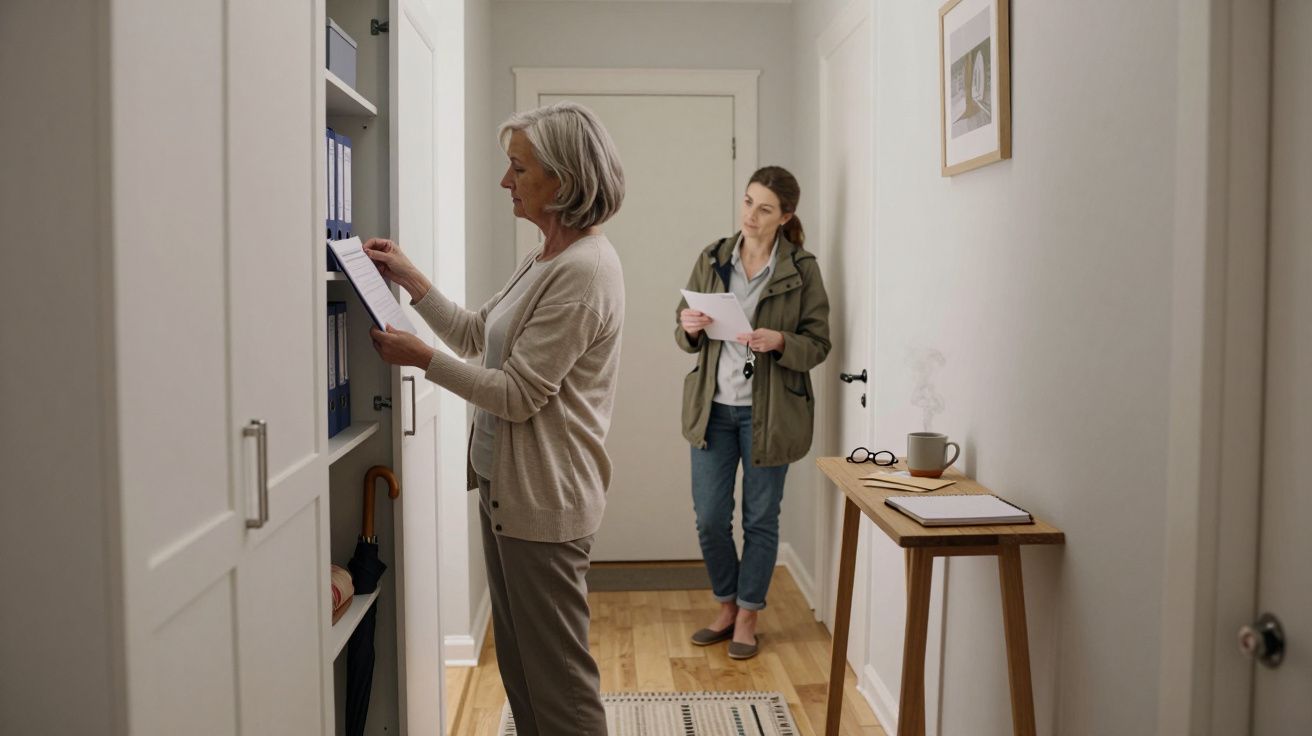
The old her would have gone home, opened three different drawers and cried into a heap of envelopes. Instead, she walked to the hall cupboard, pulled out a single lever-arch file and took it to the hospital. Inside: copies of his lasting power of attorney, a list of his current medicines, NHS and pension numbers, key phone contacts, and a simple “what’s due when” sheet for household bills.
“The doctors focused on his hip,” she said. “I could focus on him, not on panicking about where the gas bill was.” The operation still hurt. The rehab was still slow. But one layer of chaos had been stripped away.
That’s the quiet promise of a grab folder. It doesn’t change your health. It shrinks the admin storm that tends to blow up around it.
Why advisers keep talking about paper, not just passwords
You might wonder why, in the age of online banking and patient portals, anyone is still talking about a paper folder. Advisers are surprisingly united here: bits of physical paper cut through digital fog when timing matters.
In an emergency, your adult child may not know your email password, your GP’s online system, or which of the five banking apps on your phone actually holds the savings. What they can do is open a labelled folder and find:
- the name and phone number of your GP surgery
- where your will is stored and with which firm
- who has authority to speak on your behalf if you lack capacity
- which banks and insurers need notifying if you are in hospital for a while
Visibility matters. A thin sheaf of key documents is far quicker to scan than years of email or a cluttered desk. It also gives professionals something concrete. A solicitor can copy a lasting power of attorney from your file. A hospital can note your allergies from your printed medication list. Your family can see, at a glance, what’s in place and what’s missing.
Digital records still matter. The folder doesn’t replace strong passwords or online access. It simply acts as a physical “dashboard” for a life that’s grown complex.
Exactly what to put in your grab folder
You don’t need to empty your filing cabinet into one enormous binder. A grab folder is deliberately lean. If it’s too heavy to pick up in one hand, you’ve lost the point.
Most UK retirement planners suggest these sections as a starting kit:
1. Health and care
- Current medicines list (with doses, conditions, and any allergies)
- Summary list of diagnoses or key health issues
- NHS number and details of your GP surgery and main hospital clinic
- Copies of any advance decision to refuse treatment (ADRT) or advance statement
- Contact details for community nurses, carers or private care agencies if you use them
2. Legal authority and wishes
- Copies of your Lasting Power of Attorney (LPA) for health and welfare, and for property and financial affairs, plus details of where the originals are stored
- Name and contact details of your attorneys and your solicitor
- A simple note of where your will is kept and which firm holds it
- Any funeral wishes or prepaid funeral plan documents
3. Money and day‑to‑day living
You don’t need full statements, but you do need a clear map.
- List of banks, building societies and key account types (e.g. “Nationwide current account, ends 4321”)
- Details of your state pension, workplace or private pensions (providers and policy numbers)
- Direct debits and standing orders that keep the household running: utilities, council tax, rent or mortgage, care home fees, insurances
- House and contents insurance policy details and renewal dates
4. Contacts and “who to ring first”
A short, accurate contact list can calm an entire family.
- Main emergency contacts (children, partner, close friend, neighbour with a key)
- Your GP, dentist, optician and any regular consultants
- Solicitor, financial adviser or accountant
- Building manager or warden if you live in sheltered or retirement housing
The key is to make the summary the star. Originals of wills and title deeds can stay in safes or with solicitors. The folder tells your loved ones what exists and where to find it.
How to build it without feeling overwhelmed
The biggest barrier advisers see is not cost or complexity. It’s dread. Facing your own paperwork feels like opening a cupboard you know will collapse on you.
The trick is to keep the process light and finite.
Start by picking a simple A4 folder or binder, something that opens flat and has room for tabbed dividers. Label the spine with your name and the words “Emergency Folder” or “Hospital Folder”. Then:
- Set a 20‑minute timer. First session, do nothing more than gather what you already know is important: passports, pension letters, LPA copies, hospital clinic letters, the latest home insurance schedule.
- Sort into four piles on a table: Health, Legal, Money, Contacts. Don’t read every line. Just skim and park.
- Create one summary sheet per section. Handwritten is fine. Capture the essentials: “State pension paid Monday to NatWest”, “Will at Bloggs & Co, High Street”.
- Slip each section into its own tabbed section in the folder, summaries at the front, supporting documents behind.
Then stop. Have a cup of tea. The folder does not need to be perfect to be useful. It needs to exist.
Advisers often recommend a gentle ritual, not a marathon. Once a month, when a bill arrives or a hospital letter comes through the door, ask, “Does this change anything in the folder?” If yes, swap the relevant page. Five minutes, done.
Where to keep it, and who should know
The folder’s power depends on two things: that it’s findable, and that someone knows it exists.
Most people keep it:
- in a clearly labelled spot in a hall cupboard or desk drawer
- in a fire‑resistant box with other essentials
- or, in sheltered housing, in the place staff recommend for emergency information
Tell at least two trusted people where it is and what it’s for - typically your attorneys under the LPA, and one or two close relatives or friends. Some simply send a photo of the folder cover and its storage spot to their children on WhatsApp with a line: “If I ever end up in hospital, start here.”
If you’re uncomfortable with full details lying around, you can separate it:
- Core health and legal papers in the main folder
- A slimmer “contacts and summary” booklet that lives more visibly
You decide how much you’re happy to share. The goal is not to publish your life; it’s to avoid a frantic treasure hunt when you’re on a ward in a hospital gown.
What changes after you’ve done it
People who have created a grab folder often describe a slightly unexpected side effect: relief. Not the abstract “I should be more organised one day” feeling, but a concrete drop in background noise.
They stop worrying, late at night, about what would happen if they were taken ill on a holiday or if a partner with early memory problems had a fall. They know that, between the folder and the people named in it, there is a route map for the first 48 hours.
Practical benefits follow quietly:
- Faster decisions. Clinicians find it easier to confirm who can speak for you if you can’t.
- Fewer financial shocks. Direct debits don’t suddenly bounce because no one realised which account paid what.
- Calmer family dynamics. Siblings spend less time arguing over who should “deal with things” and more time sitting by your bed.
For retired couples, there is one more gain: it flushes out assumptions. Going through the folder together surfaces questions like “Do you actually want to be resuscitated in all circumstances?” or “Would you be happy to move into sheltered housing if I died first?” Conversations no one enjoys, but everyone later is glad they had.
“Paper remembers what a frightened brain forgets,” a financial planner in Manchester told me. “In a crisis, your family need a plan they can hold.”
A compact checklist to start today
You do not have to tackle everything at once. Begin with a lean version and let it grow.
- Pick: A4 folder with 4–6 dividers, clear labels on the spine
- Gather: LPA copies, NHS and pension numbers, insurance summaries, key clinic letters
- List: Bank and pension providers, regular bills, key contacts, where your will is held
- Store: In an obvious but safe place; tell at least two trusted people
- Ritual: Five‑minute check when major paperwork arrives or every few months
Even an imperfect folder is better than searching under pressure.
FAQ:
- Is it safe to keep financial details in a visible folder? Avoid full account numbers and online banking passwords. Focus on who you bank with and what products you hold. That’s enough to guide attorneys and professionals without handing a thief the keys.
- Do I still need this if everything is already online? Yes. The folder acts as a signpost: which logins matter, who has authority, which firms to contact first. It stops your family drowning in a sea of apps and emails.
- What if I don’t have a lasting power of attorney yet? Make a section titled “To be done” and put it at the front. Many people find that seeing the empty space is the nudge that finally gets them to set one up.
- Should I give my children the whole folder now? Not necessarily. Let them know it exists, where it is, and under what circumstances you’d like them to use it. You can always share copies of specific pages if that reassures you.
- I live alone and have no close family - is this still worth it? Very much so. It helps neighbours, friends, social workers and hospital staff understand who to contact, what you can afford, and what your preferences are if you’re admitted unexpectedly.





Comments (0)
No comments yet. Be the first to comment!
Leave a Comment