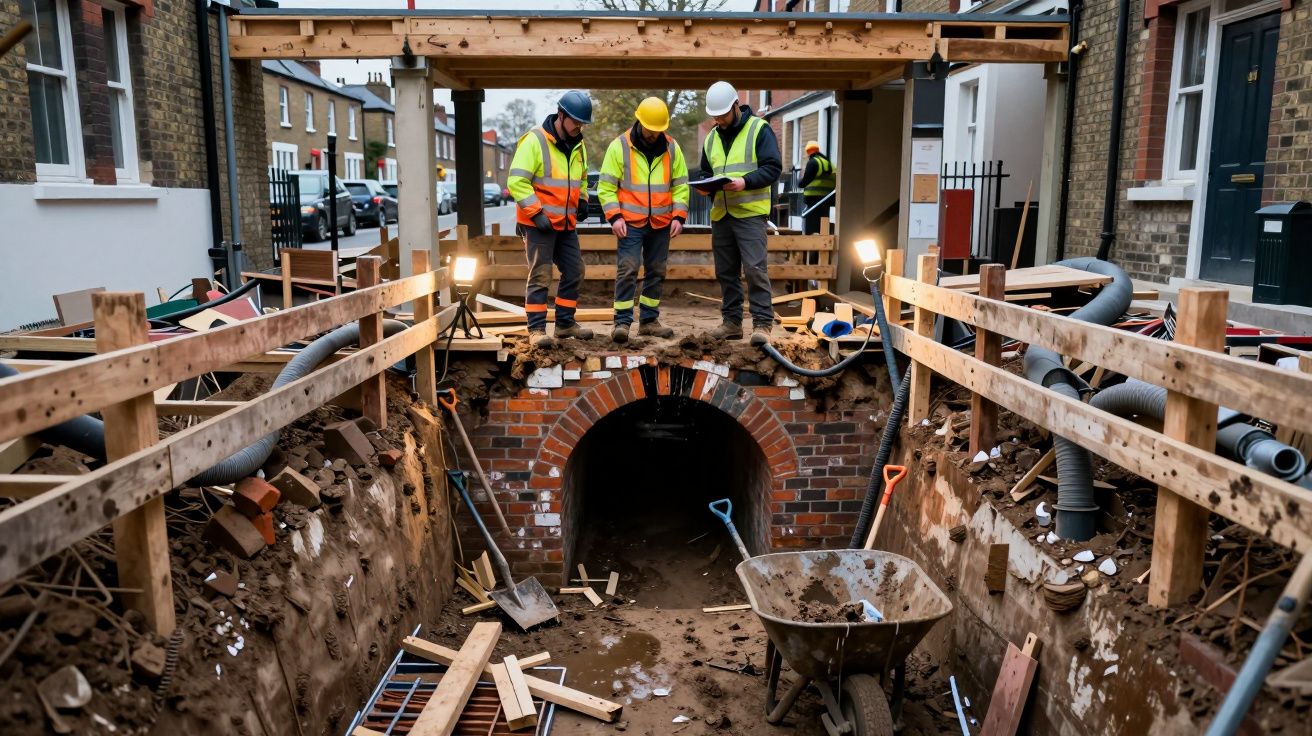
Builders digging a new basement in London hit a mystery brick tunnel – experts suspect an old smuggling route
The first sign that something was off was the sound. The digger’s bucket, which had spent the morning happily chewing through clay and rubble, suddenly rang out with a flat metallic thud that made everyone pause. The operator lifted the arm, nudged away the loose soil, and a curved line of brickwork appeared where there should have been nothing but earth. The site fell quiet in the way London rarely does. A piece of the city that wasn’t on any drawing had just turned up under a terraced street.
It’s a residential basement job in a part of London where houses change hands for seven figures and space is mined downwards when it can’t stretch sideways. The plans were routine: underpinning, a new floor slab, a playroom and utility space where Victorian coal once lived. No one had briefed the crew for archaeology. Yet the more they scraped, the clearer it became that this wasn’t an old drain or a collapsed coal hole. A low, arched tunnel in handmade brick was running across the line of the new basement, disappearing under the party wall towards the next house.
“You don’t expect to find a whole extra corridor under someone’s lounge,” one bemused site manager said. “We were meant to be making a gym, not a time capsule.”
A tunnel that shouldn’t be there
Once the dust settled and the trench was shored, the oddities stacked up. The brickwork was surprisingly neat for something that had never seen daylight for more than a century. It ran straight for as far as the exposed cut allowed, about three metres, with a gentle fall that suggested water was not its main concern. There were no modern services clipped to it, no obvious manhole, nothing that tied it to the sewers or utilities listed in the pre‑construction checks.
The crew noticed small details first. The bricks were narrower than today’s standard, with a sandy, buff colour closer to late Georgian than late Victorian stock. The mortar was lime, not cement, soft enough to scrape with a trowel. Just above knee height, on the inner face of the arch, a line of soot marked where something had once brushed past, over and over again. The opening was big enough for a person to crouch and shuffle through, but not comfortable. This wasn’t built for show.
Neighbours swore they had no idea anything lay beneath them beyond the usual London mix of pipes and old coal chutes. But one elderly resident remembered her grandfather talking about “the passage under the road” as a child, a phrase dismissed for decades as family folklore. With the new tunnel now obstructing the basement dig, the folklore suddenly had a physical address.
Why smuggling is suddenly on the table
When word of the find reached local historians and a consultant archaeologist, the comparisons came quickly. London is laced with old routes: plague pits, disused post office railways, forgotten vaults under pubs and churches. Yet the proportions and direction of this tunnel didn’t match the usual suspects. It appeared to run parallel to a nearby historic high street, not towards the river or obvious drainage outfalls.
In the eighteenth and nineteenth centuries, smuggling wasn’t just the stuff of windswept coasts and Cornish coves. Tea, spirits, silk and tobacco slipped into the city through wharves and unregistered warehouses, then moved inland along a mix of legitimate and hidden channels. A discrete, brick‑lined passage between properties could serve as a way to move contraband from a rear yard or stable block to a safe room without passing the shopfront or the gaze of excise officers.
The tunnel’s brick bond and mortar type point to a construction window roughly between 1780 and 1840, overlapping neatly with a period when London’s customs enforcement tightened and smugglers adapted. There is no definitive stamp saying “smuggler’s express”, but the blend of features is enough for experts to rank that hypothesis above a simple service duct.
| Clue | What it suggests |
|---|---|
| Narrow, hand‑made bricks and lime mortar | Late Georgian / early Victorian construction |
| Arched profile with no clear drainage fall | Human passage, not primary sewer |
| Soot and scuff marks at consistent height | Repeated use along a set route |
When building work meets buried history
On modern London sites, surprises underground are more common than most homeowners realise, but this find triggers a specific sequence. Work stops in the affected area first, not because anyone expects buried treasure, but because safety trumps curiosity. Unsupported voids can collapse, old structures can undermine foundations, and no one wants an unexpected tunnel to become an unexpected sinkhole.
The site’s engineer checked the immediate stability, propping the trench and assessing whether the tunnel was carrying any load from the house above. The party wall surveyor was pulled in early, as the structure appeared to run beneath more than one property. Within 24 hours, the local planning authority’s archaeology officer was on site, clipboard in hand, gently thrilled. The basement project had just become a small investigation.
What happens next is a balance of law, logistics and patience. In London, planning permissions for substantial digs usually carry a condition requiring archaeological watching briefs. If something of interest turns up, the developer may be asked to fund a limited excavation and recording exercise, even if the end goal remains a finished basement. The homeowner’s timeline stretches; the builder’s programme flexes. Nobody planned for a tunnel, yet nobody wants to be the one who cements over a rare piece of urban history without understanding it.
“It’s a classic London tension,” says one planning consultant. “You’re trying to deliver extra living space in a cramped city, but the city keeps reminding you it was here first.”
What experts will look for inside the tunnel
The next steps are oddly forensic for a residential project. Before anyone even thinks about widening the opening, the tunnel will be photographed, measured and sketched. Small samples of brick and mortar go to a lab to refine those initial age estimates. Any artefacts in the immediate fill - shards of glass, pottery, metal fragments - are logged and bagged, however mundane they seem. A broken bottle can tell as much about a date and use as a coin.
Specialists will also be interested in the tunnel’s route. Does it dog‑leg under the garden to meet an outbuilding that no longer exists? Does it run straight under the street towards a former coaching inn, warehouse or river wharf? Old maps and fire insurance plans can be overlaid with today’s cadastral lines to see which previous structures might line up. Names that appear innocuous on twenty‑first‑century estate agent blurbs sometimes hide a past involving bonded stores and discreet back entrances.
Smuggling is only one theory. The passage could have been built for secure movement of high‑value goods within a merchant’s own premises, for discreet access to a cellar bar, or even as part of a private escape route in a more paranoid era. But the combination of deliberate construction, lack of obvious legal function, and the particular commercial history of the surrounding streets make the smuggling story hard to ignore.
- Check alignment against historic maps and trade directories.
- Analyse deposits on brick surfaces for residues (smoke, tar, spirits).
- Look for blocked side‑chambers that might have served as storage bays.
- Compare with documented tunnels in nearby boroughs from the same period.
What it means for the street above
For the homeowners, the discovery is both a nuisance and a quiet boast. Their dream basement will likely take longer and cost more, with extra engineering to bridge or infill the tunnel safely once the archaeologists finish. Procurement schedules shift; the contractor juggles teams while a section of the dig becomes a miniature museum for a week or two. In London’s building economy, time is money and unexpected heritage comes with line items attached.
Yet there is also a peculiar pride in knowing your house now sits atop a documented oddity. Estate agents already trade on phrases like “period charm” and “rich history”; an authenticated underground tunnel with a smuggling hypothesis is the kind of story that ends up in viewing‑day whispers and local history walks. The street itself may see little change on the surface, but its conversation has new material. Children walking to school are suddenly passing over what might once have been a midnight route for barrels and bundles.
Local councils will weigh whether the find merits formal protection. In most cases, tunnels like this, if isolated and structurally awkward, are recorded, sampled and then sensitively sealed. Continuous public access is rare unless the passage links into a wider, already accessible network. The priority remains that present‑day buildings are stable and safe, even as the past is acknowledged and archived.
How to live in a city that keeps revealing itself
The London clay has given up many secrets: Roman roads, plague pits, Tudor jetties, air‑raid shelters, forgotten stations. Each time a new basement, Crossrail spur or utility trench slices down, there is a chance something unplanned will appear. For developers, that can feel like interference; for archaeologists, it is often the only way to catch glimpses of layers that would otherwise remain theoretical.
Where suspicion of smuggling enters, myth rushes in behind it. Pubs will claim underground links to theatres and churches, stories will grow around “escape routes” for politicians and princes. The reality is usually grubbier and more practical: moving taxable goods out of sight, shifting cash, dealing with licensing laws or simply avoiding mud. A brick tunnel under a terrace probably served merchants and workers before it ever fuelled ghost tours.
What endures is the sense that living in London means sharing a plot with previous lives. The builders on this site set out to dig a precise volume of space; they found a corridor of unanswered questions. When they eventually pour the new slab and waterproof the walls, a record of the tunnel will sit somewhere in an archive, its measurements locked on paper and hard drive, its story still half‑guessed. Above it, children will play in a basement carved between past and present, in a city that keeps rewriting itself every time someone digs a little deeper.
FAQ:
- Will the homeowners be allowed to keep and use the tunnel? In most cases, no. Once documented, the priority is structural safety. Sections may be left in place but are usually sealed rather than opened up as private passages.
- Could this delay the project by months? Typically, the archaeological phase is measured in days or a few weeks, not seasons, unless the find is exceptionally significant. The biggest impact is often redesign time to accommodate or safely bridge the structure.
- Does this kind of discovery affect property values? It can go either way. Some buyers are wary of any complexity below ground; others see a verified slice of history as a unique selling point, especially if it’s well documented and structurally resolved.
- Are smuggling tunnels in London common? Documented, purpose‑built smuggling tunnels within the city are relatively rare, but hidden passages and adapted cellars linked to historic trading and tax avoidance are more frequent than official records suggest.



Comments (0)
No comments yet. Be the first to comment!
Leave a Comment