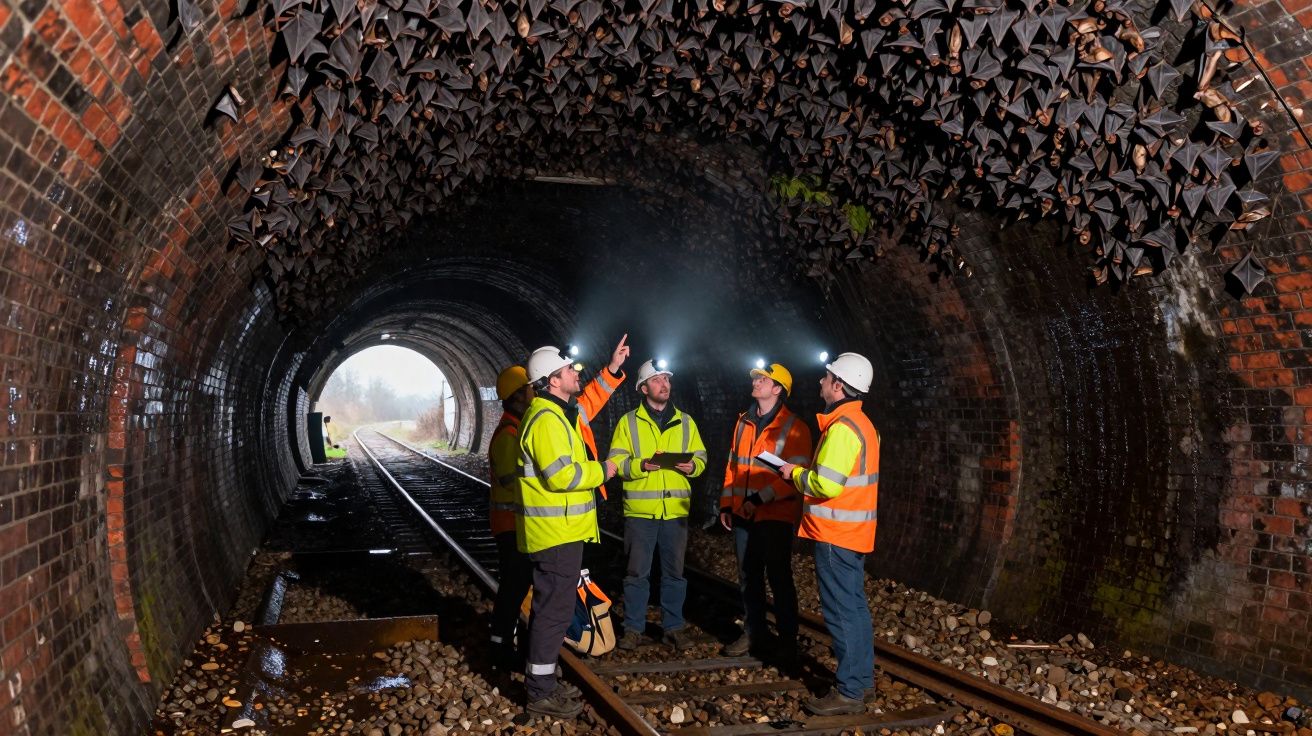
Engineers testing a disused railway tunnel discover it’s become a vast bat nursery
The first clue wasn’t the sound. It was the temperature.
The engineers stepped from weak autumn light into a breath of air that felt strangely warm, every exhale hanging in front of their head torches. The tunnel had been sealed for decades, a curved scar of brick in a hillside scheduled for structural tests before a potential reopening. They expected dripping water, loose masonry, maybe a sleeping fox. Instead, their boots crunched on something that looked like pepper scattered across the ballast.
A few metres in, the ceiling moved. At first it read as shadows. Then the shadows shuffled. One of the team killed his torch, more from instinct than training, and the shape of the tunnel changed again. The roof above them wasn’t just brick any more; it was thousands of tiny bodies, folded like leathery commas. A forgotten piece of Victorian infrastructure had quietly become a maternity ward.
How an abandoned tunnel turned into a perfect nursery
The engineers called in ecologists before touching another brick. On paper, the tunnel was a risk: old, damp, partially flooded at the far end. To a bat, it was prime real estate.
The roof and side walls offered endless crevices for roosting. The steady, cool temperature didn’t swing with every weather front. Crucially, the entrance faced a strip of rough grassland and ancient hedgerows buzzing with moths, beetles and midges – a buffet for hungry, high‑metabolism mothers.
When the surveyors returned with bat detectors and thermal cameras, the numbers startled even the experts. At peak season, the software estimated several thousand individuals: mainly Daubenton’s and Natterer’s bats, with clusters of brown long‑eared bats threaded between them. In the infrared images, the nursery glowed like a living carpet. Each bright dot was an animal no heavier than a £1 coin, nursing or jostling for space.
From a conservation point of view, it was like stumbling on an unmarked hospital. Britain’s bat populations have been squeezed for decades by pesticides, bright night‑time lighting and the loss of old barns and trees. Regulations quietly reflect that pressure: all bat species and their roosts are legally protected, even when the animals are away. The tunnel wasn’t a quaint curiosity. It was protected habitat, and that changed the entire engineering brief.
When blueprints meet wings
On the project timeline, the tunnel had a date for test drilling, reinforcement and eventual reopening as a walking and cycling route. On the new wildlife timeline, that was smack in the middle of maternity season, when mothers and pups are most fragile.
The engineers, ecologists and local council sat around a table looking at two sets of non‑negotiables: public safety and legal duty to protect wildlife. The solution was less dramatic than a showdown, more like a careful rewrite.
Work windows were shifted to cooler months, avoiding breeding and hibernation. Heavy machinery was banned from the interior until detailed roost mapping was complete. Lighting plans were redrawn: low‑intensity, warm‑spectrum lamps, shielded and on motion sensors, to keep the tunnel dark most of the time. One section known to host dense clusters was ring‑fenced from direct disturbance; reinforcement would happen from outside, or not at all.
Let’s be honest: nobody dreams of their infrastructure project being slowed by a bat nursery. Yet on site, something subtle shifted. The same team that had walked in with clipboards now found themselves whispering without quite knowing why, pointing out tiny ears and tilted faces just above their hard hats. Engineers started referring to “the residents” when discussing load paths and drainage. The bats had become a design constraint, but also a kind of client.
What this discovery says about forgotten places
The tunnel story isn’t really about one colony. It’s about what happens when human attention leaves a place alone for long enough. Across the UK, disused railway cuttings, culverts, pillboxes and air‑raid shelters have quietly turned into lifeboats for wildlife that no longer fits the tidy, lit, fenced spaces we build now.
Ecologists talk about “accidental reserves” – spaces never meant as nature reserves that still end up doing the job. Old tunnels offer:
- Stable temperatures and humidity that mimic caves.
- Darkness protected from street lights and car beams.
- Quiet, interrupted only by dripping water and the occasional fox.
In a landscape of tidy verges and floodlit retail parks, that kind of darkness is rare. For bats, which navigate by sound and are easily disoriented by bright white LEDs, it can mean the difference between raising young successfully and slowly disappearing from a region. The engineers didn’t set out to save a species. They just opened a door that had stayed shut long enough for something else to move in.
There’s a wider lesson hiding under the guano. When we map derelict infrastructure only by its risk to people, we miss its value to other species. The data is not sentimental; it is practical. Each roost, sett or nest site discovered late in a project can force expensive redesigns. Each one found early can be worked around more calmly. The discovery in that tunnel became a case study: start with biodiversity, not as an afterthought, but as a first survey layer.
Designing with bats in mind
After the initial shock, the team treated the bat nursery as a design brief. The question shifted from “How do we clear this tunnel?” to “How do we share it?” The answers were small, detailed and, to most future visitors, almost invisible.
“Consistency is the language of safety,” one bat specialist said. “If the animals can predict light, noise and air flow, many will tolerate limited human use.”
That translated into:
- Seasonal closures during sensitive periods, clearly signed at both portals.
- A “dark corridor” left unlit along the ceiling, so commuting bats could move freely.
- Smooth surfaces and quiet drainage to dampen echoes from footsteps and bikes.
- Monitoring points built into the structure so future checks don’t mean fresh drilling.
Once you see it, the pattern feels obvious. We can reinforce brickwork without smashing every ledge that holds a roost. We can open routes for people without flooding ancient dark spaces with glare. We can treat wildlife not as a surprise obstacle, but as a constant neighbour in our calculations. The bridge between “their” world and “ours” is not romance; it’s architecture.
| Key point | Detail | Why it matters |
|---|---|---|
| Tunnels make ideal roosts | Stable, dark, quiet spaces mimic natural caves | Explains why old infrastructure attracts large bat colonies |
| Early surveys change projects | Finding bats at the start avoids costly last‑minute changes | Encourages planners to factor ecology into first drafts |
| Shared design is possible | Light, noise and timing can be managed for both people and bats | Offers a practical model instead of an all‑or‑nothing choice |
FAQ:
- Are engineers allowed to move or disturb bats in a tunnel like this? No, not without special licences. In the UK, all bats and their roosts are protected by law, so any work has to be planned with licensed ecologists and often adjusted to avoid harm.
- Does this mean old tunnels can never be reopened to the public? Not necessarily. Many are open as trails with seasonal closures, limited lighting and protected roost zones. The key is designing access around the bats’ most sensitive times and spaces.
- Why should we care about “just bats” when we need safe infrastructure? Bats are top insect predators and indicators of wider ecosystem health. Protecting their nurseries often means protecting the wider network of hedgerows, rivers and dark skies that benefit other species – including us.
- Can ordinary people help with places like this? Yes. Reporting bat sightings near old bridges, tunnels or culverts to local wildlife groups helps build the maps engineers and planners use. Respecting signs and seasonal closures is another quiet, practical contribution.

Comments (0)
No comments yet. Be the first to comment!
Leave a Comment