Not a new phone: this £30 gadget can make your old mobile feel fast again
By the third stutter of the lock screen, I was ready to throw my phone into the nearest hedge. Apps took whole seconds to open, photos juddered as I scrolled, and typing a message felt like walking through mud. It wasn’t broken. It was just… tired. I did the usual rituals: deleted screenshots from 2018, offloaded apps I’d sworn I needed, turned it off and on again. Nothing really changed. Then a friend handed me a tiny, unremarkable-looking plug and said, “Use this first, then decide if you need a new phone.”
It cost less than a takeaway. And it changed everything about how that old handset felt to use.
The day I stopped blaming the phone
The gadget was a cheap USB-C hub with one job that matters more than its plastic body suggests: it let me back everything up, strip the phone, and rebuild it properly without juggling cables like a backstage tech. My friend, who fixes laptops and phones for a living, watched me try to “make space” by deleting six photos at a time and gently took over.
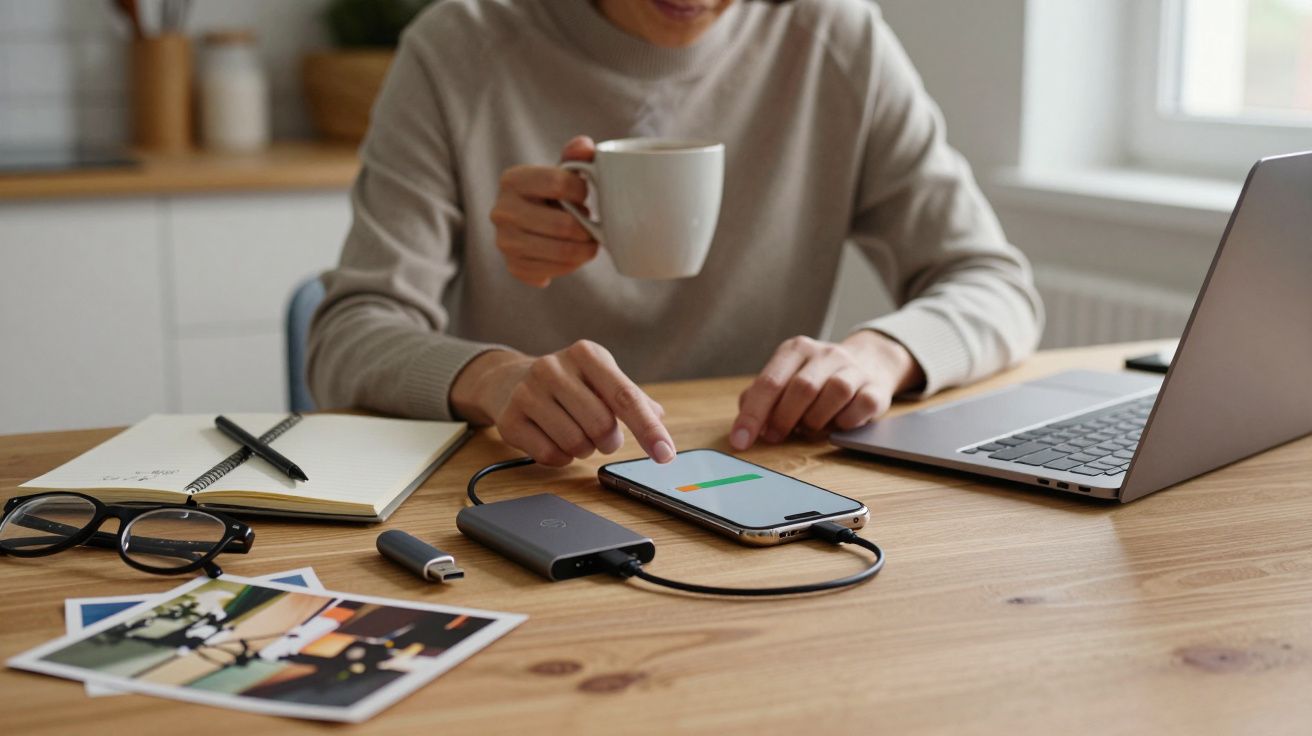
He plugged the hub into the phone, slid in a tiny SSD he’d labelled “LIFE”, and opened the file manager. No faff with cloud logins, no waiting for patchy Wi‑Fi. We dragged whole years of photos across in minutes. The progress bar boiled along instead of inching. When it finished, the gallery on my phone suddenly looked lighter, like a wardrobe after a ruthless clear-out. The phone hadn’t changed. The way it carried its stuff had.
The £30 bit of kit that unlocks all the others
I asked him why this small lump of ports made such a difference when I could, technically, have done it with a cable and my laptop. He shrugged. “Because you’ll actually use this.” And that’s the point. The right £30 gadget is not magical hardware. It’s the friction remover that lets you do the maintenance your phone has been quietly begging for.
For most of us, that gadget is one of three things:
- A USB-C hub with SD card and USB‑A ports
- A compact external SSD or fast USB stick
- A decent 20–30W charger with a proper cable
One handles your clutter, one stores your history, and one keeps the whole system from crawling when the battery dips. On their own, they’re ordinary. Together, they are the difference between a phone that limps and a phone that still feels nimble after a few years.
Why your “slow” phone often isn’t slow
Phones don’t suddenly lose their nerve. They get choked by three quiet culprits: storage nearly full, background updates clinging to old caches, and a battery that now trickles instead of sprints. You feel it as lag. The phone feels it as constant effort.
An almost-full drive leaves no room for temporary files, so every tap makes the system jostle for space. Old apps you never open still lurk with permissions, checking for notifications, holding fragments of data. A tired battery throttles performance to stop random shutdowns. None of that is glamorous. All of it is fixable without a four-figure upgrade.
Your £30 helper doesn’t add power. It gives you a sane way to clear breathing room and then keep it.
The sequence in a sentence
I asked my friend if there was a right order to drag an old phone back from the brink. He smiled. “Always. Otherwise you’ll do it twice.” His rule is as simple as it is boringly effective:
Back up first, strip next, reset last, then only put back what you actually use.
You don’t start by hunting individual apps. You start by getting your photos and files out to somewhere that is not the phone, using that hub or SSD so it’s fast and painless. Then you clear, reset, and slowly layer things back on. The process feels like spring-cleaning a flat instead of shoving one more box into an overstuffed cupboard.
Step-by-step: the 90-minute revive
Here’s the version you can do on a Sunday afternoon, tea in hand. It’s not techy; it’s administrative kindness.
1. Give everything somewhere to go (15–20 minutes)
Plug your £30 hub into the phone, slide in a decent SD card or USB stick, and open your file manager or photo app.
- Move full photo albums, videos and downloads to the external drive.
- Export your WhatsApp or Messages backups to the same place if the app allows it.
- Copy any “Documents”, “Downloads” and random folders you don’t recognise but are nervous to delete.
You are not sorting yet. You’re just moving the clutter into a spare room.
2. Cull the real hogs (10–15 minutes)
Now the phone has breathing space, look at what actually remains.
- Sort apps by size in Settings.
- Delete games you haven’t opened in months, social apps you only used once, and that “trial” photo editor you forgot.
- Clear each remaining app’s cache where possible: it’s often gigabytes of dust.
This is not the time for sentimentality about three-year-old podcasts you “might listen to one day”.
3. Commit to the factory reset (25–30 minutes)
This is the bit people avoid, and it’s the bit that makes everything feel new again. With your photos and files now safe, you can do it without that sick feeling.
- Log out of any account that might lock the device (Apple ID, Google, manufacturer logins).
- Hit Factory reset and let the phone wipe itself back to day one.
- Make a kettle, not a fuss. The phone is doing the deep clean you could never do manually.
When it restarts, resist the temptation to restore absolutely everything from a blanket cloud backup. That just drags the old clutter back in new clothes.
4. Add back with intent (20–25 minutes)
This is where the old phone starts to feel like a new one.
- First, install only the apps you know you use weekly.
- Turn off auto-install of every historical app from your account’s past.
- Sign into essential services, then pause. Wait a day or two before adding anything else.
Photos and files you genuinely need on the device can be copied back from your external drive. Everything else lives in that £30 box until you ask for it. The home screen goes from bingo card to curated desk.
5. Fix the charging bottleneck (5–10 minutes)
The cheapest, least glamorous upgrade can make your phone feel snappier purely because you’re not tiptoeing around a 12% battery all day.
- Replace old, fraying cables with one certified 20–30W USB‑C or Lightning lead.
- Use a compact fast charger that matches your phone’s maximum supported speed.
- Stop “sipping” power from random laptop ports; give the phone proper meals.
A healthy battery and quick top-ups mean the system doesn’t have to throttle itself to avoid sudden shut-offs. You feel that as smoother scrolling and fewer stutters when you open something heavy on 19%.
Why a hub beats “I’ll sort it in the cloud”
Cloud backups are brilliant until your Wi‑Fi sulks, your free storage fills up, or you can’t remember which email address you used in 2016. A small, physical drive plugged into a hub doesn’t argue. It doesn’t compress your photos into soft mush. It doesn’t panic when you change networks.
More importantly, it changes how you think. You’re not pushing rubbish into an invisible attic. You’re moving it somewhere you can actually browse later, on a laptop or tablet, without waking the phone up every time. Your old device becomes lean and present. Your history gets an organised shed instead of a teetering garage.
Small rituals that keep it feeling fast
There’s no need to turn this into a hobby. A few quiet habits will do more for day-to-day speed than any home screen theme.
- Once a month, plug in the hub and offload the latest photos and videos.
- Every few weeks, sort apps by “Last used” and delete anything with cobwebs on the date.
- Restart the phone properly once in a while; it clears out the lingering oddities.
- Keep at least 10–20% of storage free so the system can breathe.
These aren’t power-user tricks. They’re the phone equivalent of taking your shoes off at the door so you’re not constantly hoovering the hallway.
When it’s actually time for a new phone
None of this is a magic spell. There comes a point when hardware really does tap out: the camera can’t keep up in low light, security updates stop arriving, or apps quietly refuse to run on your version of the operating system. A £30 gadget won’t fix that.
What it will do is show you the truth more clearly. If, after a proper backup–reset–rebuild cycle, the phone still gasps under simple tasks, then you know an upgrade is justified. If it suddenly feels sharp again, you’ve just bought yourself another year or two of comfort for the price of a modest meal.
Either way, that little hub or drive doesn’t retire. It becomes the route you’ll use next time you switch phones: plug old in, plug new in, move only what you mean to keep.
The line you could tape to your charger
When I asked my friend what one sentence he’d stick on every cluttered phone screen, he didn’t hesitate. “Back it up, strip it back, then live light.” It covers the fear of losing photos, the reluctance to reset, and the habit of hauling every old app into each new year.
You don’t need to be “good with tech” to make an old phone feel decent again. You just need one small, unfancy gadget and a bit of sequence. The £30 isn’t paying for magic silicon. It’s buying you the chance to stop arguing with a pocket computer that, underneath the dust and the half‑charged frustration, is still perfectly capable of keeping up.






Comments (0)
No comments yet. Be the first to comment!
Leave a Comment