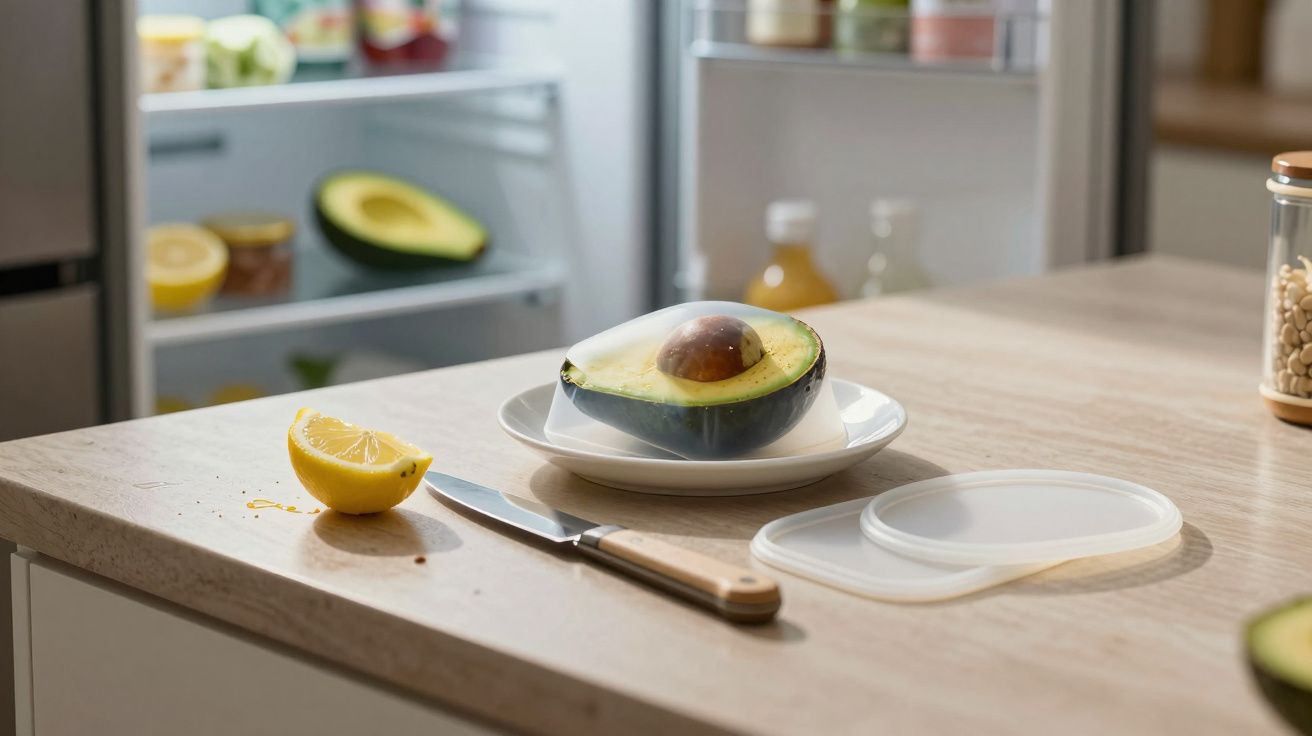
Not cling film, not foil: the reusable cover trick that keeps cut avocados green for days
It usually starts with optimism and a knife. You slice open a perfectly ripe avocado, scoop half onto toast and promise yourself you’ll “use the rest tomorrow.” By the next afternoon it’s sitting in the fridge, freckled with brown and vaguely accusing. Cling film has hugged it. Foil has wrapped it like treasure. Neither has really worked.
In group chats and office kitchens, this has become a minor sport: who can keep theirs green the longest without turning their fridge into a lab experiment. One colleague swears by leaving the stone in. Another traps the half in a jar of water. A third mists it with lemon like a tiny salad. Somewhere between the folk wisdom and the food waste, a quieter solution has crept in: reusable stretch covers that behave more like skin than packaging.
Then came the lid.
Why avocados brown (and what most covers get wrong)
Once an avocado is cut, its surface meets oxygen and the clock starts. Enzymes in the flesh react with that oxygen, turning the bright green first khaki, then mud. Your fridge slows the reaction, but it doesn’t stop the air touching the fruit. That is where cling film and foil quietly fail. They wrap, but they rarely seal.
The food scientist I spoke to put it bluntly: most of us are “air-trapping, not air-blocking.” Loose corners, tiny gaps around the stone, even the natural curve of the fruit leave pockets for oxygen. Wraps also slide off slick surfaces. You open the fridge door, the plate jolts, and suddenly yesterday’s half has been gently airing for hours, dressed in plastic that only looked protective.
Reusable silicone covers work differently. They stretch and cling with tension, not static. Pulled over the cut side, they grip the skin and create a tighter barrier, so there is much less fresh oxygen arriving to fuel that browning. The trick is not technology. It is fit.
The reusable cover method that actually works
The best method is almost boring in its simplicity: combine a proper seal with a little cold and a token of acid. No elaborate mason-jar arrangements, no balancing acts in the salad drawer. Just four deliberate moves that take under 30 seconds.
- Keep the stone in. It reduces the exposed surface and helps the cover “tent” less. More green is shielded, less needs defending.
- Brush the cut face lightly with lemon or lime. A teaspoon is enough. The acid slows the enzyme reaction without turning your avocado into citrus pudding.
- Stretch a silicone cover over the cut side, not just over the plate. You want it pulling snugly around the peel so there’s barely any air inside. Smooth it with your palm once, like closing a book.
- Chill it consistently. Back of the fridge, not the door, so temperature swings don’t nudge the reaction along.
The difference the first time is oddly striking. On day two, the surface still looks like usable food, not something you talk yourself into with a fork. By day three, there may be the faintest blush of colour at the very edge, which you can skim with a knife in one neat pass. The rest stays creamy, firm and recognisably avocado.
Why this beats cling film, foil and the water bath hack
Each of the common tricks solves one part of the problem and creates another. Cling film is thin and convenient, but it clings more to itself than to the fruit. Foil blocks light but leaves air and easily tears. The water bath submerges the cut surface and shuts out oxygen, but it also leaches flavour, wrecks texture at the edge, and invites you to forget there’s a half-avocado bobbing in the back.
Silicone stretch covers work because they align with how the fruit behaves. They flex as the avocado relaxes in the cold, maintaining contact rather than peeling back. They are thick enough to slow oxygen diffusion yet elastic enough to press out air without squashing the flesh. One cover can move from avocado to onion to half a melon without losing its shape. That’s the quiet pleasure: once bought, they keep saying “not today” to food waste.
There’s also a psychological shift. When half an avocado feels easy to save well, you are more likely to buy them more often, use a quarter in a salad or mash just enough for a sandwich. A good storage method doesn’t just preserve fruit. It changes how freely you use it.
Micro-habits that keep your halves green all week
The difference between a sad, spotted half and a still-green one is rarely a grand technique. It is a few tiny habits, repeated without fuss. Think of them as “kitchen safety cues” for your food, not unlike the social cues that calm a nervous system.
- Pick the right moment to cut. Slight give at the stem end, not full softness. Overripe avocados brown faster no matter what you do.
- Keep a small saucer and cover together. Store your stretch lids near the chopping board so you are not hunting them down with lemon on your hands.
- Go for size match, not guesswork. A cover that is just a touch smaller than the widest part of the avocado will seal better than a loose, oversized one.
- Label the back of the fridge with days. A simple magnetic strip-Mon to Sun-can anchor where you stash “day one” leftovers, so nothing drifts into oblivion.
Common mistake: cutting first, thinking storage later. Once the surface has sat out on a board during prep, it has already had a generous meeting with oxygen. Applying acid and covering immediately after cutting buys you more green hours than anything else. Keep the whole sequence small enough that you will do it on a rushed weekday morning, not just leisurely Sundays.
“You’re not trying to cheat time,” the food scientist said. “You’re just removing the accelerators-air, warmth, light.”
- Treat covering as part of cutting, not an afterthought.
- Let the acid do the subtle work; don’t drench.
- Rinse and dry covers straight after use so they’re never “missing in action.”
- On very hot days, store avocados whole in the fridge and ripen on the counter only the one you’ll eat.
The quiet maths of less waste (and less plastic)
Half an avocado thrown out once a week looks trivial. Over a year, that is roughly two dozen fruits, plus the cling film, foil and plastic tubs pressed into service and then binned. A small stack of silicone covers seems like an indulgence at first, then changes the baseline. You stop tearing off lengths of film as a reflex. You open the fridge with less dread of discovering grey leftovers.
There is also the sensory win. Avocado that has slept under a true seal tastes closer to fresh: buttery, mild, not oxidised and watery. Toast feels intentional instead of resigned. Salads look brighter. These are tiny upgrades on their own, but they soften the edges of everyday cooking. Your kitchen becomes a place of small, reliable successes rather than repeated compromises over the bin.
In the end, the reusable cover is not a gadget story. It is a design tweak: giving a soft, vulnerable fruit a second skin that behaves more like biology than packaging. The payoff arrives not in a viral “hack,” but on a Wednesday, when you lift a lid and find that yesterday’s half is still recognisably itself.
| Key point | Detail | Why it matters |
|---|---|---|
| Seal, don’t just wrap | Stretch covers cling to the peel and push out air | Slows browning far better than loose film or foil |
| Add light acid, cut oxygen | A thin citrus coating plus a tight cover | Keeps texture and colour for up to 2–3 days |
| Make it a habit | Store covers by the board and use immediately | Reduces both food waste and single-use plastic |
FAQ:
- Do I really need lemon or lime if I’m using a silicone cover? A tight cover alone helps a great deal, but a light swipe of acid further slows the browning enzymes, especially after day two.
- Will this work with containers instead of stretch covers? A rigid, well-sealed container is better than loose wrap, but it often traps more air. Stretching a cover directly over the cut face gives a closer barrier.
- Can I freeze the second half instead? Yes, but only for mashed uses. Brush with lemon, scoop, freeze in an airtight tub and use later in smoothies or guacamole; the texture won’t return to salad-perfect.
- Are silicone covers safe and truly reusable? Food-grade silicone is designed for repeated use and high and low temperatures. Wash with mild soap, dry fully, and they can last for years.
- Does leaving the stone in really make a difference? It helps more than folk myth suggests. The stone physically shields part of the flesh, meaning less area to protect and fewer spots to brown.



Comments (0)
No comments yet. Be the first to comment!
Leave a Comment