Scientists reconstruct the sound a medieval harbour would have made – and what it reveals about trade routes
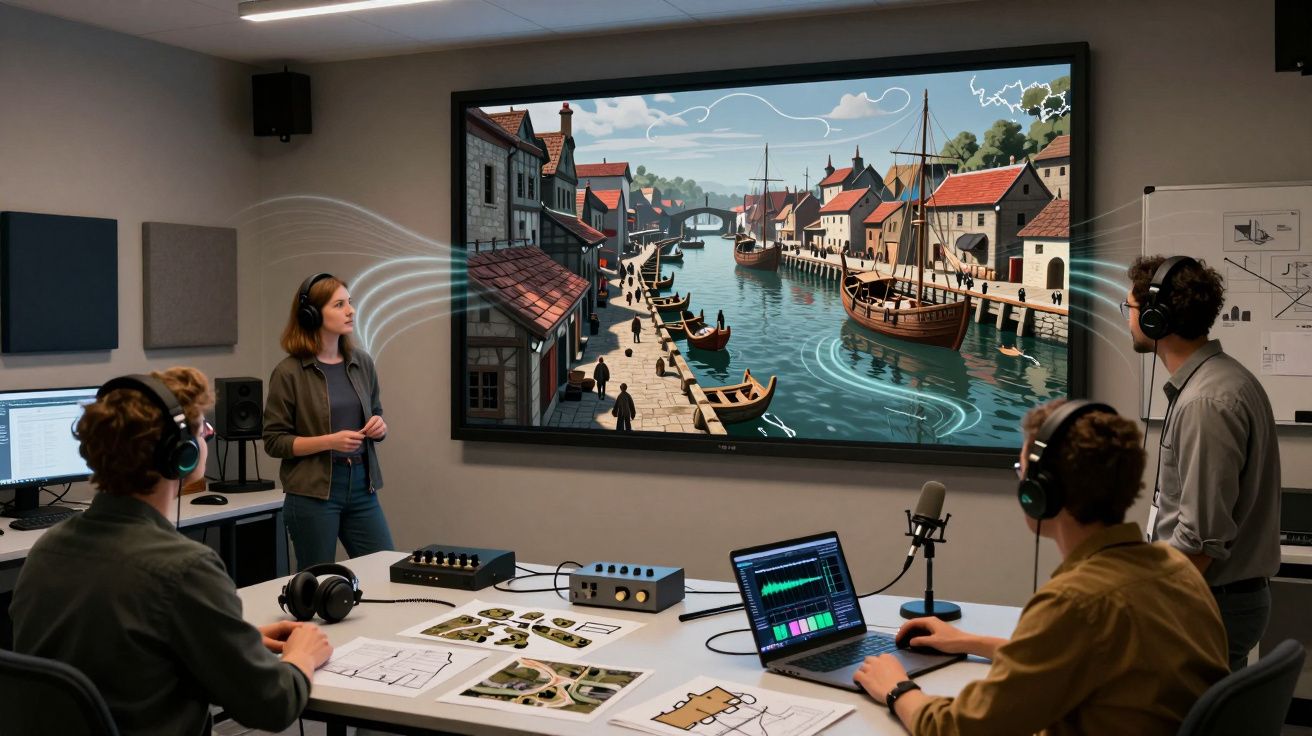
On some mornings in a small acoustic lab in northern Europe, the past begins with a hiss of waves and the clack of wooden blocks. Then come the low creak of hulls, the thud of barrels on planks, shouts in several languages layered like chords. None of it is from a film set. It is a digital reconstruction of what a medieval harbour may actually have sounded like on a working day.
A team of historians, sound engineers and archaeologists has spent the last three years rebuilding the “soundscape” of a 14th‑century port. They fed historical records, harbour plans and the physics of sound into modelling software more usually used for concert halls. The result is not just an atmospheric track. It is new evidence about where goods came from, which ships docked where, and how people moved through one of the busiest spaces of the medieval city.
They treated sound as a kind of invisible archive, full of clues about trade routes, social hierarchy and daily life that do not survive in stone or ink.
Listening to a vanished waterfront
The project started with a puzzle. Written records from one Baltic city mentioned “the noise of foreign ships” and “the clamour of the quay” but gave almost no detail about what that actually meant. The harbour itself has long since silted up and been rebuilt as warehouses and car parks. So the researchers turned to what they did still have: measurements.
Old tax rolls listed how many ships of each size paid fees. Excavations revealed the width of jetties and the types of wood used. Nautical historians provided data on rope thickness, sail area and loading techniques. From this, the team built a 3D model of the port and surrounding streets, then let virtual sound waves loose inside it.
The software calculated how different noises would have bounced off water, timber piles and stone warehouses. A hammer strike, they found, would echo very differently on a bare quay than in front of tightly packed buildings. Layer enough simulated sounds and the model begins to behave like a real place, with its own acoustic fingerprint.
How do you reconstruct a sound no one has heard?
To get from silent diagram to living soundscape, the team combined several strands of evidence. Some came from surviving objects: replicas of medieval hammers, barrels and rigging were recorded in a studio, then “placed” in the virtual harbour. Others came from ethnography, watching and listening to traditional boatbuilders and dockworkers in places where wooden craft are still used.
- Shipwrights were recorded planing and caulking timbers.
- Fishermen hauled rope and nets across wooden decks.
- Market vendors called out prices in reconstructed medieval dialects.
Each sound was measured for loudness, pitch and duration. Then the researchers asked a simple question: where in the harbour would this have been heard, and how far would it have carried? The answers depended on wind direction, building layout and the position of moored ships. Morning fog, for example, slightly muffled high frequencies, whereas a westerly wind pushed the hubbub inland towards the market.
The model does not claim to be an exact “recording” of a specific day, but a set of most‑likely scenarios grounded in physics and documents.
A step‑by‑step acoustic time machine
The workflow, repeated for several ports, followed a fairly consistent rhythm:
- Gather the physical evidence – harbour plans, excavation reports, timber remains, tax and toll records.
- Build a geometric model – 3D layout of quays, warehouses, streets and water, accurate to about a metre.
- Assign acoustic properties – how sound reflects off stone, brick, timber, water and mud at different frequencies.
- Record reference sounds – tools, voices, animals and ships, using historically plausible materials.
- Run simulations – place virtual sound sources and “listen” from multiple points: ship deck, warehouse door, town gate.
- Compare with texts – check whether chroniclers’ descriptions of “din” or “quiet corners” fit the model.
The last step proved especially revealing. Where the simulation produced a much louder sound field than texts suggested, historians went back to the documents and sometimes realised they had misread capacity or building density. Sound, in effect, became a cross‑check on the written record.
What the soundscape reveals about trade routes
Once the virtual harbour was up and running, the team used it to ask a question that had long divided scholars: just how international was this city’s trade, and where did its main routes run? Archaeologists had pottery from England, fabrics from Flanders and coins from the German lands, but the balance between them was unclear.
The sound model added a new piece of information: language drift. By overlaying reconstructed phrases in Middle Low German, Old Norse and Anglo‑Norman French onto ship positions at the quays, the researchers found that foreign speech would have clustered in distinct acoustic zones. In certain parts of the modelled harbour, the intensity of German voices drowned out local tongue almost entirely.
That pattern matched toll records that listed clusters of Hanseatic ships arriving together. It also pushed the likely position of the “English quay” several dozen metres along the shoreline compared with older reconstructions, so that shouted instructions in English would be audible from the customs office mentioned in a surviving charter.
Cargo sounds as trade markers
Not all clues came from voices. Different goods made different noises in motion. Bales of wool thudded softly; barrels of wine clinked and sloshed; bundles of metal rods rang sharply on deck.
- Shipments from the Baltic contributed more of a deep, dull thud from grain sacks.
- Mediterranean imports, especially amphorae and oil jars, produced higher, brittle clinks.
- Timber rafts scraped and groaned, dominating the low‑frequency band along certain quays.
By testing combinations of these cargo sounds in the model, the team could see which mixtures produced the volume and character described in a 15th‑century complaint about “unbearable banging of casks” near a particular church. That church’s bell tower provided a fixed reference point in both text and 3D model, tying the noisy quay to a specific stretch of waterfront that specialised, it seems, in wine and oil.
Harbours as sonic maps of power
Beyond trade routes, the reconstructed soundscapes underlined how medieval ports were places where hierarchy was literally audible. The richest merchants did not just occupy the grandest houses; they managed the noisiest parts of the harbour, where large ships unloaded.
Simulations showed that, from the balcony of one surviving townhouse, an owner could hear distinct layers: deep creaks from large cogs at his own quay, higher‑pitched splashes from smaller local boats further away, the regular stroke of a crane loading stone near the town wall. Guests standing beside him would have been acoustically reminded of his reach.
Quieter zones also mattered. The team found pockets where sound dropped by several decibels, often behind warehouses or along narrow side channels. Some charters mention “silent berths” reserved for high‑status travellers. In the model, these peaceful inlets offered acoustic privacy for delicate negotiations, away from the roar of commerce.
Silence, in a working harbour, was not an absence of activity but a controlled luxury that signalled access and influence.
A quick comparison of harbour zones
| Zone type | Main sounds | Likely users |
|---|---|---|
| Heavy cargo quay | Creaking hulls, barrel thuds, shouts | Long‑distance merchants |
| Fish landing | Slaps, gulls, chatter, knife work | Local sellers, fishers |
| Quiet inlet | Low voices, soft water sounds | Envoys, wealthy guests |
These distinctions help modern historians understand not only where ships docked, but how social life clustered around particular sound environments.
Why sound changes the way we think about the Middle Ages
For decades, reconstructions of medieval cities have focused on what they looked like: street lines, roof shapes, city walls. The sound project suggests that this is only half the story. Daily life was also defined by what people could hear, where they had to raise their voice, and which noises signalled wealth, danger or opportunity.
One finding concerns fatigue. In the busiest trading weeks, sound levels on the main quay in the model reach values comparable to a modern building site. That has led researchers to ask how dockworkers protected their hearing, and whether constant noise influenced the timing of religious processions or legal assemblies that needed quiet.
Another concerns memory. Interviews with residents who listened to the reconstructions in museums show that sound makes the medieval city feel less like a distant painting and more like a place a person might walk through. Visitors recalled specific sonic details days later - a rope whipping through a pulley, a dog barking at ducks - in a way they rarely do with static displays.
For curators, this opens a new tool: soundtracks that are not just decorative, but evidence‑based interpretations visitors can explore.
What this means for future research
The harbour soundscapes are already feeding into new lines of enquiry. Maritime historians are revisiting assumptions about ship scheduling, asking whether night‑time unloading was common or whether noise constraints kept most activity in daylight. Urban planners are comparing medieval and modern harbour noise to think about how waterfront redevelopments handle sound today.
Museums have begun commissioning immersive rooms where visitors stand on a gently moving platform as the reconstructed harbour plays around them in spatial audio. School groups, in particular, respond to the invitation to “stand where a 14th‑century sailor stood and hear what he heard”.
The methods are spreading inland. Similar acoustic models are now planned for cloisters, market squares and even battlefields. Each promises to add another layer to our understanding of places that exist today only as stone outlines and pages of text.
For listeners at home
For anyone curious, some of the soundscapes are available online through project websites and podcasts. Good headphones reveal the quiet details: a bell in the distance, the shift from local chatter to foreign speech as you “walk” along the quay. You can almost feel the spray.
In that sense, the scientists have done more than solve a scholarly puzzle. They have given modern ears a way to travel along long‑vanished trade routes, not by tracing lines on a map, but by following the rise and fall of voices and waves.

Comments (0)
No comments yet. Be the first to comment!
Leave a Comment