The colour neuroscientists recommend for a calmer bedroom – and the shade to avoid on a feature wall
The bedtime scroll, the half‑finished cup of chamomile, the ceiling you suddenly know too well. You’ve dimmed the lights, you’re doing your best version of “sleep hygiene”, and yet your brain still hums under the duvet like a fridge. One thing most of us rarely blame is the paint. The walls feel neutral, background, innocent. But they aren’t. They’re talking to your nervous system all night.
A neuroscientist I spoke to in London told me about a sleep study where volunteers stayed in identical rooms: same mattress, same noise levels, same bedtime. The only real difference was the colour on the walls. Heart‑rate monitors and brain scans recorded what the eyes quietly knew: some colours let people exhale faster, others made the brain act like the day wasn’t over. One group fell asleep almost nine minutes sooner on average. Same bodies, same days, different paint.
The shade your nervous system reads as “you can rest now”
We like to think we’re choosing colours with our taste, but the brain is more basic. It sorts light into “threat or no threat”, “day or evening”. Long‑wavelength colours like strong reds and vivid oranges share bandwidth with warning signs, tail lights and urgency. Shorter wavelengths in the blue‑green range are what we meet in dusk skies, distant hills, and shallow water. Your visual system has been practising this code for thousands of years.
Across labs, one colour family keeps popping up when the goal is calm: soft, muted blue‑green – think pale sea glass or a grey‑leaning sage. In MRI scans, these tones are linked with lower activity in areas of the brain that deal with alertness and conflict. Heart rate drifts down a notch. Eye movements slow. It’s not hypnosis, it’s a subtle shift from “ready” to “it’s fine”.
In sleep clinics, when rooms are repainted from busy brights to these quieter blue‑green tints, therapists notice fewer “I just couldn’t switch off” notes and more “it felt easier to stay in bed”. It’s nothing dramatic on day one, but over weeks it nudges routines into place. The colour doesn’t knock you out; it stops shouting.
The trick is softness. High‑chroma teal can feel like a cocktail bar. Neuroscientists talk about saturation the way sound engineers talk about volume. Lower the saturation and add a hint of grey and the nervous system reads it as distance, not demand. Your wall becomes something the eye can rest on without needing to solve.
How to choose a calming bedroom palette that actually works
Start with what your brain wants, then layer what your taste loves. For most people, that means:
- A soft blue‑green or blue‑grey on the largest wall areas
- Warm, creamy neutrals around windows and ceilings
- A few deeper accents kept low in the room (headboard, throw, rug)
Put swatches up and look at them under the light you actually live in: early morning grey, bedside lamp amber, laptop glow you’re trying to quit. What feels spa‑like at noon can look cold at 10 p.m., so give it a full day. Aim for colours that stay gentle rather than flipping harsh or gloomy.
Think about where your eye lands from the pillow. That first sweep of vision when you turn over at 3 a.m. shouldn’t hit a high‑contrast stripe or a traffic‑light red cushion. Use texture-linen, wool, washed cotton-to add interest instead of more visual noise. Your brain calms faster when the variety is tactile rather than loud.
If you share the room, build from overlap. One partner’s love of navy and the other’s fondness for green can meet in a dusty blue‑green that makes both nervous systems happy. Keep it practical: washable paint finish near the bed, softer matt above eye level where light reflection won’t bounce around as much. You’re not designing a showroom. You’re stage‑managing your own rest.
“When we repainted in a muted blue‑green, my patients stopped calling it ‘the clinic room’ and started calling it ‘the quiet room,’” one sleep researcher told me. “Same furniture. Different mood.”
The colour neuroscientists quietly warn against on a feature wall
We’ve been sold the “pop of colour” for years: a single bold wall behind the bed to show personality. The problem is that your visual system doesn’t clock it as personality. It clocks it as a flag. Feature walls in strong, warm reds – and red‑heavy corals – are the worst offenders when sleep is the goal.
Red wavelengths hit photoreceptors that stay sensitive even in low light. In imaging studies, saturated reds are linked with micro‑spikes in arousal – the brain’s “check again” loop. On a feature wall, every time your eyes skim across the room in the dark, that patch acts like a subtle alarm. You may not fully wake, but you’ll drift into lighter sleep more often.
Designers love to say red is “cosy” or “romantic” in a bedroom. Neuroscientists hear “elevated heart rate and shorter REM windows”. It’s great for a dining room or a living space where you want chatter and energy. On the wall you face when you’re trying to drop from busy beta waves to slow delta, it’s doing the opposite job.
If you already have a bold red feature wall and repainting isn’t on this month’s budget, dial down where you can. Add a large, pale headboard or artwork that covers more of the red area in your line of sight. Swap harsh white bulbs for warmer lamps under 2700K to lower contrast. The brain is negotiating, not rigid. Give it help.
A simple “calm check” before you pick up a paint roller
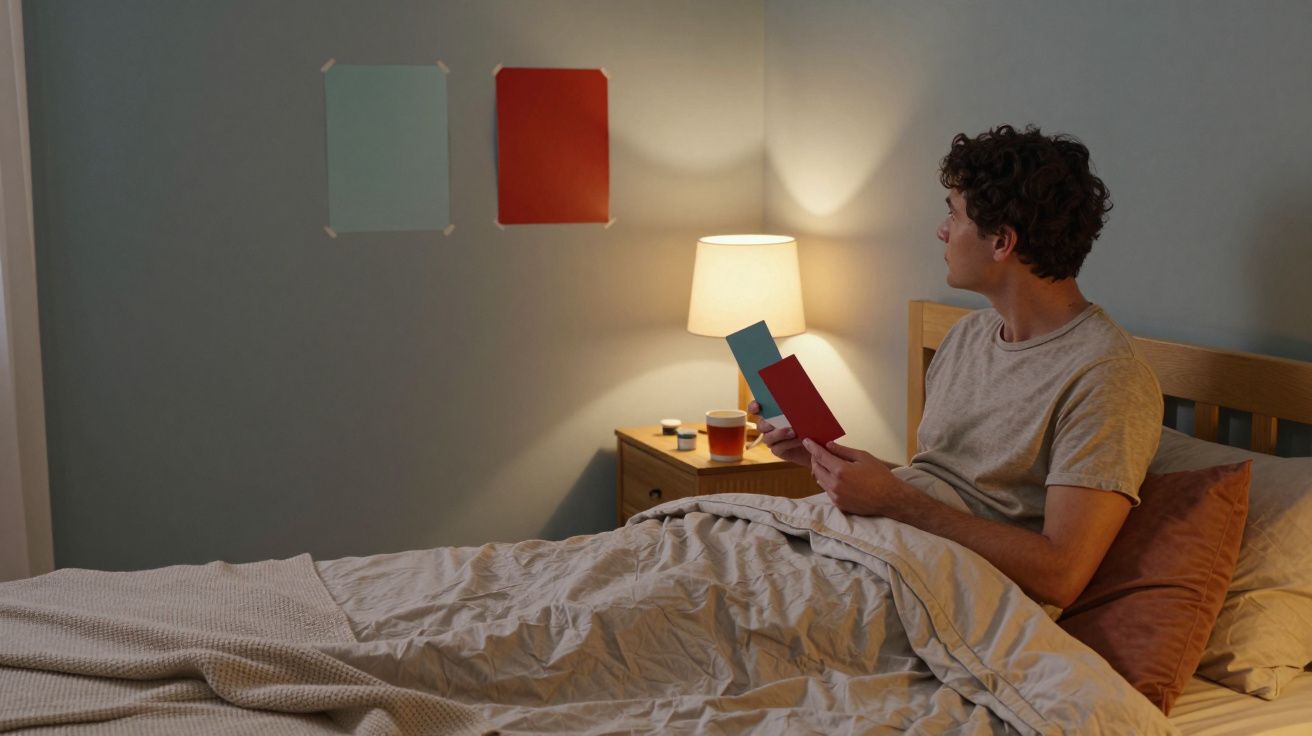
Before committing to any colour, try this small test. Print or paint a swatch about the size of a sheet of paper, tape it at pillow height on the wall opposite your bed, and:
- Look at it in bright daylight for 30 seconds, then close your eyes and notice what lingers. If you still see an after‑image, it’s probably too strong.
- Look at it under your usual bedside light at night. If your eye keeps snapping back to it, dial the saturation down.
- Do a 30‑second breathing exercise while facing it. If your breathing feels easier and slower, you’re in the right zone.
You don’t need perfect. You want “good enough that your brain forgets about it”. Real life will still come with late emails, neighbour noise, and the occasional midnight worry tour. Colour can’t erase that. It can just stop adding friction.
Here’s a quick guide to what the brain tends to like and dislike at bedtime:
| Colour family | Bedroom effect (typical) | Best use |
|---|---|---|
| Soft blue‑green / blue‑grey | Calming, lowers visual “volume” | Main walls, large surfaces |
| Warm neutrals (cream, stone) | Gentle, grounding | Ceilings, trims, wardrobes |
| Strong reds / hot corals | Stimulating, attention‑grabbing | Avoid on feature walls near bed |
Keep the calm without draining the character
A soothing room doesn’t have to look like a hotel lobby. You can still have prints, personality and that joy‑sparking cushion. The key is where you place the noise. Keep the big, vertical planes – walls, wardrobes, curtains – in that quieter palette, then let your favourites appear in smaller, movable pieces: a framed poster, a boldly patterned throw, a lamp with character.
Light and colour are a team. A beautifully chosen paint can feel wrong under a chilly, blue‑white bulb. Switch to warm, dimmable lighting and your soft blue‑greens and warm neutrals will do the calming job you picked them for. Let’s be honest: nobody remembers the exact paint name at 11 p.m. They remember whether the room feels like a landing pad or a to‑do list.
Tweak slowly. Start with bedding and bulbs, then a single wall, then the rest when time and budget allow. Each small change is a nudge that compounds: a brain that has to work less hard to ignore its surroundings has more space to let go of the day.
People love a “sleep hack”, and this one earns its place because it works while you do nothing at all.
FAQ:
- Do I have to paint my whole bedroom blue‑green? No. Using it on the largest wall or two is usually enough. You can keep wardrobes or trims in warm neutrals and still get most of the calming effect.
- Is all red bad in a bedroom? Small red accents in cushions or artwork are fine. The issue is big areas of saturated red, especially on the wall you face from the bed.
- What if I hate blue? Look for muted greens with a touch of grey, or soft taupes with a hint of green. The aim is low saturation and a cool‑leaning undertone, not one exact hue.
- Can wallpaper be calming too? Yes, if the pattern is soft, low‑contrast and not too busy. Large, high‑contrast prints can make the brain scan for “changes” all night.
- Does this matter if I fall asleep quickly anyway? Even fast sleepers can benefit. Calmer colours are linked with fewer micro‑awakenings and better rest quality over the whole night.


Comments (0)
No comments yet. Be the first to comment!
Leave a Comment