The crumbling village church hiding a Tudor wall painting under three layers of whitewash
It started with a flake.
Not a dramatic crack, not a fallen vault, just a thumbnail of plaster that pinged quietly onto the flagstones one Tuesday when the church was empty and the heating had finally wheezed off. The warden bent down with a sigh, expecting yet another crumb from the damp north wall. Instead, behind the tiny wound in the whitewash, something looked back. A curved line, dense and dark, too deliberate to be mould, too sure to be an accident. The village had lived alongside this wall for centuries. Nobody knew it was looking back.
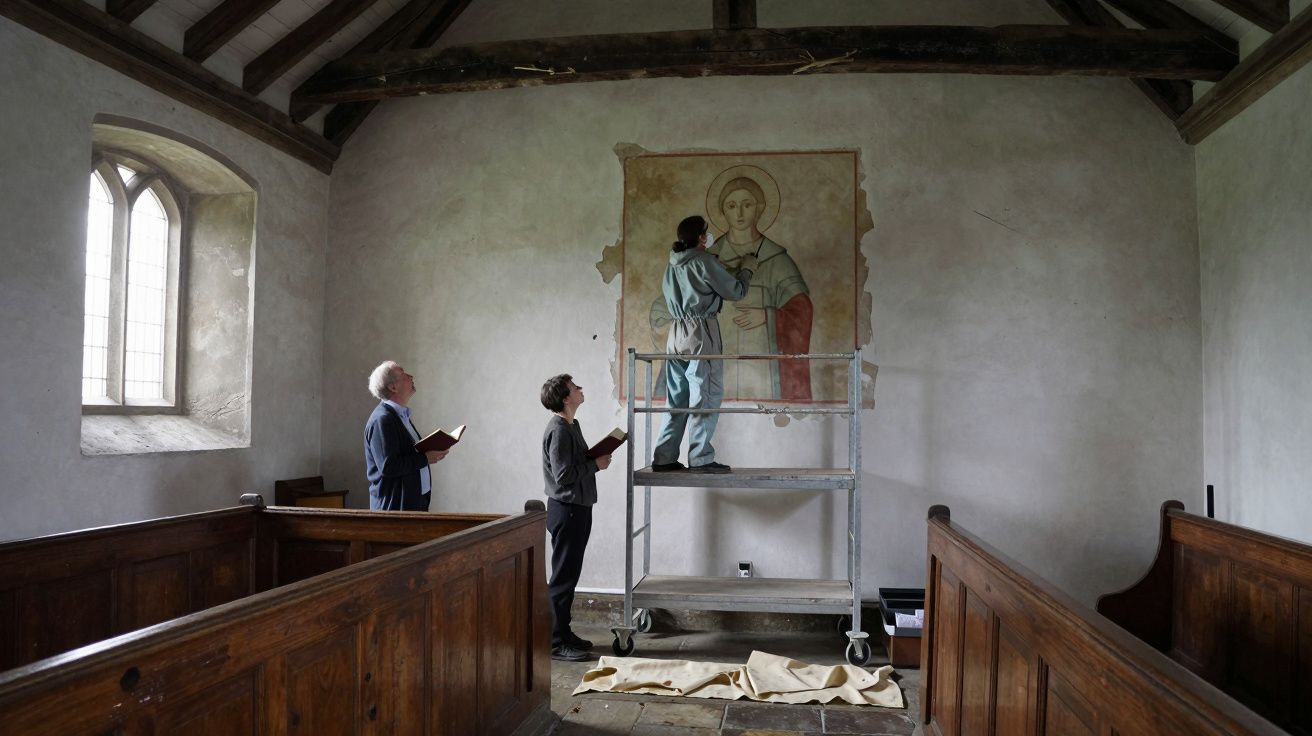
The next week, the scaffolding arrived, clanking through the lichgate under a sky the colour of pew dust. The conservation specialist climbed up with a torch, a palette knife and the caution of someone who knows that one careless scrape can erase five hundred years. What emerged, millimetre by millimetre, was not treasure in the usual sense. No gold, no jewel. Just a painted hand, then a fold of robe, then a Tudor face haloed in lime: a saint, or perhaps a donor, caught mid-gaze from a time when the village spoke to God in pictures as much as in words.
The revelation did not come with trumpets. It came with dust masks and soft brushes, with whispered instructions to “go slower” and “leave that edge”. The secret was not that some great masterpiece had been hiding in this crumbling church. The secret was that the story everyone thought they knew about this building had been painted over three times and left to harden.
Why medieval walls keep Tudor secrets
Village churches are not museums frozen in a single era. They are palimpsests, written over and over as politics, taste and theology shift. In the late medieval period, walls were crowded with colour: saints in vermilion, doom scenes above the chancel arch, vines and borders threading every spare inch. When the Reformation gathered pace, those same images became suspect. The quickest way to deal with suspect images was not to chip them off. It was to drown them.
Whitewash is lime and water with a hint of zeal. It obeys orders. In Tudor and early Stuart England, churchwardens armed with ladders and buckets obliterated painted saints by covering them, again and again, as fashions and injunctions demanded. Each coat sealed the one before more tightly into the wall. Later generations assumed the plainness was original. The colour slept on beneath three, four, sometimes five layers of pious forgetfulness.
There is a biology to it too. Limewash allows the wall to breathe, so the pigment beneath does not rot in the same way wallpaper might. The chemistry that was meant to erase actually preserved. Tiny fissures, damp patches and casual knocks can eventually disturb the upper coats, hinting at what lies below. To the untrained eye, it’s just another flake on a tired church wall. To someone who has seen this pattern before, it’s an invitation.
Our Tudor painting survived precisely because it was no longer wanted. Erasure, done in haste, became an accidental time capsule.
The slow art of uncovering a hidden painting
Revealing a wall painting is not like restoring a picture that hangs in a frame. You cannot take it down, turn it over, try again. The plaster is the canvas, and once it is gone, it is gone. The work looks slow from the ground because it is slow from the scaffold. Every square centimetre involves decisions you cannot reverse.
The method, in this church, began with mapping. Conservators tapped and listened, traced fine cracks, and used raking light to locate hollow spots where the upper lime might part from the lower layers. Only then did the scalpels and swabs appear. Water was introduced in pinhead amounts, softening the more recent coats just enough that they could be teased away without dragging the Tudor pigment with them. Progress was counted in fingers, not in feet.
People expect bright colours. What appears instead is usually muted, like a memory: iron reds, earth greens, blacks that started life as charcoal. Faces look both familiar and foreign, stylised yet oddly tender. Sometimes a banner’s Latin survives; sometimes only a shoe. The skill is knowing when to stop. Too little removal and the scene is illegible. Too much and you burn through the story into bare plaster.
“You don’t uncover a painting,” one conservator murmured, half to herself, “you negotiate with it.” The wall, bruised by centuries of damp and well-meant repairs, negotiates back.
From the nave, the vicar watched with an odd mix of possessiveness and detachment. Parishioners arrived between school runs to tilt their heads and ask the same questions: Who is it? How old is it? Can we keep it? The answers, like the work, emerged in layers.
Reading what the wall is trying to say
Once enough paint is liberated to make sense of the composition, the guessing game narrows. Clothing offers clues. A woman in a French hood rather than a wimple points to the 16th century. A particular type of border motif – grapes, oak leaves, Tudor roses – tethers the image to a fashion window of a few decades. The way the folds are drawn, even the errors in perspective, hint at whether the artist worked from a pattern book or from life.
In this case, the figure’s gown, square-necked and edged in black, spoke Tudor. The presence of a small, painted scroll bearing half a name suggested a donor portrait: a local family who paid for the wall and asked to kneel, forever, at the feet of a saint. The saint himself was only half there, a hand and a book surviving a later patch of plaster, perhaps where a crack had been patched long after the Reformation.
Parish records added texture. A 1540 churchwardens’ account listed “for paynting of ye north wall and ye story of Seynt Kateryn, iiis viid.” Another line, fifty years later, paid “for lyme to cover ye images.” Between those lines lies a silent reversal: money spent first to show, then to hide.
The wall does not give you everything. It offers fragments and asks you to live with not knowing. We can place the pigment, date the lime, posit the patron. We cannot hear the sermon that made the warden order the whitewash, nor the conversation in the pub when someone muttered that the saints looked too much like idols.
What a resurfaced painting changes in a living village
A Tudor painting doesn’t just alter the church. It alters how the village sees itself. For years, the north aisle was where draughts gathered, hymn books lurked, and the odd bat line appeared overnight on the stone. Overnight, it became a destination. Children were dragged in after school to “see what they’ve found”. Walkers on the long-distance footpath added a detour. Heritage officers phoned. Grant forms multiplied.
The building, which many residents knew mainly as a place that tolled inconveniently on a Saturday when football was on, now held a visible, delicate piece of the past. It was no longer just “old”. It was specifically old in a way you could point to. That specificity changes conversations about repair. A roof tile is no longer just a tile; it is a lid over a rare survival. Fundraising letters become easier to write when you can put a face – literally – in the first paragraph.
Something subtler happens too. Modern eyes, raised on bare plaster and white ceilings, suddenly meet colour in worship. The painted figure does not match every theology in the pews. Yet the fact of its survival softens absolutes. The church has been Catholic and Protestant, ornate and plain, crowded and almost empty. The wall holds all of those identities at once. People standing beneath it are harder to pretend that their own preferences are timeless.
“It makes you feel like a guest,” one regular said quietly, looking up. “Like we’ve borrowed this place from them for a bit, not the other way round.”
The painting also demands new habits. Sunlight must be moderated, damp monitored, heating cycles smoothed. The church’s to-do list shifts from ad hoc patching to long-term care. The past, once covered over, now sets the pace.
A simple framework for spotting (and saving) hidden stories
You do not need scaffolding to start seeing your local church differently. Most villages have at least one, and the clues are usually in plain sight if you know where to look.
- Scan the plaster, not just the windows. Discolouration, faint patterns, or repeated shapes under the whitewash can signal earlier schemes. Look especially around arches, over doorways and along north and south walls.
- Notice odd patches. Square or rectangular areas of different texture, particularly if they sit at eye level, may be later repairs hiding something beneath or above.
- Read the margins. Old guidebooks, parish magazines and even framed notes in the porch sometimes mention “traces of colour” or “indistinct figures”. Those phrases are easy to skip; they are also invitations.
- Ask, then act gently. If you see something suspiciously patterned, mention it to the warden or vicar rather than poking it yourself. A phone photo sent to a diocesan adviser can be more useful than a fingertip.
For the people who worship, dust, and chair AGMs in these buildings, the balance is delicate. They are responsible not just for Sunday, but for centuries.
Quick snapshot: hidden paintings in plain churches
| Clue | What it may mean | What to do |
|---|---|---|
| Faint red/brown lines under lime | Traces of text or borders | Photograph and flag to churchwarden |
| Patchy, thicker white areas | Overpainting or repair | Note position; could guide future surveys |
| Old mention of “colour” in guide | Prior spotting of pigment | Share with any visiting conservator |
What this changes when nothing dramatic seems to change
At the end of the works, the scaffolding left, the dust sheets were folded, and the church looked, to a casual passer-by, much as it always had. A slightly cleaner nave, a discreet rope barrier by the north wall, a new line in the leaflet. No sound-and-light show, no glass case. Yet the mood of the place had turned a degree.
The Tudor figure, half-erased and half-saved, does not fix the crumbling stonework or plug the hole in the heating fund. It does not swell Sunday numbers by a miracle. What it quietly does is refuse the idea that the past is tidy and distant. Here, in a village where the bus now comes twice a day if you’re lucky, is a painted hand from 1540 in mid-gesture, still reaching across lime and politics and neglect.
You do not need a total restoration to feel the shift. One uncovered square metre of pigment can change how a community walks into a building it thought it knew. Your church does not need a makeover; it needs a listening ear for the stories already set into its walls. That is the part guidebooks rarely tell you.
So next time you push open a heavy door in a lopsided porch, let your eyes linger where the plaster blisters. Put your tomorrow next to a piece of yesterday that refuses to stay hidden. Notice what changes in you when the wall begins, slowly, to speak.



Comments (0)
No comments yet. Be the first to comment!
Leave a Comment