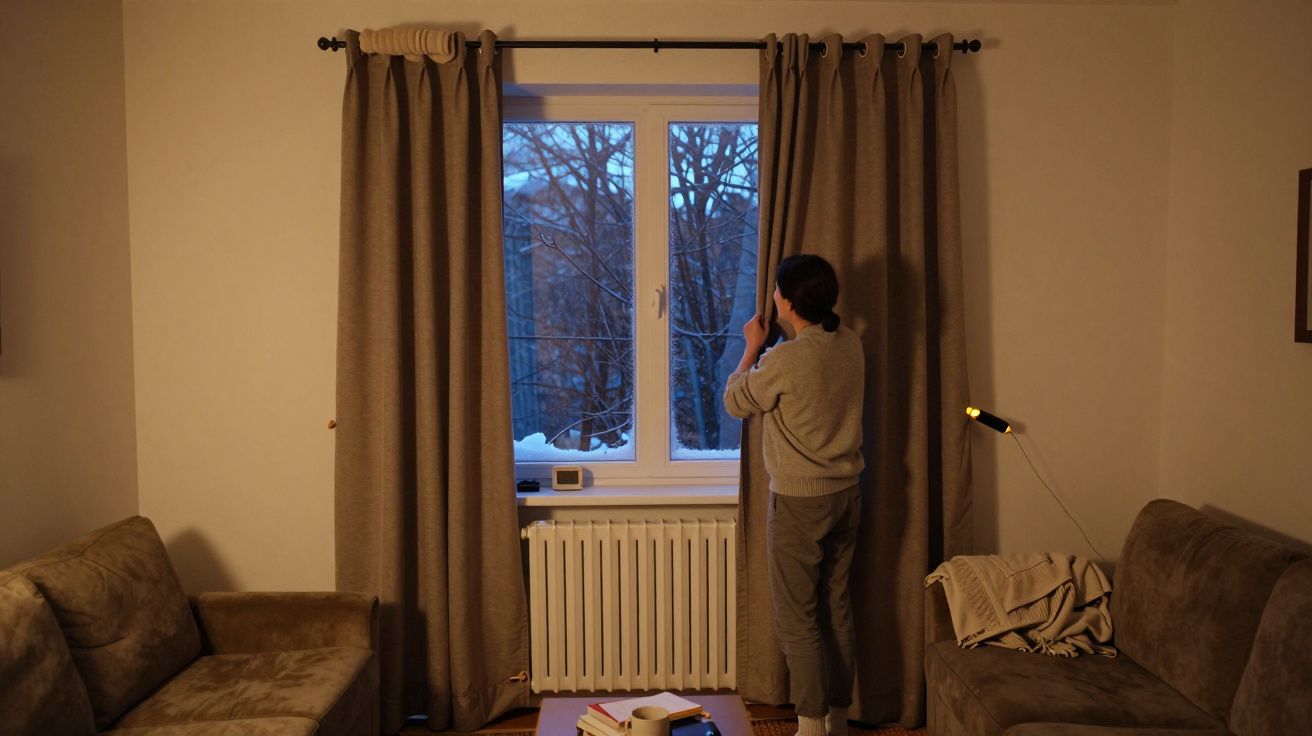
The curtain trick that keeps heat in at night without touching the thermostat, energy advisers say
The text came just after 10pm, as the wind picked up and the boiler clicked on for the third time in an hour.
“Is it true you can warm a room just by shutting curtains properly?” A friend had tagged an energy adviser on a community Facebook thread. Someone else replied with a photo of a curtain rail and three bulldog clips, like we were all about to sit an exam in soft furnishings.
On the surface it sounded daft. Bills are spiking, radiators feel lukewarm, and the official advice is… draw the curtains?
Yet when you talk to people who spend their days in cold homes with clipboards and thermometers, they say the same thing: the way you hang and close your curtains at night can mean the difference between waking up shivering, and waking up to a room that still feels vaguely human.
It isn’t magic. It’s physics, fabric and a five‑minute tweak.
The hidden cold leak behind your curtains
Stand next to a window on a still winter night and you can feel it - that slow, sneaky chill pouring off the glass. Even in newer homes with double glazing, windows are usually the coldest surface in the room. Warm air hits them, cools, sinks, and slides along the floor as a faint draught. Over hours, your room quietly empties its warmth into the dark.
Most of us assume curtains are binary: open in the day, closed at night, job done. But if they’re hung too short, too narrow, or floating a few centimetres off the wall, they create a kind of cold chimney. Air slips behind the fabric, cools against the glass, then spills back into the room. You’ve installed what looks like insulation but behaves like a slide for heat to escape.
One adviser described a late‑Victorian terrace where the living room never climbed above 16°C unless the heating was on full blast. The culprit wasn’t the boiler; it was a pair of fashionable eyelet curtains ending halfway down the radiator. Warm air from the rad shot straight up the glass and out into the night, like money in steam form.
The fix cost less than a takeaway.
The “seal and drop” curtain trick explained
Energy teams have a nickname for it: “seal and drop”. The idea is simple. You aren’t just closing the curtains; you’re turning them into a loose, padded seal around the window so warm air stays in the room and cold air stays trapped behind the fabric until morning.
Three things matter more than the fabric itself:
- Width – curtains should overlap the window frame on both sides, ideally by 10–20cm.
- Drop – they should fall to the sill or just below, not stop above a radiator or halfway down the wall.
- Seal – at night, you lightly close the gaps at the top, sides and bottom, so air can’t loop easily behind.
In practice, that can look wonderfully low‑tech. One housing officer keeps a pack of wooden clothes pegs in his bag. He clips curtains together where they meet in the middle, pinches them to the wall at the sides with adhesive hooks, and tucks the bottom edge onto the sill or behind a piece of furniture. Ten minutes later, the room’s temperature curve on his little monitor changes shape.
“We’re not adding heat,” he says. “We’re stopping it falling out of the window.”
The next morning, that living room in the terrace was a degree or two warmer than the hallway - with the thermostat untouched.
How to do it in your house tonight
You don’t need to bin your existing curtains or order anything bespoke. Start with what’s already on the rail and make it work harder. Then, if budget allows, you can upgrade the fabric later.
Here’s the quick version advisers use on home visits:
- Close as soon as it’s dark. Don’t wait until bedtime. The drop in outside temperature starts early; the earlier you trap the warmth, the better.
- Make them overlap. If your curtains only just meet, slide each a little past the centre so the fabric overlaps instead of gaping.
- Pinch the sides. Use:
- Command‑style hooks and a bit of string,
- Drawing pins on a wooden frame,
- Or even heavy furniture pulled slightly across the edge. The aim is to reduce the side gaps where you can see daylight or feel a chill.
- Anchor the bottom. Rest the hem on the window sill, a radiator shelf or the back of a sofa, or lightly tape the bottom edge to the wall on very cold nights. You’re trying to stop cold air spilling under.
- Block the top gap. If there’s a big space above a pole, a rolled towel or draught excluder on the rail shelf can stop warm air shooting behind the curtain.
If you have radiators under windows - common in UK homes - the rule is slightly different. You want warm air from the radiator in the room, not trapped fully behind fabric. Aim for curtains that:
- Hang just to the top of the radiator, not past it, or
- Can be tucked behind a shelf above the rad, creating a warm pocket that still leaks heat into the room, not the glass.
It can feel fussy the first night. By the third or fourth, the routine takes under a minute.
Why this works without costing a penny more
Curtains are simply soft insulation. The more still air you trap between fabric and glass, the better that insulation becomes. What “seal and drop” does is stop that trapped air from constantly being replaced with newly cooled air sliding down the window.
In energy‑speak, you’re reducing convection currents and thermal bridging at the window line. In plain English: you slow the loop that carries heat from your radiator to the glass, and from the glass to the street.
Studies on lined and well‑fitted curtains suggest they can cut heat loss through a window by 15–25%. Add a snug fit and a bit of DIY sealing, and advisers regularly see room temperatures holding a degree or two higher by morning. That doesn’t sound dramatic until you remember each degree you nudge the thermostat costs money.
If your room loses heat more slowly overnight, you can:
- Set the thermostat lower before bed, or
- Start the heating later in the morning,
and still feel roughly as comfortable. No app, no new boiler, just less of your paid‑for warmth slipping through the glass at 3am.
Small add‑ons that quietly boost the effect
Once the basic trick’s in place, there are a few low‑cost extras advisers mention again and again. Think of them as upgrades when you have £10–£40 spare, rather than urgent must‑buys.
- Thermal or fleece linings. Clip‑on or iron‑on linings add weight and insulation to existing curtains without replacing them.
- Secondary glazing film. Clear shrink‑film kits over the frame cut draughts and condensation, then curtains seal over the top.
- Roman blinds plus curtains. A tight‑fitting blind inside the recess, with curtains outside, creates a double barrier.
- Draught excluders on the sill. A sausage‑dog draught excluder or rolled blanket along the sill under the curtain hem stops cold leaks at the bottom of old frames.
None of this will turn a single‑glazed bay into a Passivhaus. It will stop it feeling like the inside of a fridge every morning.
“People expect some fancy gadget,” says an energy advisor in Newcastle. “But curtains, doors and gaps are where a lot of the easy wins live.”
Quick reference: where this helps most
| Where | Why it matters |
|---|---|
| Old bay windows | Big glass area, often single‑glazed, huge overnight losses |
| Bedrooms over garages | Floors and windows both leak heat; curtains slow one of them |
| North‑facing rooms | Little solar gain, so any trapped warmth is precious |
How to tell if your curtain set‑up is working
You don’t need smart sensors, though they help. Your own skin and a cheap thermometer do the job.
On a cold, dry night, try this:
- About an hour after the heating goes off, take a room temperature reading away from windows and doors.
- Close the curtains using the “seal and drop” method.
- In the morning before the heating comes on, check the temperature in the same spot.
- Next night, repeat with curtains left looser, or open as a comparison.
Most people see a difference of at least 0.5–1°C. In poorly fitted or very thin curtains, tightening the seal can hold temperatures 1–2°C higher than the “loose” night.
More telling is how the air feels when you step near the window. If that invisible waterfall of cold air down the glass turns into a faint, distant coolness behind the fabric, you’ve changed the physics of the room enough to notice.
And that, in a winter where every whirr of the boiler feels loaded, is exactly the point.
“We can’t promise lower bills from one trick,” says a retrofit coordinator in Bristol. “But we can make the heat you’ve already paid for stay put for longer.”
- Tools to hand: pegs, tape, spare hooks, a rolled towel, a cheap thermometer.
- Words that help: “draughts”, “curtain overlap”, “thermal lining”.
- Red flags: curtains stopping above the radiator, narrow panels that don’t cover the frame, big gaps at the top.
What this says about staying warm this winter
There’s a quiet comfort in realising some of the most effective tricks don’t involve new tech or complex grants. They’re the sort of things a grandparent might have done without a spreadsheet: close up early, tuck fabric around gaps, keep the heat where the people are.
The “curtain trick” won’t fix a faulty boiler, and it won’t solve mould in a damp wall by itself. It won’t erase the sharp rise in unit prices or the fear that lands with each bill. What it can do is tilt the balance a little in your favour, night after night, with habits that cost almost nothing.
Maybe that’s how we get through this patch: not just with big retrofits and policy shifts, but with small, shared tweaks. A neighbour’s tip about pegs on curtains. A text reminding someone to close up before dark. A degree saved here and there, so the thermostat doesn’t have to shoulder it all.
FAQ:
- Will closing curtains make my windows damp or mouldy? If a window is already prone to condensation, sealing heavy curtains very tightly can increase moisture on the glass. Leave a small gap at the top or side on wet nights, and open curtains fully each morning to let the area dry out. Ventilating briefly in the day helps balance warmth and moisture.
- Does this still help if I have modern double glazing? Yes. Newer windows lose less heat, but they are still colder than the room air. Well‑fitted curtains and blinds reduce that loss further, which is noticeable overnight in bedrooms and living rooms.
- Is it better to keep curtains open if the sun is shining? During winter days, yes: let sunlight in to warm the room, especially on south‑facing windows. Close curtains as soon as the light fades and outdoor temperatures start to drop, to trap that free heat inside.



Comments (0)
No comments yet. Be the first to comment!
Leave a Comment