
The “future diary” tool that helps teens with exam stress feel more in control of their lives
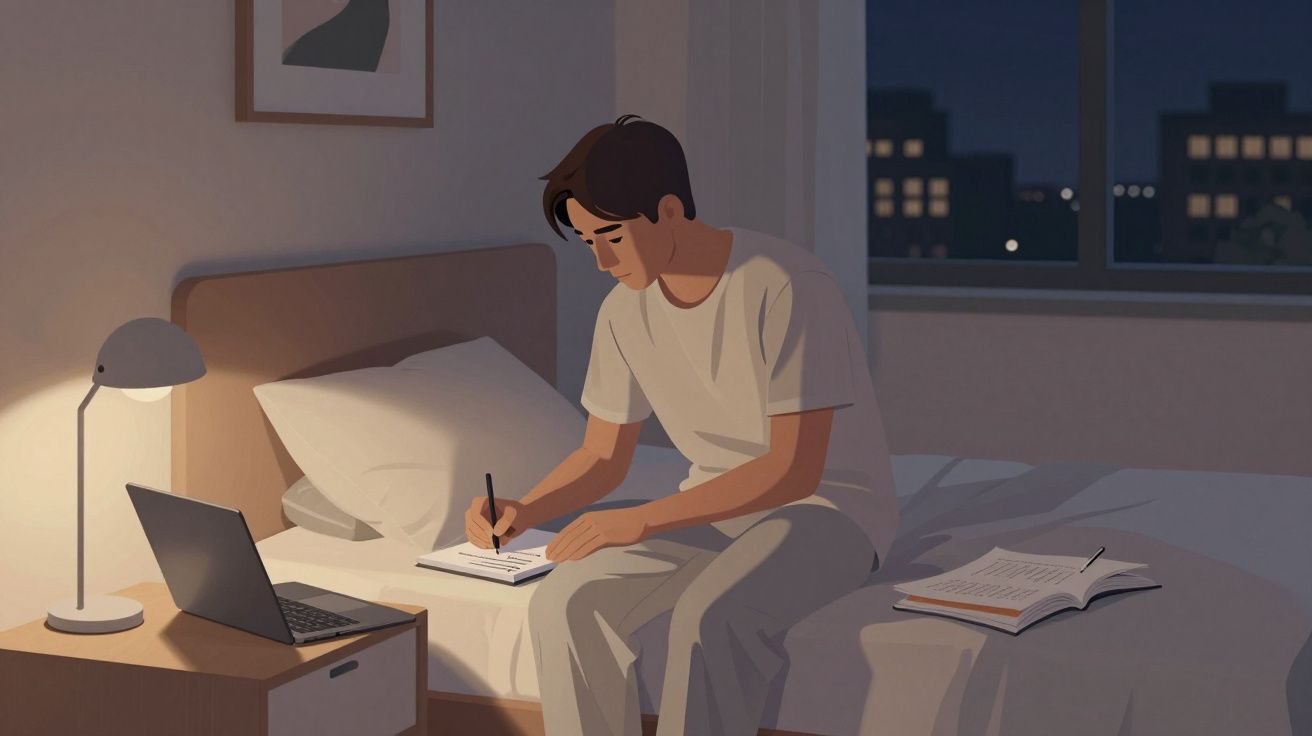
The idea sounds almost daft at first: ask a stressed‑out teenager to write about a day that hasn’t happened yet, in a notebook they barely have time to open. Teachers worry it’s “one more thing” on a crowded timetable. Parents picture a child already drowning in homework, now expected to keep a journal. Yet a small A5 booklet, trialled in a few British schools this year, is changing how some teens talk about exams, sleep and the future they think they’re failing at.
Tuesday afternoon in a South London classroom, the blinds half‑drawn against a low sky, thirty Year 11s sat with biros hovering over blank pages titled “A day in my life, one year from now”. The room was unusually quiet for the last period. One boy wrote about waking up and not checking his phone straight away. A girl at the back drew a quick sketch of an ID pass on a lanyard, then wrote “college” underneath. A pastoral lead walked the rows, watching shoulders drop a fraction. No mindfulness bells, no breathing app. Just a clear invitation: imagine something that feels believable and kind, then write it down. What happened next surprised the adults more than the kids.
The day a “future diary” made mocks feel smaller
Most schools now have some version of “exam stress support”: assemblies about revision, posters about sleep, the odd wellbeing workshop squeezed between maths interventions. What they rarely have is time for teens to think about what happens after the results slip. The future diary flips the usual script. Instead of “revise harder or else”, it asks them to picture a day when exams are over and life has moved on, even if the grades were messy.
One Year 10 described walking the dog at 7.30am “because I’m not revising any more, I just walk him”. Another wrote themselves at college, catching a later train and eating a bacon roll from the same café every Thursday. When a psychologist involved in the project asked how writing it felt, a boy in a black hoodie shrugged and said, “It’s like… not the end of the world if I flop one paper, innit. There’s other bits.” Hidden inside that throwaway comment is the shift the tool aims for: from looming catastrophe to a future with more than one door.
Early research on similar “future self” exercises suggests they can help teenagers connect present actions to longer‑term goals while softening all‑or‑nothing thinking. The diary entries don’t have to be noble or grand. They just have to be concrete. “I get up at eight, I make tea, I wear my grey hoodie, I check the bus times” does more psychological work than “I will be successful”. It gives the brain something to step into, instead of a fog labelled “later”.
“We’re not asking them to manifest their dream life,” one school counsellor told me. “We’re asking them to notice that there is a life.”
How the “future diary” actually works in school
The tool itself is simple enough to fit in a book tray. Each booklet holds a handful of guided pages:
- one “future day” a year from now, written in the present tense
- a shorter “next month” entry about a normal weekday
- prompts about what the teen is proud of in that future, and what helped them get there
- a small section to list “future problems” they handled, and how
Sessions start with a brief explanation: this is not homework, not marked, and not for a teacher to red‑pen. Staff invite pupils to imagine waking up on an ordinary good‑enough day in the future, then walk through sensory prompts-what they see, smell, hear on the bus, who messages them. Phones stay away; the focus is on writing or drawing by hand. Most classes spend 20–25 minutes on the first entry, then revisit the diary once or twice in the term as exams approach.
Crucially, the diary is not a wish list. It is framed as “a future that could realistically happen in more than one way”. A student who wants to study medicine might write about being on a campus wearing a lab coat, but also notes an apprenticeship path or a different course. Staff are trained to gently nudge away from brittle fantasies (“I’ll be a millionaire influencer”) towards grounded scenes (“I’m in a studio editing three videos I’m proud of”). They’re also told not to correct spelling or neatness. The point is ownership, not presentation.
Practical snags appear quickly. Some pupils hate writing and draw little cartoon panels instead. Others write one line and stop, saying they “can’t see that far”. In those cases, teachers reduce the distance: “Describe next Tuesday after mocks” often feels less threatening than “Next year”. Over time, the pages fill not only with plans but with tiny admissions: “I thought I failed maths but I passed”, “I didn’t get into my first choice but my second is actually better”. Those sentences land like pressure valves.
Why picturing “after exams” calms “right now”
At first glance, the diary looks like a feel‑good exercise glued on top of serious pressure. The deeper logic lies in how stress works in teenage brains. Under high threat, the future narrows to one track: “If I don’t get these grades, everything is ruined.” That thought slams the body into fight‑or‑flight and makes revision either frantic or impossible. The diary quietly introduces plural futures. It says, “More than one OK thing can happen from here.”
What matters is not a guarantee of success but a sense of agency. When a teen writes “I’m emailing my tutor about resitting” or “I’m checking apprenticeship listings” in their imagined day, they see themselves doing something in response to difficulty, not just being hit by it. Psychologists call this “procedural control”: knowing there are actions you can take when things wobble. It tends to drop anxiety faster than repeating “I will be fine” ever does.
The act of writing also slows rumination. Instead of the same catastrophic reel looping at 2am, the brain rehearses a more detailed script. “I get my results, my stomach drops, I go for chips with my mates, then I talk to Miss about options” isn’t glamorous, but it is survivable. That’s the emotional work the diary is doing: quietly training the idea that problems can be coped with rather than erased.
“The future stops being a brick wall and becomes a corridor with doors,” as one educational psychologist put it.
Bringing the tool home without turning it into homework
Parents often ask for copies of the booklet, then panic about “doing it wrong”. The home version works best when it looks low‑stakes and a bit scruffy, not like an official programme. A plain notebook, a quiet half‑hour, and a hot drink on a Sunday can do most of the work. The key is to avoid interrogating or improving what your teenager writes.
If they’re up for it, you might suggest one of three quick prompts:
- “Write about a normal Thursday this time next year, like it’s happening now.”
- “Imagine the evening after you get your results. What do you actually do from 5pm to bedtime, however it went?”
- “Pick a small thing Future You is proud of that isn’t about grades. Describe it.”
Offer to write your own future day alongside them-some parents sketch “a day when the house is a bit calmer” or “my first day not checking the school app 14 times”. The shared act matters more than the content. Resist the urge to correct unrealistic bits in the moment. If your child writes themselves at an elite university with no plan of how to get there, you can park that and later talk gently about different routes to similar feelings (independence, study, new friends).
For teens who shut down at the word “future”, shrink the scale. Ask them to imagine “three weeks from now” or “a Saturday in half term once these mocks are done”. Let them include naps, gaming and meeting friends. A believable, slightly nicer near‑future often unlocks the longer view more effectively than yet another lecture about careers.
A quick guide to using a future diary
| Step | What you do | Why it helps |
|---|---|---|
| Set the frame | Emphasise it’s private, not marked, and not binding | Reduces performance anxiety |
| Keep it concrete | Focus on times, places, small actions | Makes the future feel real, not abstract |
| Revisit lightly | Look back once or twice, tweak if they want | Shows futures can change without collapsing |
When it’s not enough on its own
No notebook can untangle a teenager’s life if they are facing serious illness, family crisis or deep depression. Some young people will write frightening futures, or none at all. In trials, a minority used the pages to describe self‑harm or not being alive next year. For staff, that became a crucial signal to step in, not a failure of the tool. In homes, the same rule should apply: if what you glimpse on the page scares you, it’s a prompt for support, not a scolding about “being negative”.
Signs that the diary exercise is backfiring include:
- futures that are only about escape or disappearance
- absolute language like “nothing gets better” across pages
- visible distress during or after writing that doesn’t settle
In those cases, pressing on with more future‑talk can feel like pushing against a locked door. The kinder move is to acknowledge that the exercise feels too much and to offer other routes-time with a trusted adult, a GP appointment, or school counselling. The diary is a tool, not a test of resilience. Opting out is allowed.
For many others, though, a few pages of imagined mornings and bus rides quietly shift the weather. Exams stay important, but not sacred. A bad paper becomes a plot point, not a final scene. Somewhere in a drawer or rucksack, a thin booklet waits, reminding them they have at least half a say in what happens next.
FAQ:
- Does a future diary replace proper revision or pastoral support? No. It works best alongside clear revision plans, sleep routines and, where needed, professional help. Think of it as scaffolding for motivation and perspective, not a study method on its own.
- What if my teenager writes a future that seems wildly unrealistic? Let them finish without interruption, then later explore the feelings underneath it. You can work together to find realistic paths to similar experiences without mocking or dismissing their vision.
- How often should they update their diary? Many schools find that two or three sessions over a term are enough. At home, revisiting it once a month, or after a big milestone like mocks, keeps it alive without turning it into a chore.





Comments (0)
No comments yet. Be the first to comment!
Leave a Comment