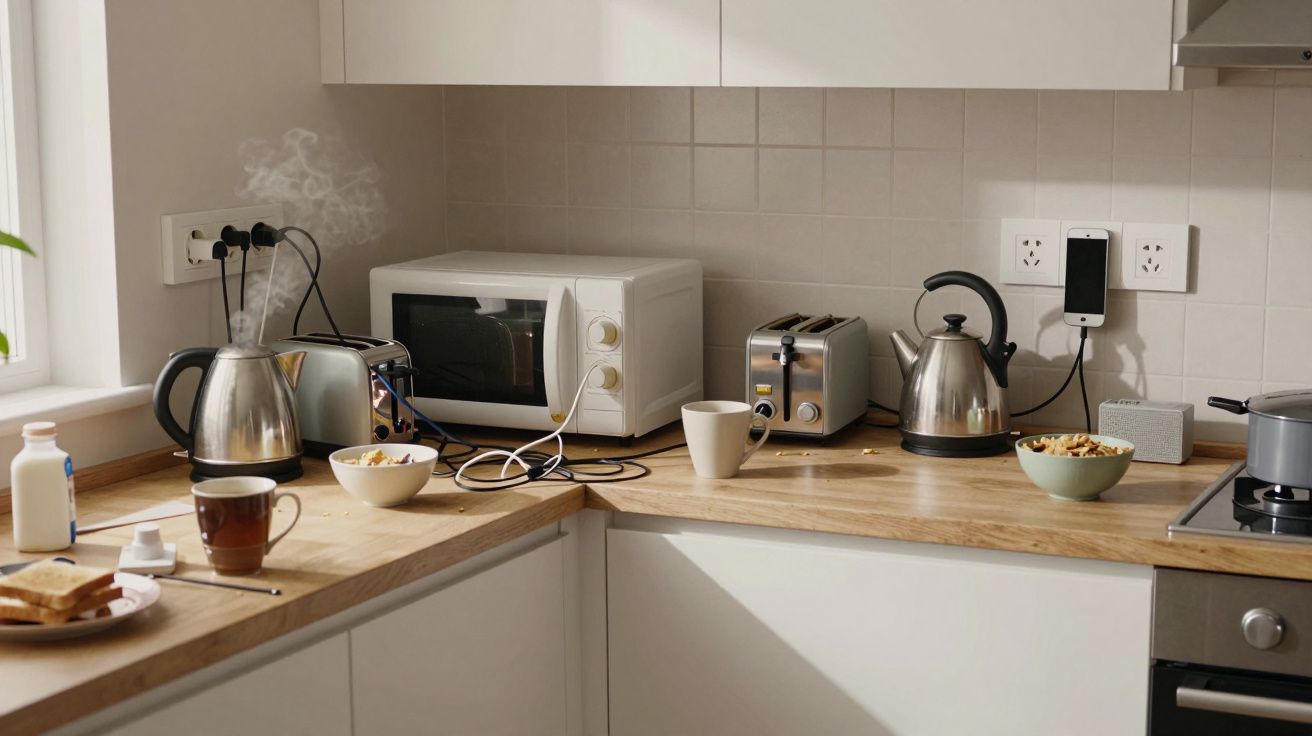
The kitchen socket electricians say should never host multi‑plug adapters
The kettle clicks on, the toaster drops, someone jabs the microwave for “just 30 seconds” and the dishwasher hums in the background. On paper, it is a normal breakfast. On the wall, it is a single double socket carrying the load of half a small café - thanks to a chunky white adapter with every hole filled.
In living rooms, multi‑plug adapters are mostly an eyesore. In kitchens, they can be a fire waiting for an invitation. Ask a working electrician which outlet makes them wince, and they will point to the same place: that convenient double socket above the worktop, usually the one under the cupboard by the kettle. The one that ends up feeding everything.
Something about that spot invites bad habits. It is the closest to the kettle lead, nearest the toaster, often home to a coffee machine, blender, air fryer or slow cooker. When plug space runs out, many people simply add more - cubes, strips, stackable adapters - without stopping to ask whether the wiring or the breaker cares about our breakfast ambitions.
The worktop double socket that quietly takes the strain
Most UK kitchens are wired so that multiple sockets share the same ring or radial circuit, protected by a 30–32A breaker. Each double socket on that run is typically rated for 13A per outlet, but in practice many families treat one as a “main hub” and plug everything in there, via adapters and extensions. The wiring inside the wall might be fine. The plastic block on the counter is not.
Think of it like a busy junction on a B‑road. The road itself can handle traffic, yet a tiny mini‑roundabout squeezes everyone through one narrow gap. A kettle alone can draw close to 3kW, a toaster around 1.5–2kW, an air fryer another 1.5–2kW. Add a microwave, and your “little adapter” is being asked to juggle far more heat than its moulded pins and thin copper tracks were ever meant to carry.
“It’s not the ring main that fails first, it’s the cheap plastic hanging off it,” says a Manchester‑based electrician. “Burned adapters above the worktop are one of the most common things I’m called to replace.”
Flex leads soften, housings discolour, and suddenly that faint fishy smell you ignored last week was the insulation complaining. The danger rarely announces itself with drama until very late in the day.
Why high‑load appliances and adapters do not mix
High‑wattage kitchen appliances pull heavy current in short, intense bursts. They also tend to live close together, used at the same time in the same morning or dinner rush. That combination makes stacking them on a single socket via multi‑plug adapters particularly risky.
Here’s the blunt physics. More current through a tight, imperfect connection equals more heat. Adapters and cheap extension blocks introduce:
- Extra joints and screws that can loosen with time and vibration.
- Thin internal metal strips instead of proper 13A terminals.
- Plastic bodies that trap heat and are often tucked behind appliances.
Layer in grease, steam and crumbs, and the environment around that socket is already harsher than in a bedroom or hallway. A tiny loosened connection that would merely warm up elsewhere can become a hot spot in a kitchen, quietly baking itself until the plastic deforms.
A rule many electricians quietly live by: if it boils water, browns bread, blasts heat or spins a motor hard, it deserves its own 13A outlet, not a shared plastic adapter. That means kettles, toasters, air fryers, microwaves, dishwashers, tumble dryers and washing machines all get direct wall sockets, with no multi‑plug units in between whenever possible.
The safer way to power a busy kitchen
You do not need a full rewire to make your kitchen friendlier to the wiring behind it. You do need to move away from the mindset that every problem can be solved by “just one more adapter”.
Electricians often suggest a few simple shifts:
- Use extension leads sparingly - and intelligently. If you must extend, choose a good‑quality, fused extension strip with its own 13A plug and built‑in overload protection, and keep it away from sinks and hobs. Never daisy‑chain strips or plug an adapter into another adapter.
- Prioritise high‑load appliances. Give kettles, toasters, air fryers and microwaves their own sockets where you can. Low‑load kit (phone chargers, smart speakers) can share a quality extension, but not the same one feeding a toaster.
- Spread the load along the worktop. Move the coffee machine or blender to a different double socket rather than piling everything into the most convenient one. A small shift in habit can halve the stress on a single outlet.
- Retire tired adapters. Yellowed, cracked or loose multi‑plugs have done their time. If plugs wobble in the faceplate or you notice warmth, buzzing or smells, that is a stop sign, not a quirk.
For homes mid‑renovation, adding more fixed sockets along the worktop is one of the best small upgrades you can make. It is dull, invisible work that pays you back every day you do not think about it.
Simple checks you can do in under five minutes
You do not need tools to spot the early warning signs that a kitchen socket is doing too much. Take a slow lap of your counters when the room is quiet and notice how everything is powered.
Look for:
- Multi‑plug adapters or cube blocks sitting in a worktop socket with more than two high‑load appliances connected.
- Adapters or strips that feel warm to the touch after use, even if the wall faceplate stays cool.
- Cables that snake behind ovens or hobs, where heat can harden and damage insulation.
- Plugs that have to be forced into a socket, or that sag and wobble when you let go.
If you find any of these, rearrange what you can straight away. Move one heavy appliance to a different socket, unplug what you do not use daily, and bin anything that looks damaged or flimsy. None of this fixes bad wiring behind the plaster, but it does remove the most common surface‑level triggers for trouble.
“Most kitchen fires I investigate could have been dodged with a ten‑minute tidy of plugs and a decent extension,” notes a London electrician who does insurance reports. “People underestimate what breakfast does to a socket.”
Quick reference: what belongs where?
| Appliance type | Best practice for sockets |
|---|---|
| Kettle, toaster, microwave | Direct wall socket, no multi‑plug adapter |
| Fridge / freezer | Dedicated wall socket, left alone |
| Phone chargers, radios etc. | Can share a quality fused extension |
From “just handy” to genuinely safe
Convenience is powerful. You only buy that first multi‑plug adapter because a lead is short or someone added a new gadget. Months later, it is part of the scenery, feeding a small forest of black and white cables, and the original problem is forgotten.
Making the kitchen safer is less about fear and more about small, boring wins: an extra double socket added where you actually use it, a retired cube block, a decision that the air fryer will live across the room because the wiring over there can share the work. None of this feels heroic.
Yet every time you ask “does this really need an adapter?” before you plug in, you trim the odds in your favour. The socket that electricians quietly dread - that overworked double above the worktop, buried under plastic add‑ons - becomes just another outlet doing the job it was designed for. And your breakfast can stay the most exciting thing happening in your kitchen.
FAQ:
- Which socket should never have a multi‑plug adapter? The busy kitchen worktop socket that already feeds high‑load appliances like kettles, toasters or microwaves. Those items should go directly into the wall, without adapters stacked in between.
- Are extension leads always dangerous in kitchens? No, a good‑quality, fused extension used for low‑load devices and kept away from sinks and hobs is generally fine. The risk rises when you run multiple high‑wattage appliances through one block.
- How can I tell if a socket or adapter is struggling? Warm plastic, discolouration, a fishy or melting smell, buzzing, or plugs that feel loose are all warning signs. If you notice them, unplug and get it checked.
- Is it worth adding more sockets? Yes. Spreading appliances across more fixed outlets is one of the simplest ways to reduce overload and cut fire risk, especially during kitchen refits or redecorations.




Comments (0)
No comments yet. Be the first to comment!
Leave a Comment