The little-known way to stack your freezer drawers so food never gets buried and wasted at the back
The waste usually starts with good intentions. You batch‑cook a chilli, freeze the extra, promise Future You a smug week of easy dinners. Three months later, you’re chipping an unlabelled red brick from the back of the bottom drawer, no memory of what it is or when it went in. The freezer didn’t fail. The system did.
Most “organising hacks” for freezers stop at “use tubs” and “label things”. Helpful, but not enough. The real shift comes when you stop treating the freezer like a cold cupboard and start treating it like a tiny archive with rules. One simple stacking method changes how you see what you own so nothing quietly dies under a crust of ice.
The core idea: files, not piles
Stand at your freezer and picture it as a filing cabinet. You’re not stacking bricks; you’re storing folders that need to be visible edge‑on. The trick is to flatten almost everything you freeze, then slot it in vertically in “lanes” instead of tossing it in flat as random layers.
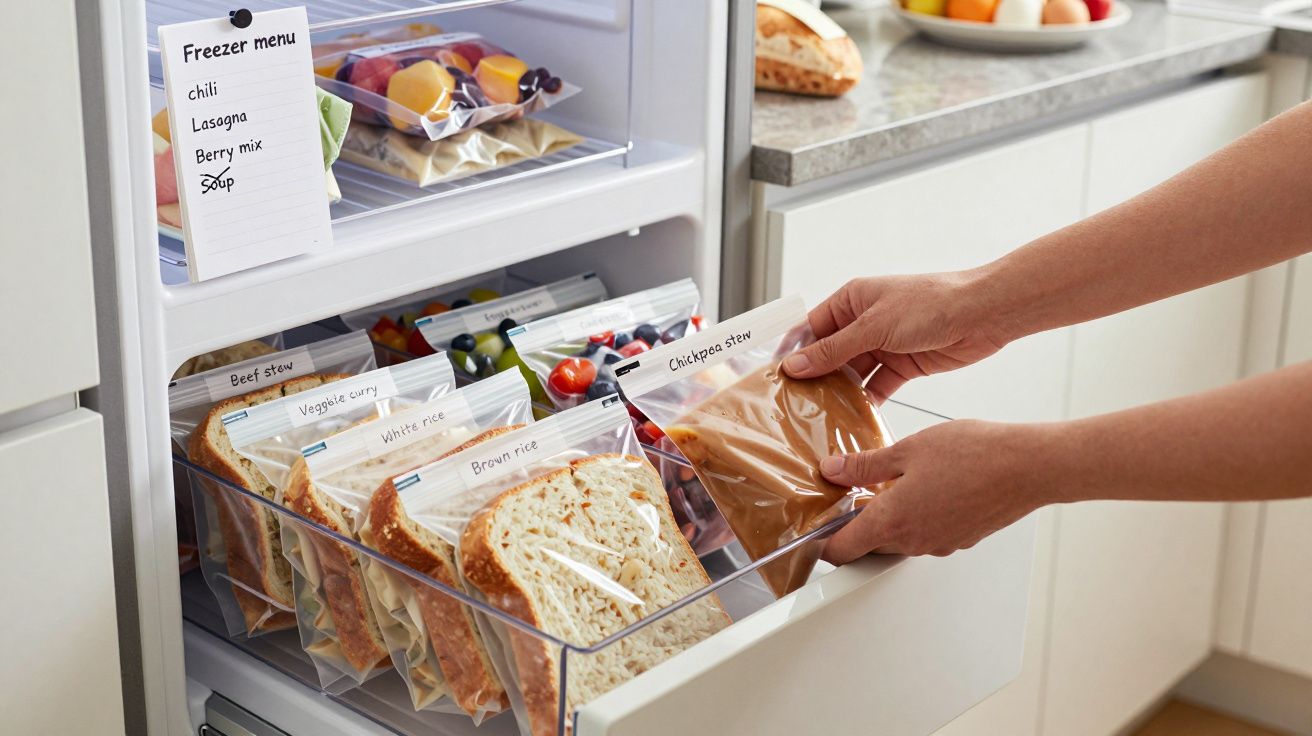
This is the thin‑bag, vertical‑file method. Leftovers, sauces, cooked grains, even chopped fruit go into freezer bags laid flat to freeze in slim slabs. Once solid, they stand upright like books on a shelf. You stop digging because there is nothing to dig under; you simply flick through the “spines”.
It feels fussy the first week. Then you realise you’re finding what you want in seconds and you’ve stopped buying your third bag of peas “just in case”.
Step by step: how to build a no‑waste freezer stack
Start with one drawer, not the whole freezer. Empty it, sort anything obviously ancient or frosted beyond recognition into the bin or food waste, and keep only what you’d be happy to eat this month. You’re not just tidying; you’re resetting the rules for what earns space.
Now create lanes. Each drawer should hold only 2–4 clear categories, front to back:
- Front: “use this week” items – open bags, leftovers, bread.
- Middle: everyday building blocks – veg, cooked grains, stock, portions of meat or fish.
- Back: long‑term projects – batch‑cooked stews, sauces, muffins, frozen fruit.
Flatten anything freezable into a bag: ladle in, squeeze out the air, seal, then lay it on a baking tray or chopping board in the freezer until rigid. Label the edge with a marker – name + date – because that’s what you’ll see when it stands up. Once frozen, stand it vertically in its lane. Two minutes extra at the start saves ten minutes of excavating later.
“Don’t let anything go in without an exit plan: a date, a label and a place,” as one professional organiser likes to tell clients.
The drawer “zoning” formula that keeps things visible
Most UK freezers are narrow, three‑drawer stacks. That shape almost forces chaos unless you give each layer a job. A simple template:
- Top drawer: quick‑grab and fragile items
Ice cream, herbs, berries, bread, open chips, ice cubes, ready meals for emergencies. - Middle drawer: tonight’s dinner and weekly staples
Pre‑portioned meat and fish, flattened leftovers, cooked rice, stock slabs. - Bottom drawer: bulk and baking
Batch‑cooked meals, large joints, extra veg, pastry, muffins, frozen fruit for smoothies.
The lanes run front to back inside those jobs. In a middle drawer, for example, you might have:
- Left lane – cooked carbs and grains (rice, quinoa, pasta).
- Centre lane – cooked dishes (curries, stews, casseroles).
- Right lane – raw proteins (chicken thighs, salmon portions, mince).
When something new goes in, it joins the back of its lane, like a queue. When you plan a meal, you shop from the front. You’ve just built a first‑in, first‑out system without a spreadsheet in sight.
The tools that make it work (and the stuff you can skip)
You do not need bespoke freezer crates in four pastel colours. A few inexpensive pieces make the vertical‑file system much easier:
- Medium‑strength freezer bags (label the edge).
- A permanent marker that actually writes on cold plastic.
- A flat tray or chopping board that fits your drawer for freezing slabs.
- Optional: a couple of open bins or file organisers to hold vertical bags upright.
Rigid containers still have a place. Soups and runny sauces behave better in tubs, especially if you’re worried about leaks. Just avoid huge boxes that eat space and force stacking. Go for shallow, rectangular ones that can sit at one side of a lane like hardback books among paperbacks.
Things to skip:
- Round tubs that waste corners.
- Random ice‑cream tubs with no consistent size.
- Mystery foil parcels that you never label “because you’ll remember”.
You will not remember. Label anyway.
Example: a “filed” middle drawer in practice
Here’s how a real‑world drawer can look once stacked as files, not piles:
| Lane | What goes here | Why it helps |
|---|---|---|
| Left | Cooked rice, quinoa, mashed potato slabs | Instant sides; no clumpy bags |
| Centre | Curries, chillies, stews, pasta sauces | Clear “grab and heat” dinners |
| Right | Raw chicken, fish, mince (portioned) | Easy to defrost one meal at a time |
Each slab shows its name and date along the top edge. When you open the drawer, you see a row of titles like a bookshelf. If a date is older than 3–6 months, it becomes this week’s priority before anything new goes in.
The “freezer menu” habit that stops duplicates
Hardware alone does not prevent waste. You also need a way to remind yourself what is there without opening drawers three times a day. That’s where a tiny freezer menu earns its spot.
Stick a magnetic notepad or small whiteboard on the freezer door or nearby. Each time you freeze a new item, write:
- The category (e.g. “Stews”, “Fish”, “Veg”).
- The exact food (e.g. “Veg chilli x2”, “Salmon portions x4”).
- The date, or at least the month and year.
When you use something, cross it off. Once a week, preferably before you shop, glance at the list and pick two or three things to base meals around. Let the freezer dictate a couple of dinners instead of the supermarket.
It sounds dull. It also removes the moment in the aisle when you stand in front of the chicken, unable to remember whether you have any left at home. Your list answers for you.
“Your freezer is already meal prep. You’re just learning to ask it what’s for dinner,” as one dietitian frames it to clients.
- Update the list before things go into the drawer.
- Use simple codes: “C” for cooked, “R” for raw, “V” for vegetarian.
- Star anything that needs using within a week.
Tiny rules that keep the system alive
The little‑known bit is not just the way you stack. It is the set of boring, repeatable rules that protect the stack from sliding back into chaos.
Borrow these and tweak:
- Nothing goes in without a label and date. Not leftovers, not bargain yellow‑sticker chicken, not “obvious” bread.
- Keep one “use me first” box at the front of the top drawer. Anything nearly at its best‑by or older than 3–6 months lives there until it is gone.
- Stick to your lanes. Chips creeping into the stews lane is how chaos begins.
- Freeze in meal‑sized portions. Half a loaf sliced, not a whole brick; two chicken thighs per bag, not eight.
- Schedule a five‑minute freezer check each month. Bin what is clearly beyond help, reshuffle lanes if your cooking changes.
You are not aiming for Pinterest‑perfect drawers. You are aiming for a freezer where you can answer, in under ten seconds, “What could I eat from here tonight?” without guilt or frostbite.
FAQ:
- Does this work with tiny under‑counter freezers? Yes. In small drawers, vertical filing is often easier because you simply cannot stack high. Flattened bags and one or two small bins turn even a single drawer into three clear lanes.
- Are freezer bags bad for the environment? Reusable silicone bags or rigid tubs are ideal if you can afford them, but even standard freezer bags used carefully and washed for re‑use beat throwing away kilos of food. The biggest environmental win is cutting waste.
- How long can I actually keep food in the freezer? Properly wrapped food is safe much longer than it tastes good. As a rule of thumb, aim to use cooked meals within 3–4 months, raw meat within 3–6, and bread within 1–3 for best flavour and texture.
- What if my freezer is a frost‑free model that reshuffles things when it hums? Frost‑free types blow air around but do not have to undo your system. Use open bins or file organisers to keep vertical bags in place so they do not slide backwards.
- I hate batch cooking. Is this still worth it? Yes. Even if you only ever freeze spare portions from normal dinners and a few basics like bread and peas, filing them vertically and zoning drawers will still save money, time, and the odd unpleasant surprise at the back.



Comments (0)
No comments yet. Be the first to comment!
Leave a Comment