The new playground rule dividing parents: “silent zones” for prams and phone calls
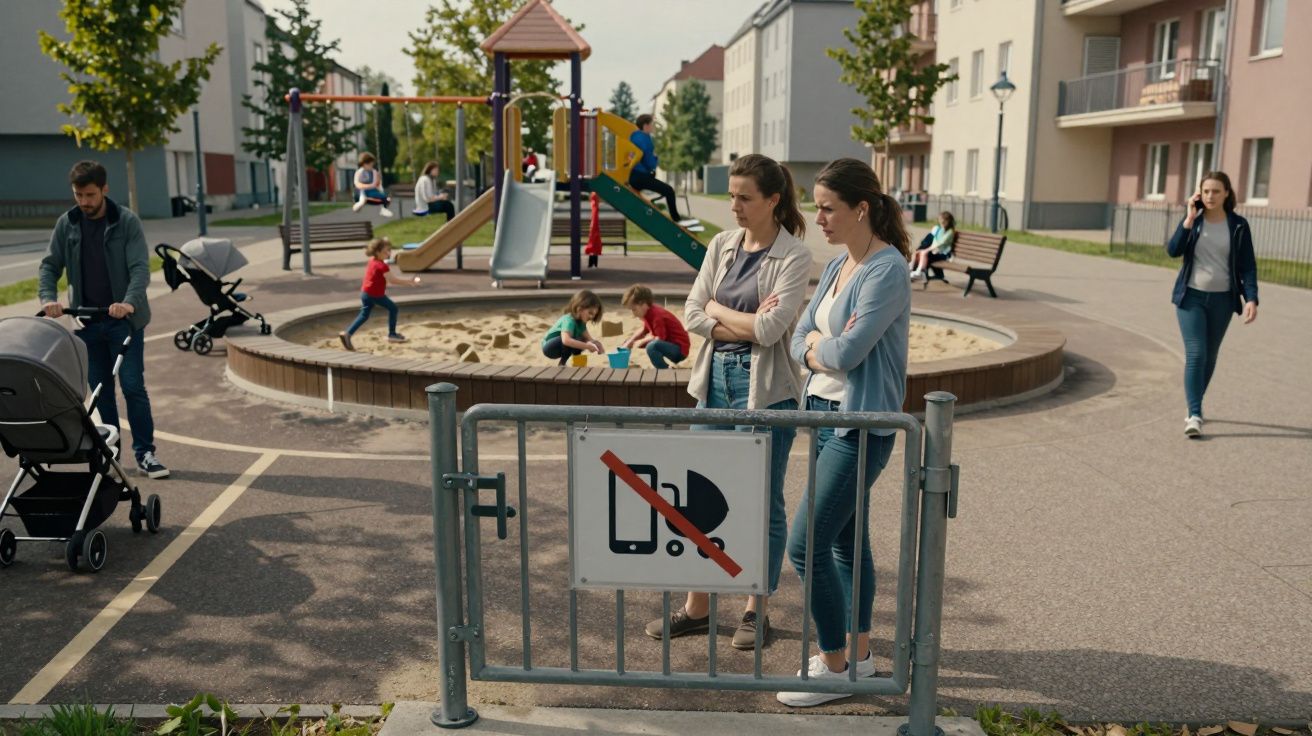
The notice went up on a Tuesday, laminated and slightly crooked on the park gate. Next to the familiar dog-on-a-lead icon, a new symbol: a buggy with a red crossed‑out phone. Underneath, in polite council type: “Quiet Area – Please keep prams and phone calls away from the central play zone.” By the sandpit, a dad with twins steered his double pram right up to the rope, hesitated, then backed away. A woman on a work call paced the path, earbuds in, steering an invisible loop around the swings.
On the bench, two mums read the sign twice. One nodded, saying it might be nice if the kids could “just hear each other for once”. The other laughed, jabbing at the laminated edge with a finger. “What are we meant to do,” she said, “hover at the perimeter like Uber drivers?” The children squealed through it all, oblivious. It felt as though the adults had been given a new rule in a game nobody remembered agreeing to play.
When noise meets nap times
On paper, the logic sounds simple: little kids benefit from calmer spaces, adults speak more kindly when they are not shouting over ring tones, everyone shares the park. In real life, it is messier. Prams are not just transport; they are mobile bedrooms and storage units. Phones are not just distractions; they are how people co‑parent across postcodes, manage shift work and catch the GP before lunch. One person’s peace is another person’s only chance to call the bank.
Talk to playground regulars and a pattern emerges. There is the baby who will only nap if the pram keeps moving, the toddler who melts down if they cannot see their parent, the carer who juggles three pick‑ups and one elderly relative on the same cracked path. The new “silent zones” ask them to orbit the play equipment instead of mingling inside it. The idea is to shrink background noise. The risk is that it shrinks something else: the sense that the playground belongs to everyone, prams and all.
Councils say they are responding to complaints. Residents in flats overlooking pocket parks report conference calls drowned out by Bluetooth speakers. Some parents say older children struggle with sensory overload when adults cluster at the climbing frame, screens glowing and notifications pinging. Others argue that the real problem is not volume but courtesy; the parent FaceTiming at full blast next to the baby swings, the podcast played out loud on a bench. A sign about prams and phone calls is a blunt tool for fine‑grained frustrations.
What “quiet zones” actually ask of parents
Strip away the symbols and the ask is modest: keep prams parked just outside the core play area, and move phone calls to the path or a different bench. No one is fining someone for checking a text by the slide. It is the long, loud, adult‑centred moments that organisers are trying to push to the edges: a twenty‑minute sales call conducted under the monkey bars, a group chat on speaker while toddlers negotiate the seesaw.
For some, that is a welcome nudge. Parents of neurodivergent children say a lower adult soundscape can make the difference between a manageable visit and a bolt for the gate. Grandparents with hearing aids describe the relief of not competing with six separate ring tones while trying to supervise a three‑year‑old at the top of a rope tower. The children, some argue, should be the noisiest thing in the playground.
But not all families arrive with two free hands and a silent phone. A single mother on a zero‑hours contract may have to accept her next shift on the spot or lose it. A father arranging a handover with an ex‑partner cannot always step away out of earshot. A carer doing remote work from a bench cannot write “out of office” every time the swings beckon. For them, each extra rule feels less like thoughtfulness and more like a quiet message: this space is not really designed with your life in mind.
How to share a playground without turning it into a library
Ask people what would actually help and the answers are surprisingly practical. Clearer zoning is high on the list. A ring of benches and buggy bays around the equipment, rather than inside it, gives adults a natural place to pause without blocking slides or clustering under the only shade. If there is a dedicated “chat corner” with seats, bins and a decent view of the sandpit, most conversations will drift there by default.
Soft social cues work better than scolding signs. A simple line about “keeping long calls and loud music away from the central play area” sets a tone without pretending anyone can parent on airplane mode. One London park has tried painting a thin blue line on the tarmac with small icons: prams and phones on one side, balls and scooters on the other. There are no fines, just a visual hint that the inner circle is for play first.
If you need a calm‑first checklist for your local playground, use this as a quick‑start:
- Put buggy parking and shaded benches just outside the main equipment zone, not in the middle of it.
- Phrase signs around behaviour, not blame: “Please move long calls away from the swings” beats “No phones”.
- Encourage one low‑noise corner for naps and feeds, away from the loudest kit.
- Ask regular users, including childminders and grandparents, what would actually make things easier.
- Make any rule clearly time‑limited if it is a trial, and publish contact details for feedback.
Banning things outright rarely builds community; nudging habits often does. A park that explains the “why” – children who get overwhelmed, residents who work nights – will get more goodwill than one that simply announces a quiet zone and waits for compliance.
What this row says about parenting, public space and who gets to be loud
Playgrounds sit at the crossroads of private lives and public norms. They are where sleep schedules, divorce arrangements, home‑working and housing density all become suddenly visible on the same patch of rubber matting. A laminated sign about prams and phone calls is simple. The stories behind it are not. The real question is not whether children deserve calmer spaces; it is who we expect to absorb the cost of providing them.
In a country where more adults are working from laptops on benches, where multi‑generational households spill into parks for air and where not every family owns a garden, the local playground has become office, meeting room and living room as well as adventure zone. Rules written for a mythical “average” parent with a landline and a stay‑at‑home schedule bump into parents paying for data by the gigabyte and answering emails between pushes on the swing.
A better pattern is possible: design spaces that anticipate phones and prams, rather than pretending they do not exist. Make room for naps without freezing out work. Spell out expectations, but leave space for judgement when a call really cannot wait. If someone still paces the slide tower on speakerphone, perhaps the question is not only “why are they so rude?” It is also “what small, practical choices did the rest of us make – or not make – to give courtesy an easy place to land?”
FAQ:
- Are “silent zones” for playgrounds legally enforceable?
Usually not. In most UK parks, signs about quiet areas are advisory rather than backed by fines, unless linked to broader by‑laws about antisocial behaviour.- Can a council actually ban phones in a play area?
Councils can set local rules, but an outright phone ban would be difficult to enforce and potentially challengeable. Most stick to guidance on considerate use.- What if my baby can only nap in the pram near me?
A reasonable interpretation of any “quiet zone” is that short stays and essential care are allowed. If staff challenge you, explain the situation and ask where they would prefer you to park.- How do I complain about or support a new rule?
Check the sign for a council email or QR code, or contact the parks department. Specific feedback about what works or does not in daily life carries more weight than general grumbling.- Could our local playground try a different approach?
Yes. Friends‑of‑the‑park groups, PTAs and resident associations can propose alternatives: clearer layouts, buggy bays, or time‑limited quiet hours instead of blanket rules.





Comments (0)
No comments yet. Be the first to comment!
Leave a Comment