The one smoke alarm test most households forget to perform each month
The beep came from the hallway at 2.17am. Not the piercing wail of a full alarm, just a single, sulky chirp every forty seconds. In the dark, half asleep, the temptation was obvious: shut the door, stick a pillow over your head, deal with it “tomorrow”.
By breakfast, the chirp had somehow faded into the general noise of the house. Kettle, radio, school bags, emails. Someone tapped the alarm casing with a broom, someone else muttered something about batteries, and then the day carried on.
What almost no one in that house did – and what most homes skip as well – was the quietest, most revealing check of all.
Not the big red “test” button.
The nose test.
The blind spot in our monthly checks
Most fire services now push the same simple advice: press the test button on each alarm once a month. It is a good habit. It proves your battery has power and the sounder still screams on command. The problem is that it is not the whole story.
The test button sends an electronic signal straight to the alarm’s horn. It does not reliably test the sensing chamber, that tiny, dust-prone space that actually smells smoke or “sees” particles. An alarm can happily beep on button press, yet stay stubbornly silent when real smoke brushes past its vents.
That gap between “it beeps” and “it really detects smoke” is where many households live, reassured but not actually protected.
Manufacturers know this, which is why the small print almost always mentions a different, less publicised step: a monthly functional test with smoke itself. A controlled wisp, not a room full of fumes. Done right, it feels ordinary, almost boring.
Done wrong – or not at all – it shows up the day you most need that alarm.
What the “nose test” actually is (and how to do it safely)
The nose test is not about filling your kitchen with burning toast every four weeks. It is a short, deliberate exercise: presenting a trace of smoke or test aerosol to the alarm so that the sensor, not just the circuitry, has to react.
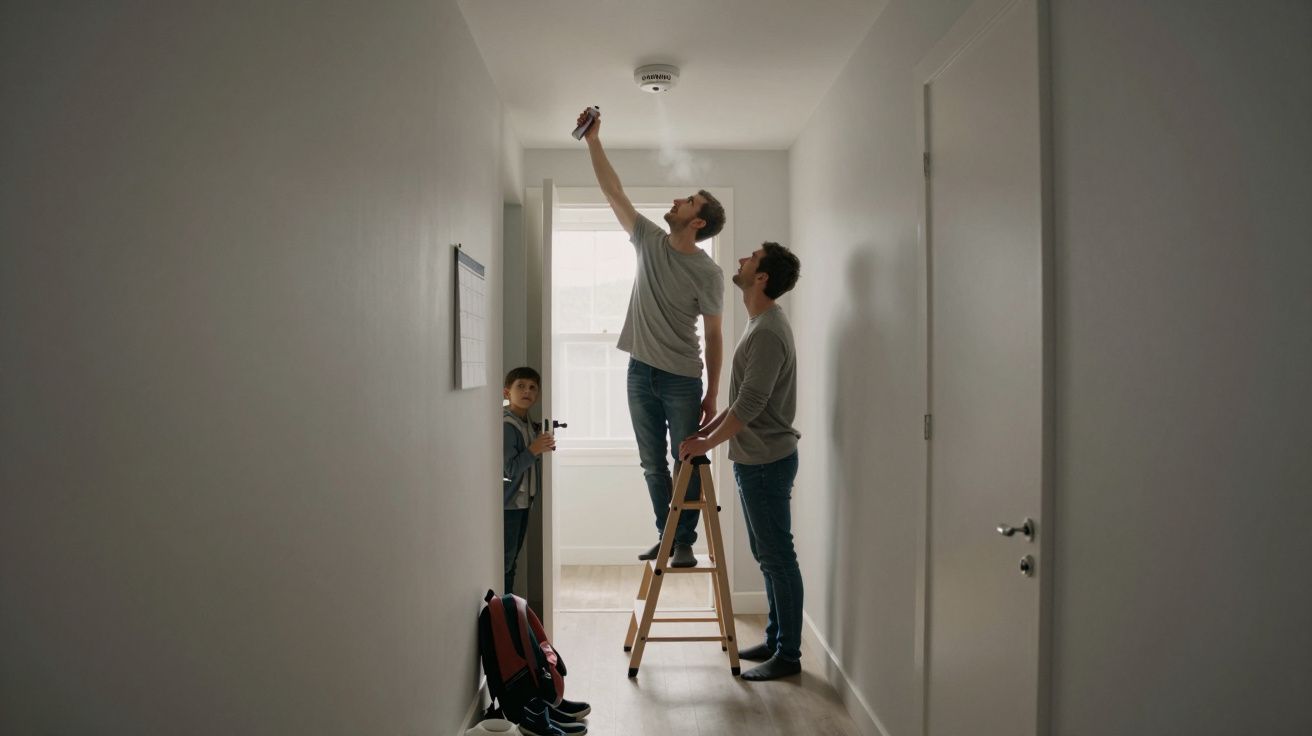
For most homes, the safest way to do this is with a dedicated smoke alarm test spray. You stand on a stable chair, hold the can at arm’s length, and direct a quick puff towards the vents. Within a few seconds, the alarm should sound, loudly and fully. After you silence it, you open a window, let the air clear, and move on.
Fire services still see two frequent missteps:
- People wave a lit match directly under the alarm, too close and too hot.
- Others run a pan dry on the hob “just to see”, triggering the extractor fan and half the street.
A good rule of thumb is simple. You should never need an actual flame or a dangerous situation to confirm that your detector can smell trouble. If you cannot get hold of test spray, a single just‑blown‑out match or candle held 30–50 cm below the alarm for a few seconds is enough. Any closer and you are flirting with heat damage instead of a clean test.
Think of this as asking the alarm to do its real job for three seconds, under your supervision, not in the middle of the night while you are asleep.
The quiet enemies: dust, steam and “nose blindness”
If the test button checks the alarm’s voice, the nose test checks its sense of smell. That sense dulls in very ordinary ways.
Fine dust from DIY, spider webs in the corners, steam from long showers, greasy kitchen air drifting down the hallway – all of it creeps into vents and settles on sensors. Over months and years, that film forces the alarm to work harder to recognise the same amount of smoke. Sometimes it starts to false alarm at the slightest toast crumb; sometimes it tips the other way and barely reacts at all.
In many homes, people respond to nuisance beeps by disabling the most sensitive unit. They take it down “just until we’ve finished cooking”, or wrap it in cling film before a bit of sanding, and forget to reverse the trick. The alarm that used to shout too often slowly becomes the one that never shouts at all.
A monthly functional test breaks that cycle. If the alarm triggers quickly on a small, safe puff of test spray, you know its “nose” is still awake. If it hesitates or stays mute, you catch the problem in daylight, with time to clean, replace or reposition it.
There is a psychological layer too. We get used to tiny signs that something is off – the faint dust ring around the ceiling base, the paint splatter covering half the grille – and stop seeing them. The moment you stand directly under the alarm with the specific intention to make it react, you start noticing those quiet enemies again.
Turning one more test into a habit you’ll keep
Adding the nose test to your routine only works if it fits the way you actually live, not the way a brochure imagines you should.
One family in Leeds ended up tying it to their calendar “rent day”: every first of the month, they log in to pay, check bank accounts, and then do a circuit of the flat. Press test button, quick puff of spray, quick visual check. It takes under five minutes. The noise is predictable, the children know what to expect, and neighbours are warned with a brief note through the WhatsApp group.
Another household pairs it with an existing ritual: the first big food shop of the month. While bags sit on the kitchen floor, one person pops a step stool under each alarm and runs the full sequence. If a unit is slow to respond, it immediately goes on the list with milk and washing‑up liquid.
These routines share three traits:
- They are anchored to something that already happens.
- They are written down, not just “remembered”.
- They make one person clearly responsible, even if others help.
The aim is not perfection; it is predictability. An alarm that is properly tested eleven months out of twelve is still far better than one that was last proven to “smell” smoke when it left the factory.
A simple checklist for the test most people skip
You do not need specialist gear to get started, just a step stool and a few calm minutes. A typical monthly run‑through might look like this:
- Choose a time when everyone is awake and at home.
- Open one window in each room where you will test, so the spray clears quickly.
- Stand on a stable chair or step (never on a swivel chair or wobbly stool).
- Press the test button first to confirm power and sound.
- Give a short burst of smoke alarm test spray towards the vents from 30–50 cm away, or pass a just‑extinguished match under the alarm at the same distance.
- Wait for the alarm to sound, then silence it according to the manufacturer’s instructions.
- If there is no response after a few seconds, repeat once. If it still stays silent, note the location and plan a replacement the same day.
- When you are done, log the date somewhere visible – on the fridge, in a shared app, or on the back of a cupboard door.
For homes with interconnected alarms, expect several units to sound at once. That is precisely what you want during a real incident, and a useful rehearsal of how loud things will be.
If you have anyone at home who is hard of hearing, this test window is also the right moment to check their vibrating pad, flashing beacon or linked pager, not just the ceiling units.
What this “forgotten” test really buys you
On paper, the benefit is obvious: more chance that your alarms will actually respond to real smoke, not just light up politely when a finger pokes them. In practice, the gains are more subtle.
Households that do a functional test tend to discover older or poorly placed alarms sooner. They notice that one unit in the steamy bathroom corridor always reacts later than the one over the landing and start asking why. They catch that brittle, yellowed plastic casing that quietly announced, years ago, that the alarm was at the end of its life.
They also give themselves one small rehearsal a month of what a real alarm sounds like, where it echoes, how fast people can move to open doors and windows. Children who grow up with that controlled noise are far less likely to freeze the first time it happens in anger.
On an emotional level, this is not about living in fear of a house fire. It is about turning something abstract – “we’re probably fine” – into something you have actually seen work with your own eyes and heard with your own ears.
| Check | How to do it | Why it matters |
|---|---|---|
| Test button | Press until alarm sounds | Confirms power and sounder |
| Visual inspection | Look for dust, paint, age label | Spots obvious faults and expired units |
| Smoke “nose” test | Use test spray or safe smoke source | Proves the sensor still detects smoke |
FAQ:
- Do I really need test spray, or is burnt toast enough? A dedicated smoke alarm test spray is safer and more controlled than deliberately burning food or overheating pans. In a pinch, a just‑extinguished match or candle held at a distance works, but avoid big, messy smoke sources.
- Won’t frequent smoke tests damage the alarm? Used as directed, test spray or brief exposure to light smoke once a month will not harm a modern detector. Continuous or very dense smoke, or direct exposure to flames, can cause damage and should be avoided.
- What if my alarm doesn’t sound during the nose test but beeps with the button? That is a warning sign. Try gently vacuuming around the vents, then retest. If it still fails to react to smoke, replace the unit; the sensor may be degraded even if the electronics are alive.
- How often should alarms be replaced entirely? Most manufacturers recommend replacing smoke alarms every 8–10 years, even if they still pass button tests. The date of manufacture is usually printed on the back or side of the unit.
- Is it normal for all my interconnected alarms to go off together when I test just one? Yes. Interlinked systems are designed so that if one detector senses smoke, the others sound too. Your monthly nose test is the perfect time to confirm that chain reaction still works.


Comments (0)
No comments yet. Be the first to comment!
Leave a Comment