The pensioner who found a WWII diary under her floorboards – and why archivists call it “a once‑in‑a‑decade glimpse”
The phone line crackled the way it only does in old houses. On one end, a 79‑year‑old in Derbyshire was trying to explain to a council officer that there was “a book” under her floorboards. On the other, someone was picturing a mouldy notebook and a minor repair job.
It was not a repair job. It was a life, pressed into pencil and ink, hidden for eighty years in a strip of dust between joists.
By the end of the week, a university archivist was standing in that front room holding the diary in gloved hands, breathing shallowly so as not to stir the brittle paper. Within a month, the same archivist would be calling it “a once‑in‑a‑decade glimpse into how an ordinary British street actually lived the war”.
The afternoon a loose board changed a story
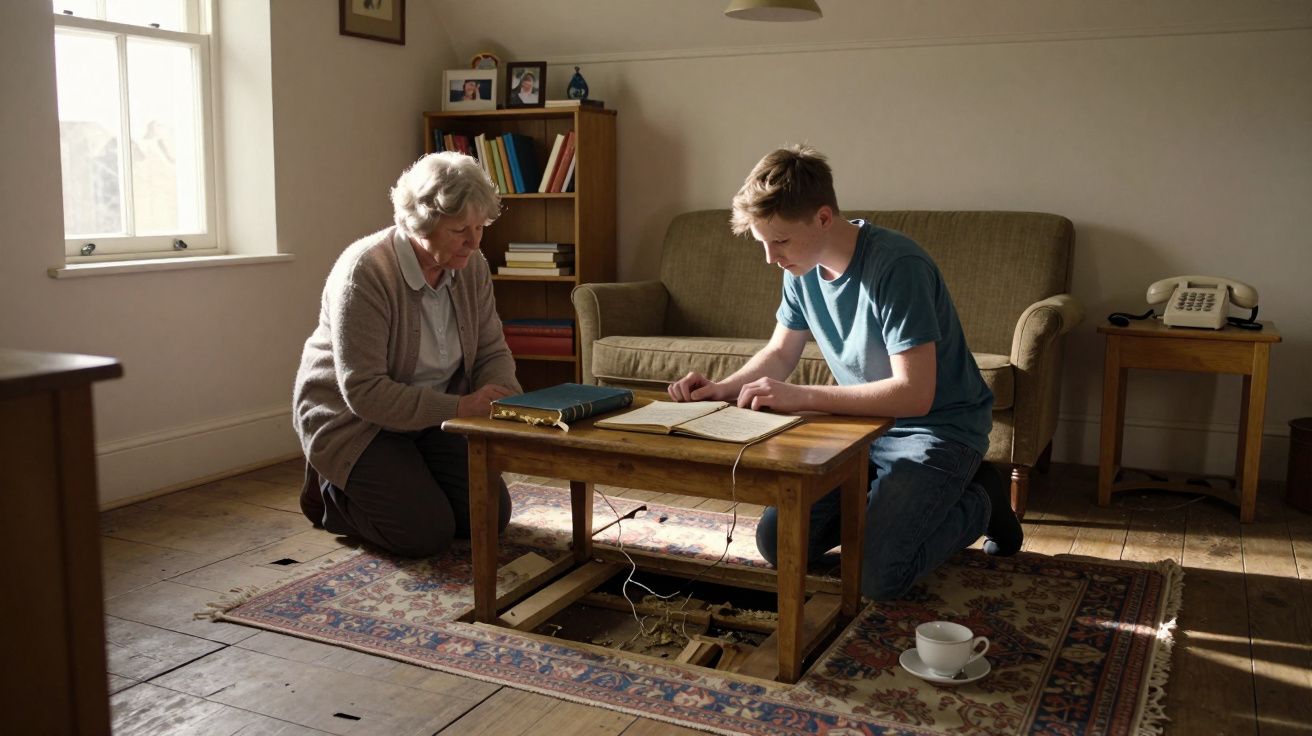
The find began with a draught. Margaret Hayes, a retired librarian, noticed a chill on her ankles as she crossed the sitting room in late November. The rug had warped slightly, and one corner of a floorboard sat proud. Her grandson brought a screwdriver the next day to sort it out.
They expected the usual: plaster dust, a few nails, perhaps an abandoned marble. Instead, there was a carefully wrapped bundle of oilcloth, tied with what had once been white string. Margaret hesitated, then slid it out and set it on the coffee table. They cut the string. Inside lay a narrow, cloth‑bound diary, its blue cover faded, edges feathered but intact.
On the flyleaf, in a teenage hand, were six words and a date: “If you find this, remember us. – Elsie, 3 Sept 1940”.
Margaret did what comes naturally to anyone who has spent a life around books. She read, slowly at first, then almost greedily, as the pages slipped from autumn 1940 through to the summer of 1944. The next morning, she rang the local records office and asked, quite calmly, whether they would like to see “something from the war that shouldn’t still exist”.
What the diary actually holds between its lines
From a distance, it is an unremarkable schoolgirl’s notebook. The pencil wavers, spelling drifts, some pages are smudged by rain or tears. There are doodles of bicycles and dogs in the margins, and once, a perfect little Spitfire picked out in blue ink.
Up close, it does what no official circular or newspaper cutting can quite manage. It records how the war sounded from the back bedroom of a terraced house.
Elsie writes about sirens and searchlights, of course. But she also notes:
- The exact taste of the first orange she sees in three years.
- The argument between neighbours about who gets the last sack of coal.
- A brother’s sulk when his toy cars are melted down in a metal drive.
- Someone’s quiet shame at freezing in the shelter and wishing the all‑clear would never come.
She notes, in a tight, urgent script, the night a nearby street took a direct hit, and the morning after, when the milkman still did his round because “he said you had to keep going or you’d never start again”.
There are no sweeping strategic insights here. There is, instead, the texture of days that official histories compress into a single sentence: “Civilian morale remained high.”
“It’s the ordinariness that knocks the breath out of you,” says Dr Amina Clarke, the archivist who took the first call. “We have government memos, we have speeches, we even have censored letters. What we rarely have is a continuous, uncensored record kept by someone who was never writing for an audience.”
Why archivists are quietly excited by a battered notebook
Archives are not short of wartime material. Britain encouraged letter‑writing, diaries, and Mass Observation reports during the conflict, and many survive. So why the fuss over one more exercise book?
Part of the answer lies in continuity. Many surviving diaries are fragments: a month here, a season there, often abandoned when the novelty wore off or life became too busy. Elsie’s runs, with only brief gaps, for nearly four years. That gives historians something they almost never get: a single consciousness travelling from the anxiety of 1940 through the numb grind of rationing into the strange lightness of 1944, when victory feels possible but not yet real.
Another part is the level of detail about a very small place. Elsie names houses by their curtains and cats. She records who swapped what for extra sugar, which lodger played the piano too loudly, how the butcher’s window looked thinner each month. Those details fix a national story to a few yards of pavement.
For archivists, this kind of source can:
- Confirm or challenge assumptions drawn from official surveys.
- Fill “quiet” months that records treat as blank.
- Reveal language, jokes and fears that never make it into public speeches.
“It’s the difference between a census return and a birthday party,” as one social historian on the project put it. “Both are useful. Only one tells you who laughed when the cake fell on the floor.”
How a private diary travels from a front room to a reading room
Once Margaret agreed to loan the diary, the process that followed was methodical, almost ritualised. No one simply “takes” a book like this and shelves it. The aim is to protect both the object and the story.
First came stabilisation. Conservators dried the pages gently, photographed every spread, and assessed where pencil had faded past legibility. A custom cradle was built so that the spine would not split under repeated handling. Only then did the transcription begin, line by fragile line.
That work is slower than most people imagine. Spelling must be preserved, slips left untouched, even doodles noted in passing. References that Elsie assumed everyone would understand – “Mr P has done it again, like last time!” – are cross‑checked against electoral rolls, bombing maps, and local newspapers. The goal is not to tidy her voice, but to place it within a web of other evidence.
Alongside the manual work, scanners produce high‑resolution images in both visible and infrared light, sometimes coaxing out graphite long since dulled. Once complete, the team intends to:
- Hold the original in climate‑controlled storage in the county archives.
- Release a digital facsimile for public viewing.
- Publish a lightly annotated edition for schools and local history groups.
None of this happens overnight. Weeks pass between the first excited phone call and the moment a member of the public can request to see “MS/2024/WW2/01 – ‘Elsie’s Diary’” in a reading room.
What makes this particular glimpse “once‑in‑a‑decade”
Archivists are not prone to hyperbole. They are trained to be suspicious of words like “unique” and “treasure”. When Dr Clarke described the diary as offering a once‑in‑a‑decade glimpse, she had a specific mix of qualities in mind.
It is rare to find, in one object:
- A nearly unbroken run of entries across multiple war years.
- A voice from outside the usual categories of officer, politician or adult observer.
- Clear geographical anchors that let researchers tie comments to specific streets, shelters and shops.
Put simply, the odds that a teenage girl’s private notebook, hidden under a floorboard in a modest house, would survive damp, redecorating, and post‑war clear‑outs are vanishingly small. The odds that it would then turn up in the hands of someone who recognised its value, rather than binning it during a tidy‑up, are smaller still.
That miraculous chain of chance means the diary can do things other sources can’t. It can show, for instance, how rumours travelled faster than official announcements, or how quickly a family adapted to shortages they had been told would be temporary. It can expose the gap between slogans and kitchen‑table conversations.
From private scribbles to a shared inheritance
For Margaret, the most unsettling part of the process has been the shift from intimacy to exposure. “I keep thinking she never meant us to read it,” she admits. “And then I read that first page again – ‘If you find this, remember us’ – and I think perhaps she did, just not like this.”
Ethically, archivists walk a tightrope. Respecting the privacy of the dead is weighed against the public value of understanding how they lived. In the UK, the general rule is that material of clear historical interest, with no obvious threat to living individuals, should be preserved and, eventually, opened.
The team working on Elsie’s diary have chosen to:
- Omit only those surnames where descendants could be easily identified and might be impacted by sensitive information.
- Keep the unedited original secure while sharing transcriptions widely.
- Work with local schools so that, where possible, young people encounter Elsie as a person, not a specimen.
In return, the community gains something hard to quantify but easy to feel. Residents who grew up hearing half‑remembered stories from grandparents suddenly have a written voice from their own street, describing the same corner shop or park railings. The abstract “Home Front” becomes specific, almost painfully so.
How you might recognise – and not accidentally destroy – the next diary
Most people will never find a wartime journal under their floorboards. Yet attics, sheds and old suitcases across the UK still hold letters, notebooks and scrapbooks that no‑one alive has properly read.
The pattern that archivists see is depressingly consistent: the items most likely to be thrown out are the ones that feel too mundane. Shopping lists. Domestic moans. Weather notes. These are, as social history, gold.
If you suspect you have something like that lurking in a box, a few simple steps can help:
- Do not “clean it up” with household products or tape. Leave repairs to conservators.
- Do not store it in the loft if you can avoid it; damp and heat fluctuate wildly.
- Do contact your local county record office, university archive or local studies library before you decide to bin it.
You are not promising to part with anything simply by asking. Archivists will usually offer advice on care, and, if it turns out you do have something of wider interest, can explain options ranging from long‑term loan to full donation.
As Dr Clarke puts it, “The difference between a box of old paper and a window on the past is often just one phone call.”
A small, fragile book, and a long echo
When Margaret visits the archive now, she signs in as any reader would. A staff member brings out the diary in a pale box, sets it on the foam cradle, and steps back. Margaret sits, turns a page with steady fingers, and meets a girl who once slept in the same footprint of house, under the same sloping roof, listening to different planes.
There is something quietly bracing in that distance and closeness. The war is gone; the human responses – boredom, fear, pettiness, loyalty, sudden joy at an orange – are not.
Elsie’s diary will not rewrite grand narratives of strategy and diplomacy. It was never meant to. It does something smaller and, for many readers, fiercer. It asks us to remember that history is not just what prime ministers say into microphones, but what a teenager, pencil in hand, jotted down before the siren sounded again.
| Key point | Detail | Why it matters |
|---|---|---|
| Continuous, local record | Four years of near‑daily entries from one street | Reveals how war shaped ordinary routines and relationships |
| Rare survival | Hidden under floorboards since 1940, only recently found | Combines chance preservation with modern archival care |
| Public value | Will be digitised, annotated and shared | Turns a private diary into a resource for schools, families and researchers |
FAQ:
- If I find an old diary or letters, what should I do first? Keep them flat and dry, avoid handling them excessively, and contact a local archive or records office for advice before attempting any cleaning or repair.
- Do archives really want “ordinary” family papers? Yes. Everyday accounts of shopping, work and neighbours often fill gaps that official records leave, especially for women, children and working‑class communities.
- Can I keep the original and still let researchers use it? In many cases, yes. Archives can work with long‑term loans or take digital copies, depending on the item’s condition and your wishes.
- Is there a right time period to save? Anything that helps document social life before the digital age – roughly pre‑2000 – can be valuable, but materials from major events such as wars, strikes or migrations are especially useful.
- Will my family’s name end up on public display? Archivists follow ethical guidelines and data protection law. They can discuss anonymising sensitive details or restricting access for a period if there are concerns.

Comments (0)
No comments yet. Be the first to comment!
Leave a Comment