The quiet foot symptom podiatrists link to future balance problems – and the home test to try now
In the chemist queue, someone shifts from one leg to the other and jokes about “getting old feet”, and someone else mutters about needing better trainers. Your child asks why grandad falls more often now, and you try to turn words like “nerves” and “circulation” into something that makes sense. It sounds like background worry until it isn’t, until a small stumble on the stairs or a near-miss at the kerb suddenly feels like a warning. The question is simple, really: how early do our feet whisper about future balance problems, and are we listening?
The morning a numb toe changed the story
Most people don’t intend to learn about their nervous system from a sock. But that’s how it happens for many podiatry patients. One morning a big toe feels oddly fuzzy pulling on shoes, or the sole of the foot might as well be a folded towel. You wiggle, stamp, blame a tight trainer. It passes. Until it doesn’t.
Podiatrists have a phrase for this: “loss of protective sensation”. It sounds mild, almost polite, until you grasp what it means. When the fine nerves in the feet stop carrying messages properly, your brain loses some of its grip on where you are in space. The risk isn’t just a blister you don’t feel. It’s the slip on a wet pavement that you don’t quite catch, because your balance system has been running on delayed messages for years.
Once you notice the pattern, the dots connect quickly. The older neighbour who “just doesn’t feel the floor anymore”. The person with diabetes whose annual foot check becomes the most important appointment of the year. The runner who can’t tell if their sock has rucked up. Subtle numbness and dulled touch are not cosmetic issues. They are an early, quiet forecast of how steady you may be ten winters from now.
The quiet symptom: when sensation goes soft
When podiatrists talk about future falls, they rarely start with glamorous scans or high-tech gait labs. They start with one simple question: “Can you feel this?” They press lightly under toes, along the ball of the foot, around the heel. They may use a soft nylon filament or a tuning fork. What they are really testing is the quality of your conversation with the ground.
In healthy feet, two things work together. There is light-touch sensation – the ability to notice a crumb in your shoe – and there is position sense, sometimes called proprioception. The latter is the quiet genius behind every step you take in the dark. Tiny receptors in skin, muscles and joints tell your brain, a hundred times a second, where you are and how much you are leaning.
When those signals fade, people often say their feet feel “thick”, “spongy” or “like cardboard”. They may not notice small stones, uneven slabs or the edge of a carpet. The body compensates for a while: eyes work harder, ankles stiffen, steps become wider. From the outside, it can just look like a “careful” walker. Inside, the safety margins are shrinking.
Loss of feeling in the feet doesn’t only raise the risk of ulcers – it quietly erodes the feedback your balance system depends on.
Why poor foot sensation and balance are so closely linked
Imagine standing on a paddleboard with your eyes closed. You are relying on three main systems to keep you upright:
- Your eyes, which track the horizon and surroundings
- Your inner ear (vestibular system), which senses head movement
- Your feet and legs, which feel pressure, stretch and tilt
If one system drops out, the other two can pick up the slack for a while. But if foot sensation erodes, you lose the constant stream of data about how weight shifts across your soles. Each small wobble becomes harder to correct quickly. On flat, bright supermarket floors, you cope. In a dim hall with a patterned carpet and a stray shoe, the calculation becomes far trickier.
Research in older adults and people with diabetes keeps landing in the same place: those with reduced foot sensation and weaker ankle muscles are more likely to fall. Not dramatically, not theatrically. Just a slow rise in stumbles, a reluctance to walk in the dark, a hand that always reaches for the banister now. The quiet symptom has become a quiet behaviour change.
It helps to name this properly. It isn’t clumsiness. It isn’t just “bad balance”. It’s a nervous system that has fewer touchpoints with the floor, and a musculoskeletal system that has to work twice as hard to compensate.
The simple home test podiatrists wish more people tried
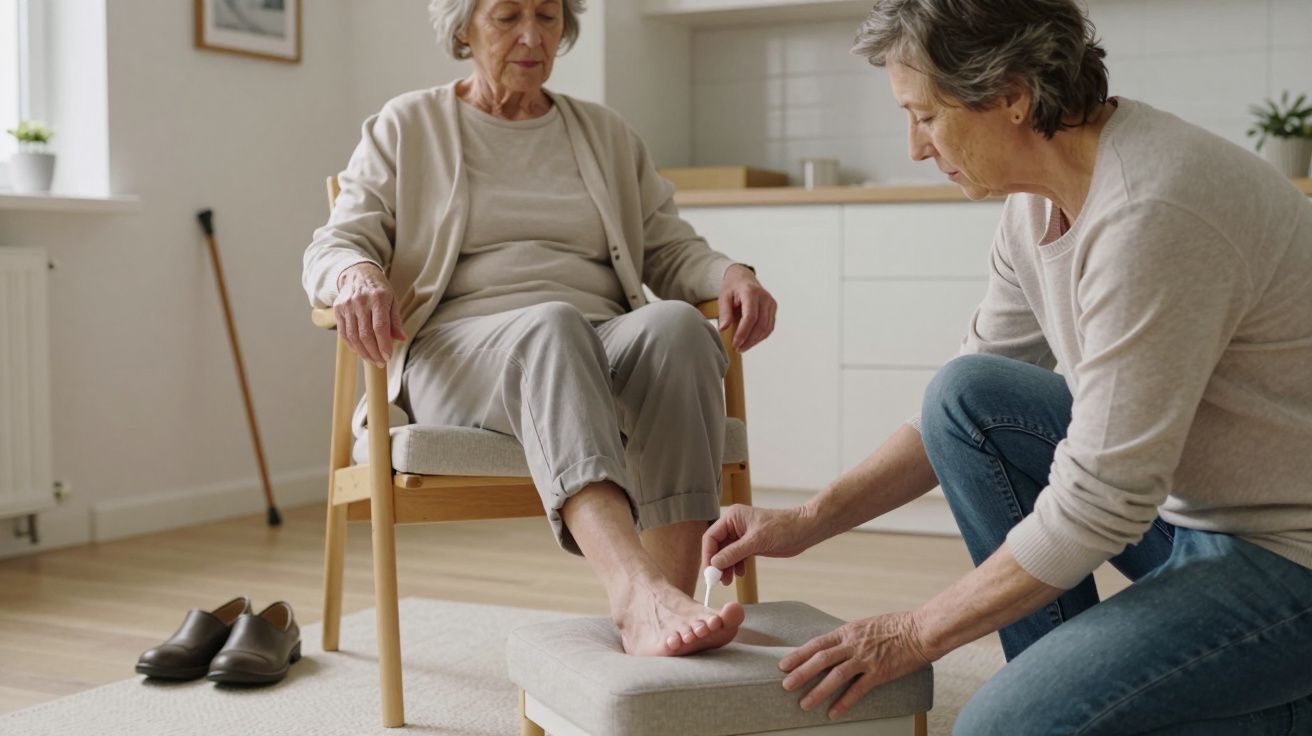
You cannot replicate a clinic in your bedroom. But there is a basic, safe home check that echoes what podiatrists do and can flag when it’s time for a professional assessment. Think of it as giving your feet a fair audition.
Step 1: The touch-and-compare check
You’ll need:
- A cotton bud or twisted corner of a tissue
- A firm chair
- A partner if possible (but you can do a version solo)
- Sit with both feet bare and supported, soles facing slightly towards you.
- Close your eyes. Ask your partner to gently touch either your big toe, little toe, the ball under your big toe or your heel on one foot at a time.
- Each time you feel the touch, say “yes” and try to name where it was (toe, ball, heel).
- Swap feet. Your partner should keep the touches very light and randomised.
- If you are alone, you can touch yourself but try to vary the order and keep your eyes closed between touches.
You’re not scoring yourself on perfection. You’re listening for patterns. Do you consistently miss the same area? Does one foot feel clearly “duller” than the other? Do you need firmer pressure to register the contact?
Step 2: The quiet balance check (near a wall)
You’ll need:
- A clear space next to a counter or wall
- Flat shoes or bare feet
- Stand with feet hip-width apart, one hand hovering (not gripping) the wall or worktop.
- Gently shift your weight from heels to toes and back again. Notice how clearly – or vaguely – you feel pressure move under each part of the foot.
- Then, keeping support within reach, place one foot directly in front of the other, heel-to-toe, like standing on a tightrope. Hold for up to 10 seconds.
- Step out of position if you wobble or feel unsafe. Never force it.
If the pressure feels mysterious under your feet, if you cannot tell where your weight is without looking down, or if heel-to-toe standing feels far harder than you’d expect, your feet may not be feeding your balance system as confidently as before.
Any home test is a conversation starter, not a diagnosis. What matters is using it to justify seeking proper help, rather than brushing worries aside.
When to take numbness – or “thick” feet – seriously
Everyone has experienced a temporary dead leg after sitting awkwardly; that pins-and-needles rush is nerves rebooting. Persistent foot changes are different. Podiatrists urge people not to wait until they are regularly tripping or falling to mention symptoms.
Common red flags include:
- Numbness, tingling or burning in toes or soles that lasts more than a few days
- Feet that feel “padded” or “like walking on foam” most of the time
- Cuts, blisters or hard skin you only notice by looking, not by feeling
- New balance worries, especially in low light or on uneven ground
- Needing to stare at the floor when walking to feel safe
These signs don’t guarantee serious disease, but they change the risk equation. In people with diabetes, they can indicate developing neuropathy and a higher chance of both ulcers and falls. In others, they can point to circulation problems, nerve compression in the back, the after-effects of chemotherapy, or simply a long-lived foot that needs more care.
The thread through all of them is the same: less sensation usually means less automatic safety.
Practical steps to protect feet – and balance – now
Balance is not a fixed talent; it’s a capacity you can support, much like strength or flexibility. The earlier you start, the more reserve you build for future winters and wet pavements.
1. Protect and check the nerves
- If you live with diabetes, keep your HbA1c and blood pressure as close to targets as you can and attend every foot screening.
- Avoid smoking; it further narrows blood vessels that feed foot nerves.
- Review any new numbness or foot pain with your GP or podiatrist rather than assuming it’s “just age”.
2. Make foot checks a quiet daily habit
After a shower or before bed, take 30 seconds:
- Look at soles, between toes and around heels for colour changes, cracks, cuts or swelling.
- Use your hands to feel for hot spots, hard patches or areas of reduced sensation.
- Moisturise dry skin, but keep cream away from between the toes to avoid dampness.
A small torch or phone light helps if your eyesight is not sharp. If you struggle to reach, a family member, carer or a small hand mirror can bridge the gap.
3. Train your balance in tiny doses
You don’t need a gym. You need repetition.
Simple daily drills:
- While brushing your teeth, stand on one leg for 10–20 seconds, holding the sink edge lightly if needed. Swap legs.
- Practise slow heel-to-toe walking along a hallway, eyes open, once or twice a day.
- Rise onto your toes and lower back down 10 times, using the back of a chair for support, to strengthen calf and ankle muscles.
Over weeks, these micro-sessions nudge your brain to keep investing in ankle reactions and body awareness. Done barefoot on a safe, clear, non-slippery surface, they also give your foot sensors something to do.
4. Choose shoes that help, not hinder
Shoes become part of your balance system. The wrong ones can sabotage it quietly.
Look for:
- A firm heel counter (the back of the shoe that cups your heel)
- A broad, stable base with a low heel
- A sole that bends at the ball of the foot, not in the middle like a concertina
Avoid excessively soft, squishy soles that blur ground feel completely, and high heels that tip weight forward and narrow your base of support. Indoors, supportive slippers with a back and good grip beat loose mules every time.
A quick comparison: which habits help most?
| Habit or change | Best for |
|---|---|
| Daily visual and touch checks | Catching early skin and nerve issues |
| Simple balance drills | Maintaining confidence on uneven ground |
| Supportive, low-heeled shoes | Reducing slips and ankle twists |
The idea is not to become a balance athlete. It is to keep the odds quietly stacked in your favour.
What to ask a podiatrist or GP
Healthcare appointments are short, and it’s easy to leave without raising your real worry: “Will I still feel steady in five years?” A short, pointed list of questions can make the difference between vague reassurance and a concrete plan.
Consider:
- “Can you check my foot sensation today, including under the toes and forefoot?”
- “Do I have signs of neuropathy or circulation problems in my feet?”
- “Is there anything in my medication list that might be affecting my balance or nerves?”
- “Which kind of exercises and footwear would you recommend specifically for me?”
If you’ve tried the home touch or balance checks and noticed changes, say so. Describe real situations: the near-fall on a bus, the way you now avoid dim restaurants. These stories help clinicians see the practical risk, not just the numbers in your notes.
Foot sensation testing is not just for people with advanced diabetes or obvious problems. It is a basic safety check, like testing brakes before a long journey.
The map beneath your feet
What happens in your feet is not a side plot to your health. It shapes how confidently you cross roads, climb steps, or carry a sleeping child up to bed. When sensation fades, the world doesn’t stop; it just becomes more demanding, asking your eyes and muscles to do jobs they were never meant to shoulder alone.
Most of us won’t spend evenings reading medical journals about peripheral nerves. We don’t need to. We need a small, repeatable habit: look, touch, notice. Try the simple home test. Pay attention to the quiet differences between left and right, between this year and last. If the map beneath your feet feels blurred, that is information, not failure.
Your feet are often the first to know when your balance future is changing. The grown-up move is to listen while the signal is still soft – and to ask for help before the ground feels like guesswork.
FAQ:
- If I notice some numbness, should I panic? No. Numbness is a prompt, not a verdict. It’s a reason to book a GP or podiatry appointment for proper testing, especially if you have diabetes or circulation issues.
- Can balance really improve later in life? Yes. Targeted strength and balance exercises, better footwear and treating underlying issues can all reduce fall risk, even in your 70s and 80s.
- Are barefoot shoes good or bad for balance? They can improve ground feel for some people but may be risky if you already have poor sensation or weak muscles. Get individual advice before switching.
- How often should I do home balance drills? Small, daily doses work best – think minutes, not hours. Consistency matters more than intensity.
- When is urgent help needed? Seek same-day medical advice if numbness comes on suddenly, affects both legs rapidly, is linked to back pain or bladder/bowel changes, or if you have a foot wound you can’t feel that looks infected.



Comments (0)
No comments yet. Be the first to comment!
Leave a Comment