The simple roof check homeowners should do before the first autumn storm rolls in
You know that faint dread you get when the first proper autumn storm is forecast, and there’s a little voice in your head that says: “I hope the roof’s all right…” You shut the windows, move the garden chairs, maybe clear the leaves off the patio. Then the rain starts needling the glass, the wind picks up – and you suddenly remember the brownish stain on the spare-room ceiling you’ve been ignoring all summer.
Most of us only really think about the roof when something has already gone wrong. A drip in the loft, a patch of mould, that mysterious plink into a saucepan in the middle of the night. By then, the damage has usually been quietly building for months. The unglamorous truth is that one five‑minute check, done before the first big autumn blow, can save you from the late‑night bucket routine and a much bigger repair bill.
And no, it does not involve climbing up there with a ladder and a head torch. It starts with a mug of tea and a slow walk round your own house.
The day a “tiny” stain turned into a very big bill
The penny dropped for me in a semi‑detached house in late October. A couple had noticed a faint yellow mark on the landing ceiling back in July. It was small, easily hidden in conversation. They decided it was “probably just old” and, like most of us, they got on with their summer.
By the time the first real autumn storm came through – fat, sideways rain, gusts strong enough to rattle the letterbox – that mark had widened into an abstract watercolour above the loft hatch. A single drip became a steady patter. Out came the saucepan, then the roasting tin, then a frantic call to a roofer made from the top of the stairs while balancing on a chair.
When we finally got into the loft, you could trace the problem like a story. A slipped tile near the ridge. A bit of old, cracked mortar around a chimney. A line of damp running down the felt, soaking the insulation beneath. The storm hadn’t caused the leak. It had simply revealed months of slow seepage that a quick pre‑season check might have caught while it was still a £150 fix, not a £1,500 headache.
Water does not arrive dramatically, in most houses. It sneaks. It creeps along timbers, wicks through insulation, finds the smallest gap and makes it bigger. That quiet ceiling stain you barely noticed in bright July light is the house clearing its throat. The storm just turns up the volume.
What the first autumn storm really does to your roof
On a dry, still day, your roof is mostly left in peace. Tiles sit where they were put; flashing lies flat; gutters sulk quietly under a film of dust. The first storm after a long dry spell changes all that in a single evening.
Wind lifts at anything that is already a bit loose – a corner of felt, a tile that’s slightly out of line, old sealant that has dried and cracked. Rain doesn’t fall politely straight down. It’s driven sideways, up and under overlaps, into hairline gaps round chimneys, vents and skylights. Gutters that have been slowly collecting leaves and moss suddenly have to cope with the first proper deluge in months.
Your roof, in other words, gets stress‑tested. Not in a laboratory, but in real time, over your furniture.
The important bit is this: storms are very good at finding weaknesses that already exist. They almost never create problems out of nowhere. Which is why a simple “storm rehearsal” check, done from the safety of the ground and your loft, can make such a difference.
The five‑minute roof check every homeowner should do
You don’t need specialist tools, a drone or a head for heights. You just need to look – properly – before the weather does its worst. Think of it as a small autumn ritual, like digging out the heavier duvet.
Step 1: Walk slowly round the outside
Pick a dry, bright day and walk right round your house, pausing at each corner. Look up at:
- The line of the tiles or slates – are any slipped, missing or noticeably out of line?
- The ridge (the very top line) – does anything look gappy or uneven?
- Chimneys and roof joints – can you see cracked or missing mortar, flashing that’s lifted, or obvious gaps?
- Skylights or roof windows – do the seals look intact and snug, or perished and gappy?
You’re not trying to diagnose like a roofer, just to spot things that look obviously “not like the rest”. If one tile is noticeably lower, your gutter is sagging in the middle, or a chunk of mortar is missing from around a chimney, that’s worth attention before the wind and rain have a go at it.
If access is tricky, a pair of binoculars or your phone’s zoom camera can help. You’re still firmly on the ground.
Step 2: Look hard at your gutters and downpipes
Gutters are the unsung bodyguards of your roof and walls. When they’re blocked or sagging, water has to go somewhere – often straight into the fabric of the house.
Ask yourself:
- Can you see plants, moss or piles of leaves in the gutters?
- Are there any obvious sags where water might sit instead of flowing?
- Do downpipes still seem properly fixed to the wall, with no gaps where they meet the gutters?
If the answer to any of these is “yes, that looks a bit off”, you’ve just found a simple, high‑value autumn job. Clearing gutters and firming up brackets is dull work, but it’s the kind that quietly prevents stained ceilings and blown plaster. If you’re not steady on a ladder, this is exactly the sort of small job many local roofers or handypeople are happy to do between bigger jobs.
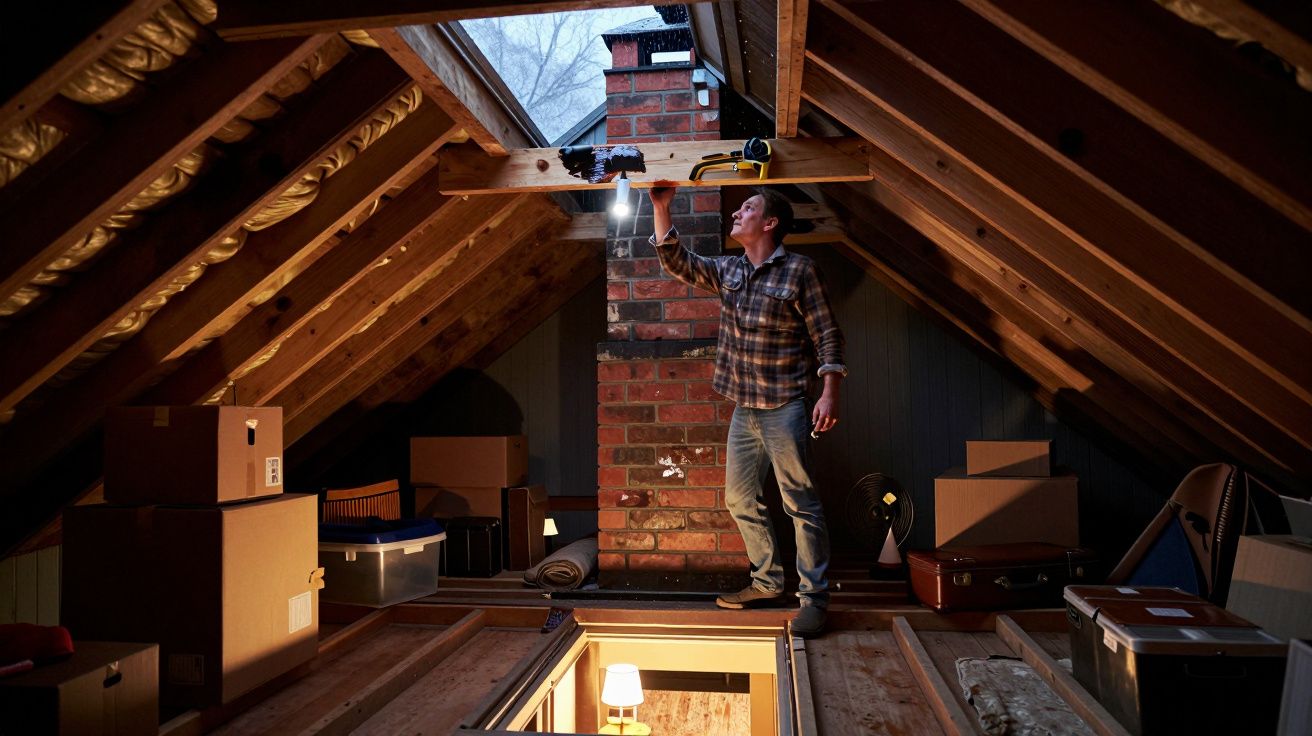
Step 3: Do the “wet patch” test in your loft
The most revealing part of your check happens inside, not outside. Choose a rainy day if you can, or go up once the storm has passed but while everything’s still damp. Take a torch, watch your footing, and stick to the joists or any boarded area.
Once you’re up there:
- Turn off the loft light for a moment and let your eyes adjust. Can you see any pinpricks of daylight where there shouldn’t be any?
- Run the torch slowly along the underside of the roof – look for darker, damp‑looking patches, shiny drips, or timbers that look stained or mouldy.
- Check round chimneys, roof windows and any vents first; these are common entry points.
You’re looking for contrast: areas that are a different colour or sheen to their neighbours, or insulation that looks clumped and heavy rather than light and fluffy. That’s where water has been, or still is.
If you’re unlucky, you may hear the tell‑tale drip… drip… onto the back of the plasterboard. It’s an eerie sound, because you know it won’t stay hidden for long.
Think of your loft as the early warning system. If you listen before the ceiling starts shouting, you’ll catch trouble while it’s still cheap.
Why this one check matters more than a dozen gadgets
Modern homes buzz with alerts for almost everything – smart thermostats, security cameras, leak detectors by the washing machine. Yet the biggest single surface protecting your house is usually left to faith and habit. You assume the roof is fine because it was fine last year.
That five‑minute circuit outside and ten minutes in the loft flips that assumption into observation. It does three useful things at once:
- It turns vague worry into a list. Instead of thinking “I hope the roof is OK”, you know “there’s one slipped tile above the kitchen and the back gutter sags”. Those are solvable problems.
- It lets you choose the timing. Booking someone to fix a small issue on a dry Wednesday in September is very different from begging for emergency help on a Sunday evening in November.
- It saves the bits you can’t easily replace. Ceilings, timber and insulation soak up water like a sponge. Catching leaks in the roof layer prevents that slow, hidden rot that nobody budgets for.
There is also a quieter benefit. Doing a simple, non‑dramatic check reminds you that you are not entirely at the mercy of the weather forecast. You can’t stop a storm, but you can make sure your roof is not greeting it with loose teeth.
What to do if you spot something worrying
Finding a problem doesn’t mean you need to panic. It just means your house has given you useful information in time.
A rough rule of thumb:
| What you see | Likely response |
|---|---|
| Small stain in loft, no obvious drip | Photo it, monitor next storm, seek a roofer’s opinion soon |
| Obvious slipped/missing tiles or cracked flashing | Ask a roofer to inspect and quote before heavy weather |
| Dripping, soaked insulation, or daylight through the roof | Treat as urgent; call for prompt repair and protect belongings below |
Take clear photos from the ground and in the loft if you can do so safely. They help professionals give you a realistic idea of urgency and cost, and they also give you a record if you ever need to talk to your insurer.
What you should not do is climb onto the roof yourself unless you’re trained and properly equipped. Autumn roofs are slick, ladders slip, and a broken leg is far more expensive than a call‑out fee.
Turning roof checks into a quiet autumn habit
The houses that get through rough weather best are rarely the ones with the shiniest gadgets. They’re the ones whose owners do small, boring things at the right time: clearing a gutter, nudging a slipped tile back into place, calling a roofer in September instead of praying in December.
Building a simple roof check into your autumn routine is a modest act of care with an outsized payoff. Once a year, when the forecast starts mentioning “first significant rain”, you:
- Walk round the outside and actually look up.
- Glance along the gutters and downpipes.
- Pop into the loft with a torch and listen.
Fifteen minutes, no heroics. Then, when the first storm rolls in and the rain rattles the tiles, you can settle back on the sofa with a blanket and a book, not a bucket and a sense of dread. Your roof still has to do its job. You’ve just quietly given it a much better chance.






Comments (0)
No comments yet. Be the first to comment!
Leave a Comment