The surprising link between cluttered hallways and procrastination, backed by new behavioural research
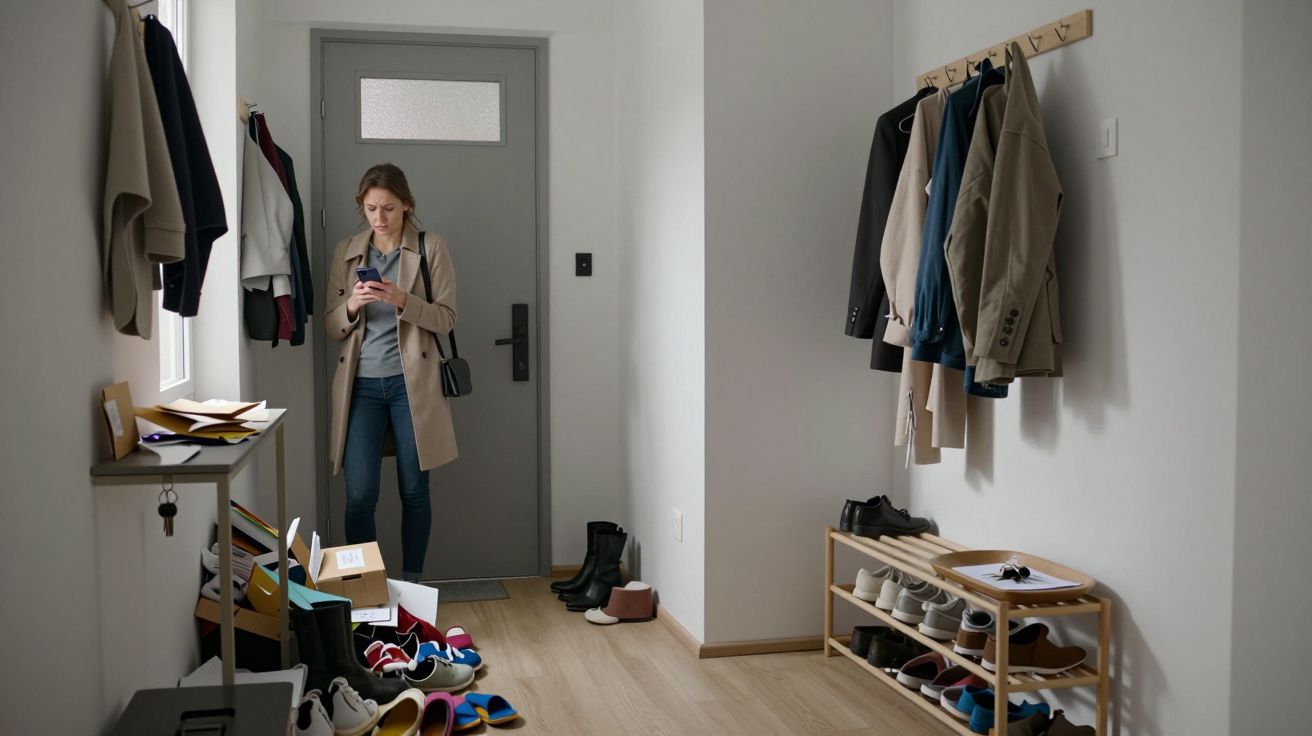
On a grey Tuesday morning, Anna stands in her hallway, bag on shoulder, keys somewhere under a pile of post. A coat half‑slips from the peg, yesterday’s parcels lean against the skirting board, two pairs of shoes block the door like sleepy guards. She pauses to pick a path through it all, sighs, and decides to answer one email before leaving. Twenty minutes and three scrolls through social media later, she is still there.
The hallway didn’t cause the procrastination on its own. But new behavioural research suggests spaces like this don’t just “look messy” – they quietly nudge our brains towards delay, indecision and that familiar sense of stuckness. The clutter becomes less a backdrop and more a script.
When your front door becomes a decision minefield
Researchers studying micro‑environments in homes have started focusing on thresholds: doorways, entrances, the places where one activity ends and another begins. In recent experiments, people asked to complete a simple task after walking through a visually chaotic corridor took significantly longer to start than those who walked through a clear one. They also reported feeling “less ready” and “slightly overwhelmed”, even though the task itself hadn’t changed.
Behaviourally, cluttered hallways combine several known procrastination triggers in a few square metres. There are:
- Multiple unfinished tasks in sight (returns to post, shoes to put away, tools from last weekend).
- Repeated micro‑obstacles (stepping over bags, moving coats, shuffling mail).
- Constant visual noise that demands sorting, even if you never consciously do it.
Each of these adds a tiny layer of friction between intention and action. One doesn’t matter. Twenty do.
A recent UK study on household “transition zones” found that people with highly cluttered hallways were more likely to delay leaving for commitments and to describe mornings as “chaotic” or “out of control”.
Over time, your brain starts to pair “passing through the hallway” with “feeling behind”. That association can spill over into other parts of life, especially work that already feels effortful or exposed, such as starting a big project or opening an awkward email.
The psychology hiding in the shoe pile
It’s tempting to read clutter as a simple lack of storage or discipline. Behavioural scientists paint a subtler picture. Several findings keep surfacing:
Decision fatigue
Every object out of place is a microscopic choice: hang or keep wearing, bin or keep, deal with now or later. Hallways accumulate these micro‑decisions because everything passes through them. When you are already tired, the easiest option is “later” – for the post, the coat, and the phone call you meant to make.Temporal blurring
Piles in hallways are rarely random. They often represent delayed actions: things to take to the charity shop, forms to post, items to return. You walk past a physical queue of “un-done” every day. That reinforces the feeling that you are generally behind, a state strongly linked with avoidant procrastination.Threat signals in disguise
Our nervous systems like clear exits. A visually blocked or cramped doorway raises, ever so slightly, the sense that leaving the house is an ordeal. Studies using heart‑rate monitors found small but consistent spikes when participants navigated narrow, cluttered exits compared with the same spaces cleared. The brain reads hassle as low‑grade threat, and threat favours short‑term comfort over long‑term goals.
Clutter doesn’t only slow us physically; it alters how we interpret time, risk and effort. For someone already prone to overthinking, a hallway stuffed with delayed decisions can feel like a corridor of judgement.
From hallway chaos to “I’ll start that report tomorrow”
The link between a messy entrance and desk procrastination isn’t obvious until you trace the chain. Behaviour researchers map it like this:
- You wake up slightly anxious about a task.
- You hit the hallway and get a subtle jolt of “I’m behind” from the mess.
- That feeling makes the task seem bigger and more threatening.
- To soothe the discomfort, you pick an easier activity (scrolling, tidying, another coffee).
- The delayed task grows larger in your mind, reinforcing the pattern tomorrow.
In interviews, people who rated themselves as “chronic procrastinators” spoke about their hallways in revealing ways. One described his as “a holding area for everything I don’t want to think about”. Another joked that his front door was “the boss I avoid walking past”.
What’s striking is that clearing a small, visible patch often has outsized effects. In one small UK trial, participants who reduced hallway clutter by just 30% (measured in items on the floor and surfaces) reported:
- Fewer late departures in the following month.
- A modest but real increase in “on‑time starts” for planned tasks.
- A shift in self‑description from “disorganised” to “busy but coping”.
No personality transplant, no new app – just fewer trip hazards between bed and front door.
How to turn your hallway into a launch pad, not a trap
You don’t need a show‑home entrance to change how your brain feels about starting things. The research points towards small, structural tweaks that reduce decisions and increase clarity.
1. Create a “corridor autopilot”
Think of your hallway as the runway for your day. The goal is to minimise choices when you are least resourced, usually mornings and late evenings. Try:
- One hook per person for daily use only; everything else lives in a cupboard, not on the wall.
- A single tray or shallow box for post and keys, emptied at a fixed time once a week.
- A narrow shoe rack with a strict rule: only today’s and tomorrow’s shoes stay here.
Limiting visible options reduces the mini negotiations that feed delay: not “which of these seven coats?”, but “this one, or I move it first”. Your future self will always choose the easier option; design so that the easier option is also the better one.
2. Separate “in transit” from “to deal with”
One of the clearest findings from the new studies is that mixed piles – where items to be stored, fixed, posted and binned all touch – are especially paralysing. Our brains struggle when categories blur.
Introduce two clearly labelled zones:
- In transit – things leaving the house in the next 48 hours (returns, borrowed books, parcels).
- To deal with (elsewhere) – items that need action but not in the hallway (forms to fill, repairs, filing).
Keep the second zone outside the hall if you can, even if it is just a small box on a desk. The entrance regains its primary job: getting you out of the door, not confronting you with your whole life admin.
3. Use “anchor habits” instead of big tidying days
Almost nobody realistically empties and scrubs their hallway every weekend. Behavioural change sticks better when it’s attached to existing, small routines.
A few anchors that tend to work:
- When you put your keys down, one thing on the floor goes back to its home.
- When you bring post in, you immediately recycle the obvious junk at the bin.
- Once a week, linked to a regular event (Friday dinner, Sunday film), you spend five minutes resetting hooks and the shoe rack.
Five minutes may feel pointless, but momentum matters more than grandeur. In follow‑up interviews, participants who switched to micro‑tidies reported that the hallway felt “less accusatory” – a surprisingly powerful phrase when talking about a pile of trainers.
A calmer corridor, a kinder inner voice
The most interesting shift may not be visual at all. Several studies note that when people improve a single “transition zone” in their home, their self‑talk about productivity softens. Instead of “I’m hopeless”, you start to think “I work better when the first steps are easy”.
This matters because harsh self‑criticism is one of procrastination’s favourite fuels. A clutter‑heavy hallway offers a daily prompt for that voice: “Look at this state, no wonder you’re late again.” A simpler, more intentional space doesn’t just remove objects; it removes opportunities to confirm that negative story.
As one participant put it: “When the hallway is clear, it feels easier to believe I can clear other things too – like my inbox, or that project I’ve been putting off.”
None of this means you must live like a minimalist with monkish pegs. Real homes have sports kits, prams, school bags and muddy boots. The point is not perfection, but direction: shaping the space so it says “out you go, you’ve got this” rather than “stay here, it’s all too much”.
A few square metres between your front room and your front door can’t fix every habit. But they can change the opening scene of your day – and for a brain leaning towards “later”, those opening seconds are often where the script flips.
| Hallway shift | What changes | Why it helps procrastination |
|---|---|---|
| Fewer visible items on the floor | Quicker, smoother exit | Reduces friction and excuses to delay leaving or starting |
| Clear categories (in transit vs to deal) | Less mixed “life admin” in one spot | Cuts overwhelm and decision fatigue at the door |
| Tiny, regular resets | Hallway rarely reaches crisis state | Supports a calmer self‑image and more consistent on‑time starts |
FAQ:
- Does a messy hallway really affect my work, or is that over‑thinking it? Research suggests the effect is small but real; cluttered thresholds increase delay and stress, especially when you already feel behind. It won’t cause procrastination alone, but it can reliably nudge you towards it.
- What if I have a very small flat and no storage? Focus on vertical space (hooks, over‑door racks) and strict limits: one basket for shoes, one for bags, one tray for post and keys. The goal is fewer categories in sight, not emptiness.
- Isn’t it better to tackle my procrastination directly instead of my hallway? Both help, but environment changes are often easier to start with and support any cognitive or time‑management strategies you use. They remove friction so other tools work better.
- How long until I notice a difference? Many people report feeling calmer within a few days of simplifying their entrance; measurable changes in punctuality or task‑starting usually show up within a few weeks of keeping the new habits going.
Comments (0)
No comments yet. Be the first to comment!
Leave a Comment