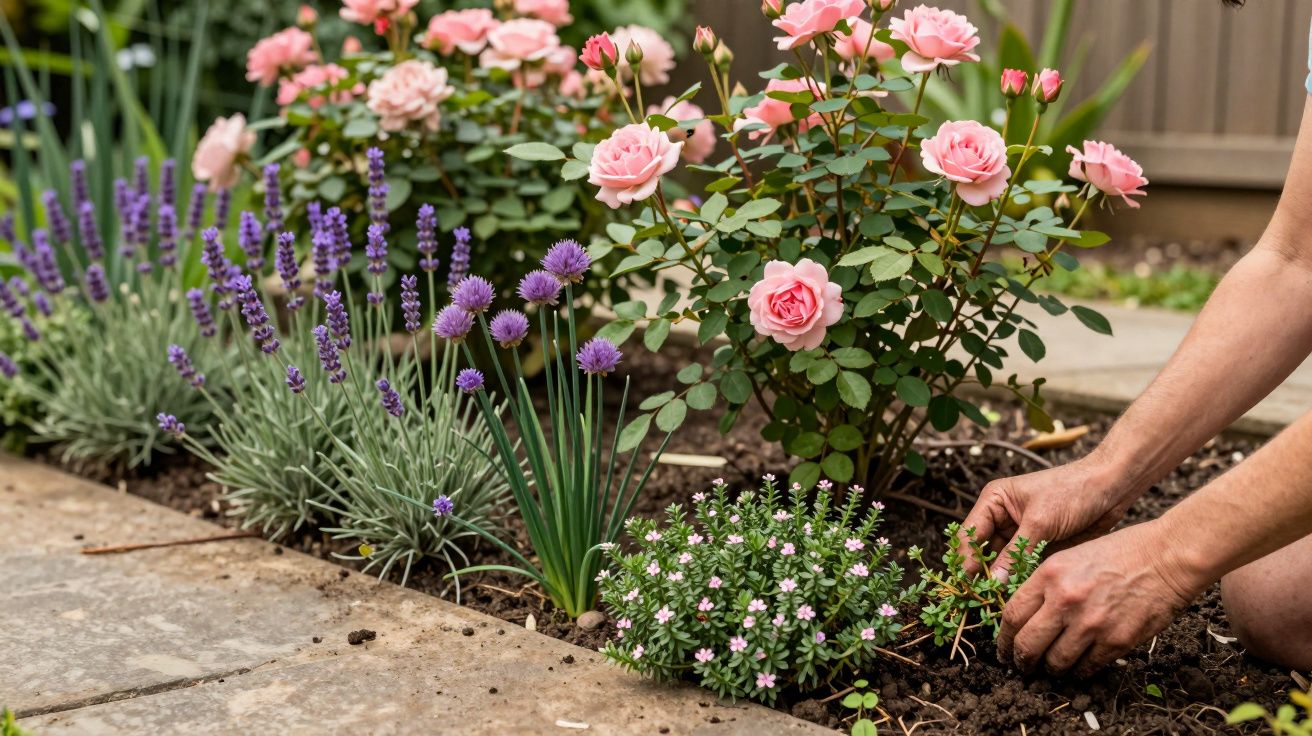
The three herbs gardeners tuck near roses to keep aphids away without chemical sprays
The first greenfly usually appears on a warm afternoon, when the buds are just starting to swell and you’re finally feeling a bit smug about your roses. By the weekend, the soft new growth can be crowded with pale insects, sticky honeydew and the odd trail of ants. You can reach for a spray, organic or not, or you can borrow a quieter trick from gardeners who hate chemicals but love clean buds: plant the right herbs in the right places and let the scent and insects do the work.
This isn’t about a magic forcefield. It’s about nudging the garden so that aphids feel less at home and their predators feel more invited. Three herbs in particular turn up again and again in rose borders, tucked at the feet of shrubs or slipped into nearby pots: lavender, chives and thyme. Together they shift the balance from “buffet” to “busy, hostile territory” as far as greenfly are concerned.
Why herbs help roses more than another bottle of spray
Aphids are drawn to soft, sappy growth and the chemical cues that plants release when they’re actively growing or slightly stressed. Roses are generous with both, especially after pruning, feeding or a sudden warm spell. Broad-spectrum insecticides don’t just hit the greenfly; they also flatten ladybirds, lacewings, hoverflies and tiny parasitic wasps that would have eaten the problem for you.
Herbs work differently. Their essential oils and flowers change how the border smells and who visits it. Strongly aromatic leaves can mask the signals roses give off, making it harder for aphids to home in. The flowers feed hoverflies, ladybirds and small wasps whose larvae gorge on greenfly. At the same time, low, dense herb foliage helps spiders and ground beetles hide out under the roses, ready to ambush soft-bodied pests.
You’re not “repelling every aphid”; you’re making the plant less obvious and surrounding it with creatures that see greenfly as lunch.
There’s also the health question. Frequent spraying, even with things labelled “natural”, can scorch young leaves, upset soil life under the plant, and drift onto nearby herbs and salads. Companion planting is slower but gentler. You set it up once, then top up with the odd trim and a light feed, rather than reaching for the bottle every time you see a sticky shoot.
Herb one: lavender, the scented bodyguard
Lavender is the classic rose partner in UK gardens, and not just because it looks pretty in catalogues. Its strong, resinous scent confuses sap-sucking insects that navigate by plant smell, while its purple flower spikes pull in hoverflies and bees for weeks through summer.
Planted in a low hedge or loose line along a rose bed, lavender forms a fragrant buffer zone. Aphids are less likely to start colonies on the outermost rose bushes, and any that do appear are more quickly noticed by passing predators attracted to the lavender’s nectar. The plants themselves like the same sunny, open conditions as many roses, and the woody framework helps keep wind moving through the border, which discourages mildew and other fungal hangers-on.
For most UK sites, English lavender (Lavandula angustifolia cultivars such as ‘Hidcote’ or ‘Munstead’) copes best with winter wet. They want:
- Full sun and free-draining soil, ideally with a bit of grit
- Spacing of 30–40 cm between plants to avoid a solid hedge of woody stumps
- A light trim after flowering, never cutting back into old, leafless wood
Cut stems for the house after rain has dried; bruised foliage can release extra scent around the roses where you’ve walked.
Herb two: chives, the quiet aphid deterrent
At first glance, a clump of chives looks far too modest to protect anything. Yet that oniony smell carries weight in mixed borders. Many gardeners notice fewer aphids on roses where Allium family plants grow close by. The theory is simple: the sulphur compounds in their leaves and roots interfere with the scent trail aphids use, and the fine grassy leaves help break up the visual outline of the rose stems.
Chives also earn their keep in spring, when their neat purple pom-pom flowers open just as aphids are starting to colonise fresh growth. Those blooms are magnets for small hoverflies whose larvae will happily patrol nearby rose tips. Unlike some companion plants, chives take kindly to a regular haircut, so you can eat half the clump and still have enough foliage left to do the masking job.
To use chives well around roses:
- Plant them 15–25 cm from the base of the bush so they don’t crowd the stem
- Grow in small drifts of 3–5 plants dotted through the bed, not a single lonely clump
- Divide congested clumps every 3–4 years to keep growth fresh and leafy
In pots, tuck chives at the rim of containers holding patio roses. The roots appreciate the same regular water, and the leaves soften the hard edge of the pot while quietly scenting the space.
Herb three: thyme, the low, humming carpet
Thyme doesn’t stand tall or make a visual fuss, but at soil level it changes the mood completely. A mat of thyme around a rose’s feet replaces bare compost or bark with a living, humming surface that bees, solitary wasps and tiny beetles crawl over all day. Its spicy, resinous smell sits right where many aphids would otherwise set up on basal shoots and suck unnoticed.
By covering the soil, thyme also reduces splashback from heavy rain or over-enthusiastic watering, which helps keep fungal spores from bouncing onto lower leaves. The warmth stored in its dense foliage on sunny days is perfect for speeding up the life cycle of beneficial insects. For the rose, that often means predators arrive earlier in the season and stay longer.
Choose creeping varieties such as Thymus serpyllum or low-growing common thyme. They’re happy with:
- Full sun and lean, well-drained soil
- Being planted 20–30 cm away from the main stem so air can still move around it
- Occasional light clipping after flowering to stop them becoming woody mounds
In tight or soggy spots, use thyme in shallow troughs or bricks set into the front of the bed, so roots avoid waterlogged clay but the scent still hangs in the air around your roses.
Putting the trio to work around your roses
The three herbs don’t need to be jammed right up against the rose stems. Think of creating overlapping “zones” of scent, shelter and nectar radiating out from each shrub rather than a rigid ring fence. A simple pattern that works in many small UK gardens is:
- Lavender in a loose row along the sunnier edge of the rose bed
- Roses set 40–60 cm back from that line
- Clumps of chives between and just in front of the roses
- Patches of thyme at the very front, spilling onto paths or edging stones
Leave some bare access for weeding and feeding. Herbs help, but roses still need the basics: adequate water during dry spells, a balanced feed in spring, and deadheading or light pruning to keep growth steady rather than stressed and sappy.
| Herb | Main role near roses |
|---|---|
| Lavender | Scent mask + nectar for hoverflies |
| Chives | Scent mask + spring predator draw |
| Thyme | Ground cover + insect habitat |
The aim is fewer explosions of greenfly, not a sterile, insect-free garden. A handful of aphids early on is often what brings the ladybirds in.
If you suddenly see a big flush of aphids before your herb layer is properly established, use a soft, targeted response: squish the worst clusters, blast stems with a firm spray of water, or wipe shoots with a gloved hand. Then let the predators you’ve invited finish the job rather than resetting the whole system with a heavy spray.
Small habits that keep the balance in your favour
Think of the herbs as part of a rhythm, not a one-off fix. A few small habits make them more effective:
- Water deeply but less often so herbs root down and cope with dry spells
- Avoid strong nitrogen feeds that push out very soft, juicy rose growth favoured by aphids
- Leave a few spent thyme and chive flower heads for seed and shelter if you can stand the scruffiness
- Skip “tidy to the bare soil” weeding; a little low cover gives predators somewhere to hide
If you garden in a very shady or north-facing plot where lavender sulks, lean more heavily on chives, thyme in the brightest spots, and other compatible, aromatic plants like oregano or marjoram to fill the same roles.
FAQ:
- Will these herbs completely stop aphids on my roses? No. They usually reduce the number and speed of infestations and help predators move in faster, but you may still see some aphids, especially in warm, dry spells.
- Can I grow the herbs in pots near potted roses? Yes. Group pots of lavender, chives and thyme around container roses so their scent and flowers still influence the immediate area.
- How close should I plant herbs to avoid competing with rose roots? Keep a small clear circle around the main stem, roughly a hand-span wide, and plant herbs just beyond that so air and water can reach the rose base.
- Do I need to stop using all sprays once I plant herbs? It helps to avoid broad-spectrum insecticides, which kill beneficial insects. If you must intervene, use targeted, gentle methods and treat only the worst affected shoots.
- Are any of these herbs unsuitable for very heavy clay? Lavender and thyme dislike sitting wet in winter. In heavy clay, plant them on slight mounds, add grit, or keep them in nearby containers while still interplanting chives in the bed.




Comments (0)
No comments yet. Be the first to comment!
Leave a Comment