Why birds ignore your feeder in winter – and the simple location shift that brings them flocking back
It started with an empty hook outside my kitchen window.
The feeder was full, the fat balls were fresh, and the only movement in the garden was next door’s washing. No blue tits, no sparrows, not even the scruffy robin who usually appears the second I look away. I tapped the glass as if that would help. It did not. A week later, the seeds still sat there like an unanswered invitation, and I began to wonder what I’d done wrong.
One small change solved it. I moved the feeder less than two metres.
The quiet reasons birds give your feeder a miss
We like to imagine birds as grateful guests, thrilled by any free buffet. They are not. They are cautious, hungry, and watching for sharp claws. In winter especially, every visit to your feeder is a calculated risk between calories gained and being caught.
Looking at my own setup, I realised I’d placed the feeder where it suited me, not them: centre of the lawn, miles from cover, in a windy corner that turned every perch into a fairground ride. The food was fine. The location was all wrong.
Birds want three things from a winter feeding spot:
- A clear view of danger on the approach.
- A fast bolt-hole when something spooks them.
- A feeding station that does not swing like a ship in a storm.
If any of those are missing, they will choose your neighbour’s scruffy hedge over your pristine but exposed hanging tube every time.
The two-metre rule that changes everything
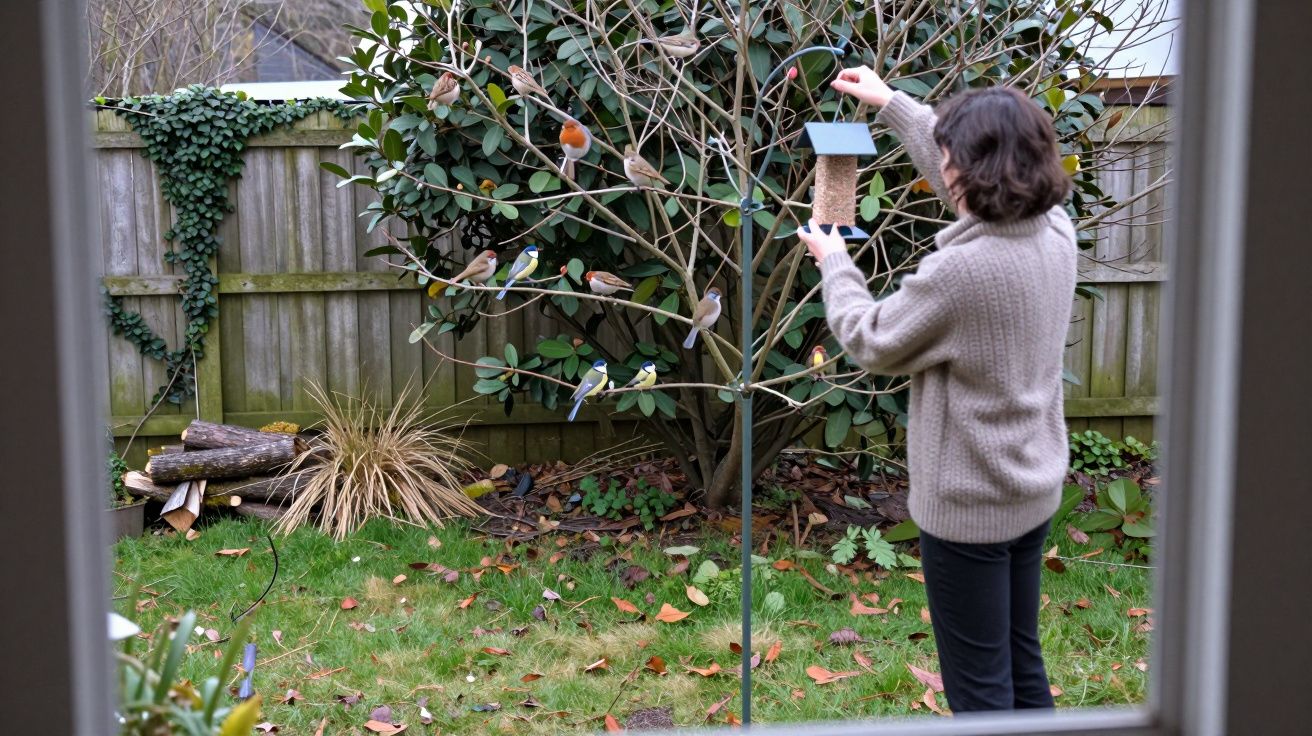
The feeder only came to life when I tucked it closer to cover, not further away. About an arm’s length and a generous step from the big camellia bush – roughly two metres – turned out to be the sweet spot. Near enough for a quick dart to safety, far enough that lurking cats could not turn the shrub into an ambush zone.
The moment I shifted it, the mood changed. First, a dunnock hopped along the fence, clearly taking notes. Then the robin tested a low branch, flicked its tail, and dropped down to investigate. Within three days, the feeder looked busier than a train platform. The food had not changed. Only the geometry had.
We’ve all hung a feeder where a nail already is, or where we can see it from the sofa. Birds don’t care about your viewing angle. They care about escape routes. Two metres from dense cover is often the line between “too risky” and “worth it”.
Reading your garden from a bird’s-eye view
The trick is to walk outside and see your space the way a cold, jittery blackbird might. Stand where you plan to hang the feeder, then slowly turn a full circle. Ask three questions as you go.
- Where is the nearest cover? Think shrubs, hedges, a small tree, even a deep ivy-clad fence. That is the emergency exit.
- Where could a predator hide? Low walls, thick ground-level planting, sheds with blind corners, and, above all, the favourite haunts of local cats.
- What does the wind do here in January? A feeder that swings wildly or knocks against a post will waste birds’ energy and nerves.
If the feeder is currently more than 3–4 metres from cover, most small birds will avoid it in open daylight, especially if there are easier pickings nearby. If it is right inside a tangle of branches, bigger birds may struggle to land cleanly, and everything will feel cramped.
What you want is sight-lines: a clear approach and a fast retreat.
Simple placement tweaks that work in real gardens
You do not need to redesign the garden to fix this. A few small shifts often change the traffic overnight.
- Bring the feeder nearer to shrubs, not the patio door. Aim for that two‑metre buffer rather than the very centre of the lawn.
- Raise it out of pounce range. Hang or mount feeders so that the lowest perch is at least 1.5 metres off the ground, away from handy launchpads like bins or low walls.
- Cluster, but don’t crowd. Group a seed feeder, fat ball cage, and suet block within a small area so birds can hop between them, but give each one enough gap that wings are not bumping.
- Tame the swing. If a feeder dangles from a long chain, shorten it or add a stabilising hook to a bracket so winter winds don’t turn every visit into an ordeal.
- Keep windows in mind. Place feeders either very close to glass (less than a metre) or a clear distance away (more than three metres) to reduce high‑speed collisions.
Let’s be honest: nobody goes outside with a tape measure and a blueprint for tits. You don’t have to. An afternoon of small experiments, watching which perches they try and which they shun, will tell you more than any diagram.
When “too tidy” is the problem
A manicured winter garden can be strangely hostile. Dead stems are trimmed, leaves hoovered, borders scraped back to bare soil. It looks neat to us and barren to them. No insects, no seedheads, nowhere to lurk between feeds.
The winter birds that ignore your feeder might be happily working through your neighbour’s unpruned hedge or messy corner, where cover and snacks coexist. That scruff offers a safe waiting room. They can perch, preen, and dart in to feed when the coast is clear.
You do not have to abandon tidiness entirely. You can leave one patch deliberately looser:
- A clump of ornamental grass left uncut until spring.
- A strip of hedge allowed to stay dense and slightly shaggy.
- A small log pile against a fence, with leaf litter tucked in.
That bit of visual noise near your feeder helps birds feel there is a whole mini‑ecosystem to support them, not just a lonely metal tube full of peanuts.
Feeders, food, and the myth of “they’ve all disappeared”
Sometimes, nothing is wrong with your setup at all. The birds have simply found a better offer that week. In a mild winter, natural food – berries, seedheads, grubs in bark – can stay plentiful far longer than we expect. They will take that first.
Your feeder is a backup plan, not always the main event. The goal is to be the place they trust when the wild menu thins out. That means:
- Keeping feeders reasonably clean, so mould and droppings do not build up.
- Avoiding giant hoppers that stay half‑full and stale for weeks.
- Offering mixed foods – sunflower hearts, a good-quality seed blend, and suet – so different species can take what they need quickly and go.
You may notice quiet weeks when your feeder looks ignored, then a sudden rush of visitors when a cold snap hits. That rhythm is normal. Location makes sure that when they need you, they can use you safely.
A quick placement checklist that actually gets used
If you want something to check in five minutes rather than a long theory lesson, work through this once, then adjust.
- Is the feeder about two metres from decent cover – not hugging it, not stranded?
- Can a cat hide within a couple of leaps of it?
- Is there a clear flight path in and out, without tight gaps or fluttering laundry?
- Does the feeder stay relatively still on an average windy day?
- Can you see it from a window without making every approach feel like a spotlight?
If you can tick most of those, you are offering a place that respects winter nerves as much as winter hunger. Birds learn these places fast, and word spreads on wings.
What changed when I moved mine
My garden did not turn into a wildlife documentary overnight. What changed was more subtle and more satisfying. The robin stopped doing suspicious drive‑bys and started using the feeder daily. A little knot of long‑tailed tits began turning up in a whirl once or twice a week, moving like a single thought.
I still get quiet patches, especially when the ivy on the back wall is heavy with berries. The difference is that, now, when the temperature drops and the wild food disappears, the hook outside my window does not stay empty. It hums quietly with the business of small lives carrying on.
The feeder did not need more gadgets, more exotic seed, or another shopping trip. It needed respect for what a tense little body risks when it lands. A two‑metre shuffle gave it that.
FAQ:
- Why did my feeder go quiet as soon as I refilled it?
Birds are wary of sudden changes. A newly cleaned or moved feeder can take a few days to feel “proven” again. Keep it in one place, avoid heavy scents, and give them time to rebuild trust.- Should I put the feeder right in a tree to protect them?
Not quite. Tuck it near a tree or shrub, but not deep inside. Too much cover makes it easier for predators to lurk and harder for birds to escape cleanly.- What if I only have a balcony, no shrubs or trees?
Use planters, a small trellis, or even a bamboo screen to create a sense of cover, and place the feeder close to that structure while keeping it out of reach of cats below.- Do I need different feeders for different species?
A basic seed feeder and a suet block or fat ball holder will serve most common garden birds. Location and consistency matter more than a long row of specialised gadgets.- How often should I move the feeder once I’ve found a good spot?
As little as possible. Birds like predictability. Only shift it if droppings build up underneath, predators start lurking, or you discover a clearly safer position.



Comments (0)
No comments yet. Be the first to comment!
Leave a Comment