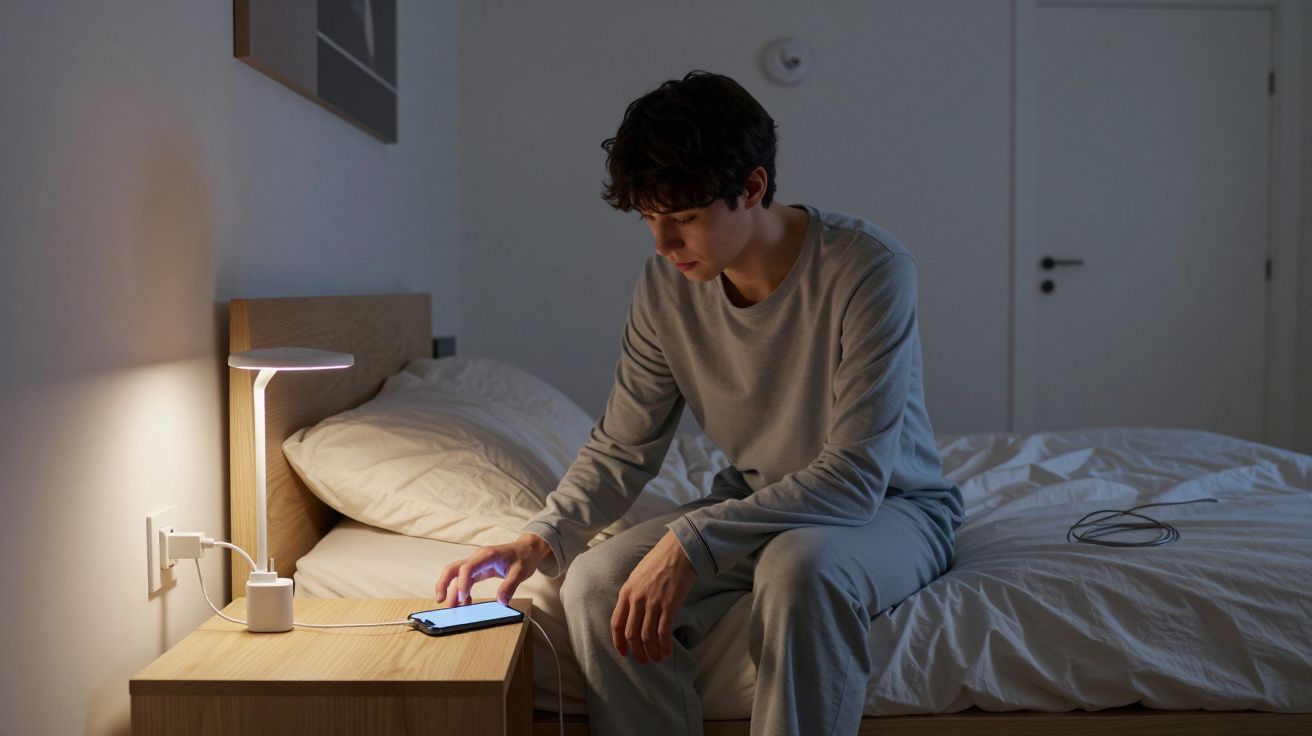
Why charging your phone overnight in bed worries fire brigades more than you think
The glow of a screen on the duvet feels harmless. You plug in, scroll a bit too long, let the phone slip onto a pillow and fall asleep. Somewhere in the small hours a cable warms, a battery hits 100%, a cushion traps the heat, and the tiny risk you never notice in the day quietly climbs. Fire crews see the end of that story more often than you think.
Across brigade briefings and fire‑investigation reports, a quieter message keeps surfacing: it is not just “cheap chargers” that start bedroom fires. It is soft furnishings, clutter, tired lithium batteries and the habit of charging unsupervised on the bed. Change those and you cut the risk more than any miracle “fireproof” case ever will.
Why the way you charge matters more than the brand on the box
Modern phones carry dense lithium‑ion batteries that juggle a lot of energy in a small space. Under normal conditions, the built‑in protections work: they limit current, ease off at 100%, and shut things down if something goes badly wrong. The trouble starts when heat has nowhere to go, cables are damaged, or outlets are loaded with a web of adapters and multi‑way blocks.
A phone under a pillow or tangled in bedding cannot shed heat properly. A bent third‑party cable may arc at the plug. An old power bank or swollen battery can tip from “a bit warm” into thermal runaway, where heat feeds heat and plastics around it start to burn. By the time you smell anything, you may have seconds, not minutes.
Cool surface, clear space, awake person nearby: that trio matters more than you think when you plug in for the night.
The three big hazards hiding in bedtime charging
Not every risk looks dramatic. Fire investigators repeatedly find the same quiet culprits after a bedroom fire.
| Hidden hazard | Why it matters |
|---|---|
| Soft furnishings | Duvets, pillows and throws insulate heat and burn fast once alight. |
| Tired batteries & cables | Wear, kinks and swelling defeat built‑in safety margins. |
| Overloaded sockets | Multi‑plugs and cubes add heat and failure points at the wall. |
A phone on a hard bedside table with a certified charger behaves very differently to one wedged under a sleeping teenager’s shoulder on an overloaded extension lead. The hardware might be identical; the environment is not.
What fire brigades actually see when phones go wrong
Talk to crew members and you hear similar scenes. A scorched patch on a mattress where a device sat on charge atop a fleece throw. A melted charging block on a cheap cube adaptor that fed four devices from one tired wall socket. A desk‑fan and a phone sharing a cable‑tower that overheated behind curtains.
None of these fires began with an impressive bang. They typically start as a smoulder: a hot connector softens plastic, foam spits out toxic smoke, and by the time flames show, thick fumes already fill the room. Sleeping occupants breathe those fumes first.
One investigator describes a pattern: “We find chargers wrapped around bedposts, cables repaired with tape, power banks under pillows. People don’t plan a fire; they just plan to be comfortable.” The risk is not about panic, it is about habits.
A seven‑step bedtime routine that crews wish every household used
You do not need new gadgets to make charging safer. You need a repeatable routine that works even when you are half‑asleep.
- Pick a hard surface: use a bedside table, shelf or desk for charging, not the bed, sofa or carpet.
- Give it air: keep phones, tablets and power banks uncovered, with a hand’s width around them so heat can escape.
- Use proper kit: stick to chargers and leads from the phone maker or reputable brands with clear safety markings (like UKCA/CE).
- Check cables: bin frayed, kinked or loose leads instead of taping or twisting them “just for now”.
- Tame the socket: avoid stacking adapters; plug high‑draw chargers directly into the wall or a decent surge‑protected strip.
- Think “awake charging”: top up in the evening while you are still up, not just when you collapse into bed.
- Close the door: at night, keep bedroom doors shut; if something does ignite, that barrier slows smoke and flames.
None of these steps is dramatic. Together, they turn a risky scene – hot device, soft fabric, no supervision – into a much calmer one for the power grid in your bedroom.
Why “on the bed” turns a small fault into a fast fire
Beds are comfortable precisely because they trap heat. Foam, feathers and synthetic fillings all hold warm air close to your body. A charging phone or laptop left on that same surface slowly warms the patch beneath it. Add a pillow or duvet over the top and you build a tiny oven.
Lithium batteries do not like being squeezed, bent or overheated. Their safety layers can break down, creating internal short circuits. In a worst‑case fault, they enter thermal runaway, releasing gas and more heat in a tight feedback loop. On a desk, that is nasty but often containable. On a mattress, there is immediate fuel.
The bed is the perfect fuel, the pillow is the perfect insulator, and a hot battery is an eager ignition source.
Many bedroom fires never make the news because smoke alarms sound, doors hold for a while, and firefighters get there in time. Those same crews will tell you: swap a mattress and duvet for a bare shelf and the incident might never have started.
Spotting the early warning signs on your kit
Most risky chargers and batteries do not fail out of the blue. They give off small clues first.
Look for:
- Cables with exposed metal, melted plastic or greenish staining on the plug.
- Plugs that wobble in the socket, feel hotter than you can comfortably hold, or smell of hot dust or plastic.
- Phones or power banks that swell, rock on a flat table, or show gaps around the screen edges.
- Devices that only charge if you hold the connector at an angle, or that randomly drop charge.
Any one of these is a nudge to replace, not to persevere. A new lead costs less than a takeaway. Rebuilding a bedroom costs rather more.
Small layout changes that quietly cut your risk
You do not need to rewire the house. A few layout tweaks go a long way:
- Move multi‑way extensions off carpets and away from curtains.
- Keep chargers where you can see and reach them, not buried behind the bed.
- Give teenagers a fixed “charging shelf” in their room and agree a “no phone in bed” rule tied to that spot.
- Add one extra smoke alarm in or just outside the main sleeping area if you do not already have one.
You are not aiming for perfection. You are aiming for a room where, if something fails hot, it has very little to catch.
A simple “phone‑safe” checklist for night‑time
Use this as a quick mental run‑through before you turn out the light:
- Is any device charging on the bed, sofa or under a pillow?
- Is any cable visibly damaged, or held together with tape?
- Is any adaptor wobbling in a multi‑plug or stacked on another block?
- Is the bedroom door about to stay open all night?
- Is there at least one smoke alarm you would hear from that room?
Fixing one “yes” a week is enough to turn your bedroom from a likely hotspot into a much quieter place, as far as your local fire station is concerned.
What your future self – and the crew on the engine – will thank you for
Safer charging is dull by design. You will never know which fire you quietly avoided by not tucking your phone under the duvet, or by throwing out that suspect cable before it tried one last charge. Firefighters notice, though, when they see more phones on tables and fewer melted chargers in the bedding.
Teach children where their devices sleep, not just where they sleep. Show them the “hard surface, clear space” rule and explain why power banks do not go under pillows on sleepovers. You are not just protecting a phone; you are buying your family a better chance of hearing the alarm, breathing clean air, and walking out the door if something does go wrong.
FAQ:
- Is it really that bad to charge a phone under my pillow? Yes. Pillows trap heat and can push a warming battery past the point it was designed for, turning a minor fault into a serious fire risk.
- Are cheap chargers always dangerous? Not always, but unbranded, ultra‑cheap chargers are more likely to skip safety tests and use poor components. Sticking to reputable, certified chargers greatly lowers your risk.
- Can I leave my phone on charge all night on a bedside table? It is much safer on a hard, clear surface than in the bed. Ideally use a good‑quality charger, avoid clutter around it, and keep the room door closed with a working smoke alarm nearby.
- Do I need to unplug everything at the wall before sleep? You do not have to unplug every appliance, but anything that runs warm, has a damaged cable, or sits near soft furnishings is worth switching off at night.
- What should I do if my phone battery starts to swell or get very hot? Stop using it, turn it off, disconnect it from the charger, and place it on a non‑flammable surface away from bedding. Arrange a professional repair or replacement and do not puncture or squeeze the battery.



Comments (0)
No comments yet. Be the first to comment!
Leave a Comment