Why drinking from the same plastic bottle all week worries microbiologists
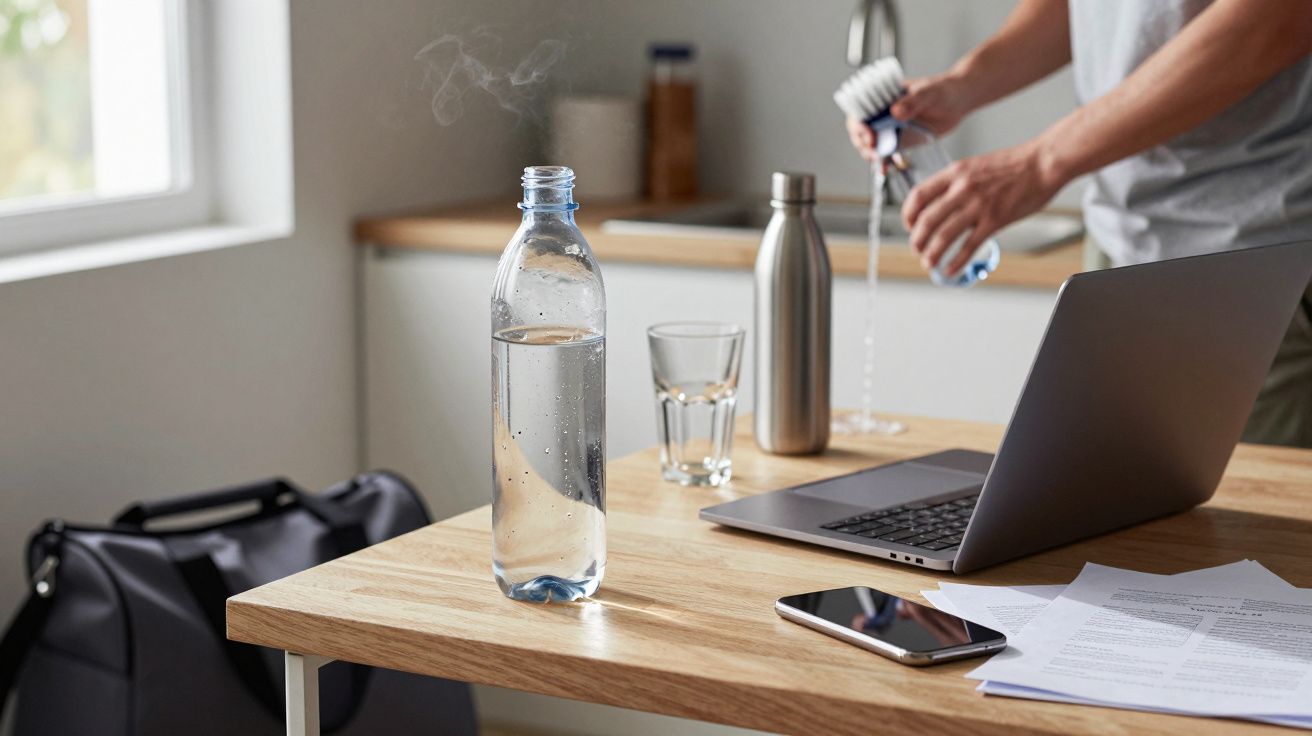
The bottle lives on your desk like a loyal pet. You fill it in the morning, sip between emails, top it up at lunch, carry it to the gym, and take it to bed because you’ll “drink more water that way”. By Friday, the branding is half-rubbed off, the cap creaks a little and there’s a faint smell you can’t quite name. You rinse it when you remember. Properly washing it feels like overkill for something that only ever holds water.
Microbiologists think about that bottle very differently. They picture a warm tube you touch with unwashed hands, breathe over and press against your mouth dozens of times a day. A portable petri dish. They don’t see “still basically clean”. They see a damp, sugar-dusted interior film that never really gets a reset.
The tiny ecosystem hiding in your “just water” bottle
Every sip you take leaves something behind. Not just lipstick rings or coffee backwash, but microscopic traces of saliva, skin cells and food particles. To you, it’s invisible. To bacteria, it’s catering.
When you refill the same bottle over and over without soap, you’re not starting fresh. You’re topping up a mini-reservoir where microbes can hang around, multiply and build a slimy biofilm on the walls. That faint cloudiness or slick feeling inside an older bottle? That’s not “hard water”. It’s life.
In lab tests, reusable bottles that people “only used for water” often carry more bacteria than a kitchen chopping board.
Most of these microbes won’t make a healthy person seriously ill. Many are ordinary mouth bacteria that your body already knows. The concern for microbiologists is the combination of three things: constant moisture, warmth close to body temperature, and repeated contact with your face and hands. It’s a perfect rehearsal space for germs to get comfortable.
Why your weekly bottle habit helps germs settle in
From a microbiologist’s point of view, the problem isn’t that you own a plastic bottle. It’s how you treat it.
- You rarely let it dry fully between refills.
- You top up water on top of water, day after day.
- You touch the lid and spout with hands that have met keyboards, loos and door handles.
- You sometimes “park” it on the gym floor or in the bottom of a bag.
Plastic surfaces, especially inside the grooves of screw tops and those pop-up spouts, develop tiny scratches with use. Bacteria love those crevices. Once they form a biofilm, they become harder to shift with a quick swill. Rinsing moves the floaters and leaves the clingers.
Add in backwash – the tiny amount of fluid and microbes that go from your mouth back into the bottle with each sip – and the population grows steadily. Sugar from the odd juice or flavoured tablet, milk traces from a previous protein shake, or even remnants of herbal tea make the feast richer. What feels like “just water now” still carries yesterday’s menu.
Microbiologists worry because we’ve grown used to reusing single-use bottles the same way we treat reusable ones, without the cleaning routines those need.
The health risks: mostly mild – until they’re not
For most people, the outcome of a grimy bottle is subtle: a funny taste one afternoon, a slight queasiness you blame on lunch, a sore throat that might be a cold. It’s rarely dramatic. That’s why the habit sticks.
But given the right circumstances, that bottle can become a more serious vehicle:
- Stomach upsets and diarrhoea if opportunistic bacteria like certain strains of E. coli or Pseudomonas find a foothold.
- Recurrent sore throats or mouth irritation when you keep reintroducing the same oral bacteria in high numbers.
- Higher risk for vulnerable people – young children, pregnant women, older adults, or anyone with a weakened immune system.
Microbiologists see these bottles as “multipliers”: they don’t just hold what you drank once; they give it time and comfort to expand.
The lid design matters here. Flip caps, sports nozzles and built-in straws are harder to clean well and stay damp longer. Germs in those narrow spaces don’t need much to keep going – a bit of condensation and a warm room is enough.
None of this means you should be afraid of your water bottle. It means you should treat it more like cutlery than furniture: something that goes near your mouth and deserves proper washing, not occasional wishing.
How to keep your favourite bottle – without the invisible gunk
The good news is that microbiologists aren’t asking you to throw out your bottle every Monday. They’re asking you to break the “week-long, no-soap” pattern.
Build a simple, boring routine:
- Wash daily with hot water and washing-up liquid. Use a bottle brush so you actually touch the inner walls.
- Pay extra attention to lids, straws and threads. Those are the crevice hotels for microbes.
- Let it dry fully, open, at least once a day. Bacteria struggle on dry surfaces. Constant damp is their ally.
- Deep-clean weekly. Soak in warm, soapy water or use a sterilising tablet made for baby bottles or sports gear, following the instructions.
If your bottle has a strong smell even after washing, that’s a clue: a biofilm has probably had time to build. At that point, microbiologists would rather you retire it than keep scrubbing forever. Plastic holds onto odours for a reason – it also holds onto what caused them.
Think of it like this: if you wouldn’t drink from the same unwashed glass for a week, your bottle doesn’t deserve that treatment either.
Plastic vs metal vs glass: what microbiologists quietly prefer
Material doesn’t change the laws of microbiology, but it does change your margin for error.
| Material | Microbiologist’s view |
|---|---|
| Stainless steel | Durable, less scratch-prone, tolerates hot washes well. A strong choice if you actually clean it. |
| Glass | Easy to see residue, doesn’t hold odours. Needs a protective sleeve and careful handling. |
| Soft plastic | Light and cheap, but scratches, discolours and holds smells. Fine with strict washing, risky with lazy habits. |
Well-made reusable bottles designed for repeated cleaning usually fare better than flimsy single-use ones pressed into long service. If the plastic is cloudy, warped or permanently scented, microbiologists see a surface that’s been colonised too many times.
Small changes microbiologists wish everyone would make
If you asked a room full of microbiologists what they’d change about everyday bottle habits, their answers would be surprisingly modest.
- Wash the bottle and lid properly every evening, not “when it looks dirty”.
- Stop reusing thin, single-use bottles beyond a day or two.
- Avoid sharing bottles, especially at the gym or with children who are unwell.
- Empty and air-dry the bottle overnight instead of keeping it half full on the bedside table.
- Replace cracked, smelly or heavily scratched bottles without nostalgia.
“We don’t hate reusable bottles,” one microbiologist said. “We hate the myth that clear water means a clean container.”
Clean, reused bottles cut plastic waste, encourage hydration and travel well. The worry comes when “reusable” gets confused with “immune to biology”. Your mouth, your hands and the world you move through don’t stay sterile, and your bottle doesn’t either.
Tweak the ritual and the same object shifts from a quiet concern in a microbiologist’s mind to something they’d happily drink from themselves. Wash, dry, repeat. It’s not glamorous, but it’s the difference between a helpful habit and a hidden culture you never meant to grow.
FAQ:
- Is reusing a plastic bottle for a few days really that bad? One or two days with proper washing in between is very different from a full week of top-ups without soap. The risk builds with time, moisture and neglect, not with the idea of reusing itself.
- Can I just use boiling water to disinfect it? Hot water helps, but soap plus physical scrubbing breaks down the biofilm that bacteria hide in. For plastic, boiling water can also warp the bottle, so use comfortably hot, soapy water instead.
- Are stainless-steel bottles automatically safer? They’re easier to clean thoroughly and less likely to scratch, but they still need daily washing. A dirty metal bottle can harbour as many germs as a dirty plastic one.
- What if I only ever put plain water in it? Your mouth, hands and environment still contribute microbes and tiny food traces. “Just water” doesn’t mean “just sterile”.
- How often should I replace a reusable bottle? There’s no fixed expiry date. Replace it when it stays smelly after washing, shows cracks or deep scratches, or when seals and lids are hard to clean properly.



Comments (0)
No comments yet. Be the first to comment!
Leave a Comment