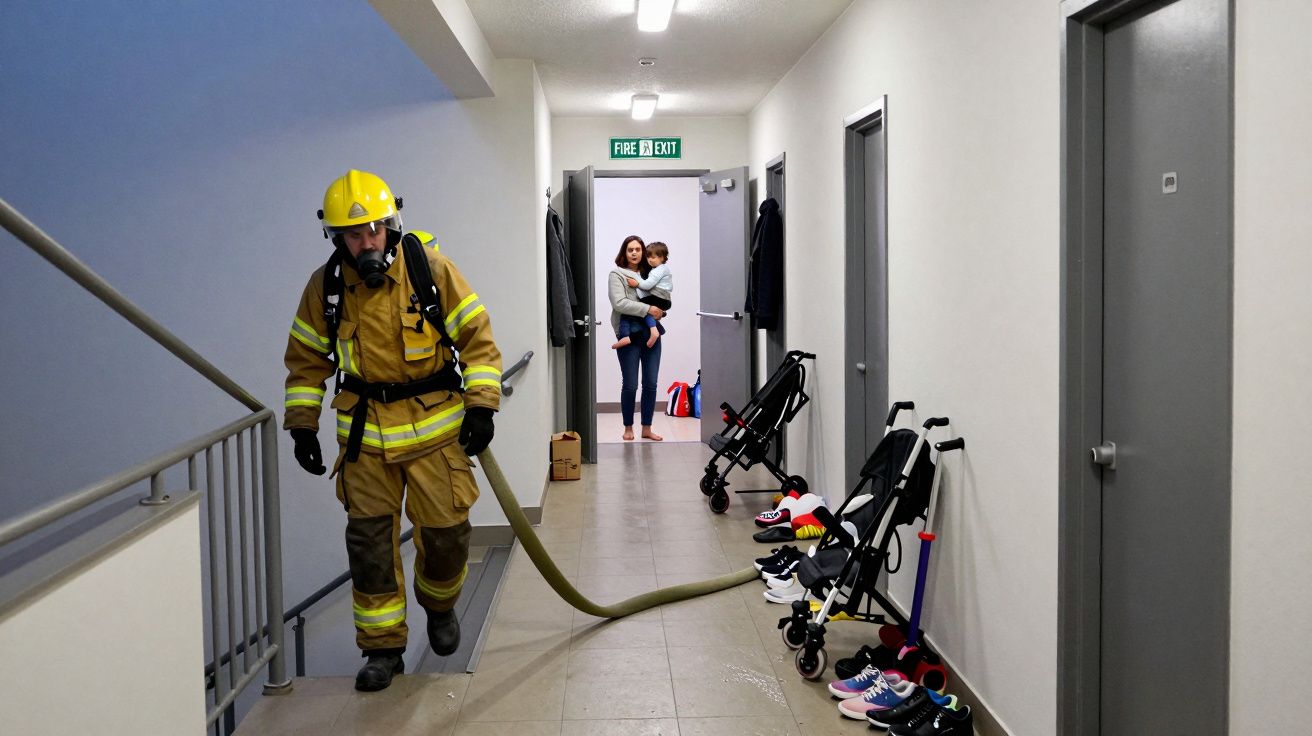
Why firefighters beg people not to block this tiny space on landings with shoes
The warning rarely sounds dramatic. It appears as a line in a fire safety leaflet, a quiet request on a stairwell noticeboard, a passing comment during a home visit: “Please keep landings and escape routes clear.” Then you walk through a block of flats on a wet evening and see the reality-rows of shoes, scooters, pushchairs and parcels pressed neatly along a wall, as if order alone made them harmless.
In most buildings, that “tiny space” on a landing looks like dead room. It feels polite to tuck things there instead of cluttering your hallway. To firefighters, it is not spare space at all. It is your oxygen, your seconds, and the narrow strip of floor that turns a burning building into a building you can walk out of.
The landing that looks tidy until it fills with smoke
In daylight and clear air, a landing with a shoe rack or two still seems generous. You step around it without thinking. Children zigzag past scooters. A neighbour manoeuvres a buggy with a practised tilt of the wrist. It works-until it does not.
Smoke changes the rules in minutes. In a real fire, visibility in a stairwell can drop below a metre. People do not pick their way daintily; they move hunched, coughing, often with one hand on the wall and another gripping a child. What felt like a minor obstacle when you could see becomes a trap when you cannot.
Firefighters say they repeatedly find residents tripping over shoes left outside front doors. In drills, that stumble steals a second. In a real fire, it can cost much more.
Fire crews also use those same landings as their working space. They haul hoses, breathing apparatus, thermal imaging cameras and casualty bags up those stairs. A single abandoned shoe rack can snag a hose or force a firefighter to squeeze sideways with 20–30 kg of kit on their back. That loss of speed and balance is not theoretical; incident reports show injuries linked directly to clutter in escape routes.
Why that “just a few pairs of shoes” matter in a fire
It is tempting to think the risk is mostly about blocked doors. The truth is quieter and more technical. Modern shoes, prams and plastic storage boxes burn faster and dirtier than many people realise. Foams, synthetic fabrics and plastics can produce thick, toxic smoke long before flames reach them.
A small fire starting inside one flat spreads heat and smoke into the communal area. If that corridor or landing is lined with combustible items, it effectively becomes extra fuel.
- More fuel means more heat sooner, which can damage the integrity of doors and walls faster.
- More plastic and foam means more choking smoke, which is what kills most people in fires.
A single pushchair can produce a surprising amount of heat and smoke when burning. Add cardboard boxes of deliveries, a wooden shoe cabinet and a couple of plastic crates, and you have unintentionally built a fire load right on your only way out.
From a regulatory point of view, communal areas are designed as escape routes, not storage rooms. When residents line them with belongings, they quietly change what those spaces are. The building’s fire strategy, evacuation timing and even door ratings were calculated on the assumption that corridor and landing surfaces would be bare.
The gap you owe your future self
Fire services do not ask you to strip your life down to bare walls. They ask for something very specific: a clean, continuous route from your door to safety. Think of it as a corridor you are setting aside for the worst day you hope never comes.
A practical way to picture it:
Imagine trying to carry a sleepy child, in low light, through that landing. If your elbow would brush it or your foot might catch it, it should not be there.
In many blocks, that translates to a simple rule of thumb:
- No shoes, mats or plant pots outside flat doors.
- No prams, bikes or mobility scooters parked in corridors or on landings.
- No temporary “I’ll just leave it here for an hour” piles of recycling or deliveries.
Those rules are not written to spoil neighbourliness or tidiness. They exist because fire crews have seen too many near-misses in spaces that were “almost clear”. A 30-centimetre shoe rack may look trivial. In a panic, in smoke, in the dark, it is not.
What firefighters actually need on your landing
From a firefighter’s perspective, a good communal landing is almost boring. It is bare, wide, and predictable. Doors open fully. Handrails are reachable. Corners are visible. That plainness buys them room to work and you time to leave.
There are three quiet priorities:
Clear width
Staircases and landings are designed with a minimum width so several people can move at once while firefighters enter. Even a small shelf or cluster of shoes narrows that width and creates pinch points.No extra fuel
Every added object is something that can burn or melt. Removing those objects keeps heat and smoke lower for longer, giving fire doors and alarms time to do their job.Line of sight
In smoke, firefighters rely on memory and touch, but in the early stages of an incident, clear sight lines help them identify doors, signage and potential casualties quickly.
Many services now actively encourage residents to report clutter in communal areas, not to shame neighbours, but to intervene before a bad habit hardens into accepted décor.
“But I’ve got no space inside”: realistic alternatives
The practical pressures are real. Small flats, no ground-floor space, cramped hallways-it is easy to see why landings become overflow storage. The task is not to deny that pressure, but to redirect it.
You can usually make three changes without spending much or starting an argument with your housing provider:
- Move storage fully inside the flat:
Install over-door hooks, narrow shoe cabinets and under-bed boxes. A tall shoe rack in a bedroom is annoying; a shoe rack on a landing can be deadly. - Use approved communal storage, not improvised corners:
Some buildings provide designated pram or bike stores with fire-resistant construction. If they exist, use them. If they do not, ask your landlord or managing agent to explore options. - Adopt a “nothing stays out” rule for deliveries:
Collect parcels as soon as possible, and avoid leaving recycling or rubbish sacks in corridors “for later”. Even overnight is too long.
Where space is genuinely unworkable, tenant groups and residents’ associations have a strong argument when they approach landlords: “We want to comply with fire guidance; help us with practical storage solutions.” It reframes the issue from enforcement to partnership.
What to do if your neighbour’s landing is full
Awkwardness stops many people from saying anything when a neighbour’s dozens of shoes or a bulky pushchair creep into the shared landing. The risk, however, is shared too. If a fire breaks out, your exit route is just as affected as theirs.
A calm, staged approach often works best:
Start with information, not accusation.
A simple printed note from the managing agent or a fire safety leaflet in the communal entrance can set the baseline without singling anyone out.Use the building’s official channels.
Report persistent clutter to your landlord, housing association or management company. They carry legal responsibilities for common areas and should have a clear-fire-policy.Frame it as protection, not personal taste.
When talking to neighbours, use phrases like, “The fire brigade have said…” or “The building’s safety notice asks us to keep this space clear,” rather than, “I don’t like your shoes here.”
Landlords who ignore repeated reports are not just being unhelpful; they may be in breach of fire safety legislation. Keeping a written record of concerns, photographs and dates strengthens any future investigation if something goes wrong.
Five-minute checks that actually make a difference
You do not need to become a fire engineer to protect your staircase. A short monthly walk-through and a handful of habits go a long way.
- Walk your whole escape route-from your bed to the street-imagining it full of smoke. Clear anything your feet or shoulders would hit.
- Check that communal doors close themselves fully and are not wedged open with furniture or mats.
- Move all shoes, bags and buggies fully inside your own flat, even if it means reorganising a cupboard.
- Ensure emergency lighting, exit signs and call points are not obscured by noticeboards, plants or decorations.
- If you see new clutter building up, raise it early before it becomes “how things are”.
None of these steps look heroic in the moment. They are small, routine corrections-more like wiping a spill than rebuilding a wall. Yet they are the difference between a stairwell that fills with panic and one that quietly does its job when alarms sound.
Firefighters are not asking you to imagine a blaze every time you open your door. They are asking you to leave them the space to reach you if that day ever comes.
FAQ:
- Is it actually illegal to leave shoes on a communal landing?
Often, yes. Fire safety regulations treat shared corridors and landings as escape routes that must be kept clear of obstructions and combustible materials. Exact enforcement varies by landlord and local authority, but many tenancy agreements explicitly ban storage in these areas.- What about a tiny doormat-does that matter?
A flat, non-combustible mat that does not reduce the width of the escape route is usually tolerated. Problems start when mats become piles-shoes, umbrellas, parcels or decorative furniture creeping into the walkway.- Where should prams and bikes go in a block of flats?
Ideally in designated stores or inside your own flat. If your building offers no safe storage, you can collectively ask the landlord or managing agent to provide a compliant solution rather than informally colonising landings.- Why do firefighters make such a fuss about “a few obstacles” if alarms will warn us anyway?
Alarms buy time; clear routes let you use it. Most fire deaths in homes are from smoke inhalation, not burns. Anything that slows you down or adds fuel to a corridor can turn survivable conditions into lethal ones more quickly.- What should I do if my landlord ignores clutter in communal areas?
Raise the issue in writing, keep records, and if nothing changes, contact your local fire and rescue service or housing authority. They can carry out inspections and, where necessary, enforce changes to keep escape routes clear.




Comments (0)
No comments yet. Be the first to comment!
Leave a Comment