Why hanging family photos in this one room boosts emotional resilience for children
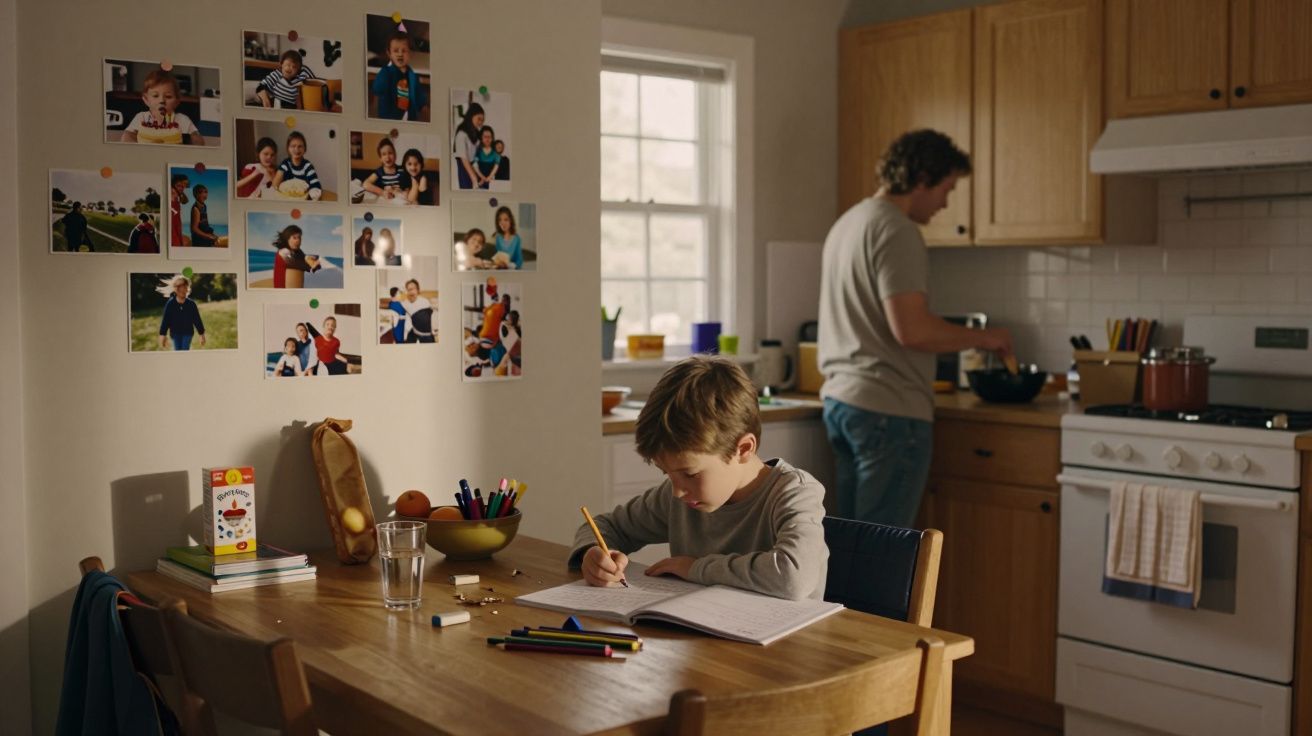
By late afternoon, the house is mostly noise. Shoes in the hallway, a half‑finished worksheet on the table, someone asking what’s for tea before you’ve even taken your coat off. Then you walk into the kitchen and there they are: a crooked row of holiday snaps, a school photo with missing teeth, a faded print of Grandma holding a baby who is now taller than you. It is ordinary, domestic, almost boring.
It is also one of the quietest ways you are wiring your child’s sense of who they are.
Photos do not just record the past. For children, they act like a mirror and a map at the same time. The room you choose to hang them in changes how often that mirror is seen, and how often that map is read. Put them in the loft and they become archaeology. Put them in the kitchen and they become infrastructure.
Why the kitchen wall matters more than the hallway gallery
Most homes have a natural gallery space: the staircase, the hallway, that neat grid on the living‑room wall. Those places look good. The frames line up, visitors comment, and everything feels curated. Children walk past them quickly, on the way somewhere else.
The kitchen behaves differently. Children loiter there: over cereal, waiting for toast, leaning on a counter while you stir a pan. Their eyes wander when their hands are busy, and what sits at eye level soaks in without effort. A family photo in a kitchen is not an exhibit, it is background radiation.
Psychologists sometimes call this ambient belonging - the sense that “this is my place and my people” without anyone saying it out loud. Children do not need a speech about family values; they need a hundred small proofs that they are seen, wanted and part of a story that started before them and will go on after. A scrappy collage by the fridge can do more for that than the most perfect gallery wall on the stairs.
Photos as emotional “anchors” during everyday storms
Stress for children rarely arrives as a single dramatic moment. It shows up as a bad spelling test, a friendship wobble, a football trial that goes sideways. Most of those feelings peak in the most ordinary room in the house - the kitchen - while they are dropping a bag or asking for help with homework.
A visible photo in that moment can work like a tiny emotional anchor. The brain registers familiar faces, especially smiling ones, in fractions of a second. Those faces are tied to memories of being held, laughed with, celebrated. When a child glances up and catches their own small self on a beach, wedged between parents, the body often softens before the mind has found words.
This is not magic, it is pattern. Over time, the child learns - without anyone explaining it - that even when the day has gone wrong, the larger story has not. They place a bad mark or a harsh comment inside a bigger frame that includes birthdays, messy cakes, muddy walks and people who look at them the way you do in those pictures. That is the seed of emotional resilience: “Things are hard, but I am not alone and I have done hard things before.”
Think of photos in the kitchen as emotional subtitles: quiet lines under the chaos that keep saying, “You belong here. You have survived other days. You are more than this moment.”
Choose moments that tell a deeper story, not just the glossy ones
It is tempting to only print the perfect shots: everyone facing forward, matching outfits, no one crying. Those have their place. But a wall of flawless images can accidentally tell a false story - that family life is smooth, success is expected, and you are supposed to look composed while it happens.
Resilient children do not learn that life is perfect. They learn that it is bumpy and still worth loving.
When you are choosing what to hang in the most lived‑in room of the house, think about balance rather than polish:
- A snapped picture of a child helping to stir batter, flour on their jumper.
- A blurred birthday moment where the cake is tipping and everyone is laughing.
- A shot of a grandparent mid‑story, hands moving, child half on their lap.
- A rainy‑day walk where everyone looks windswept but together.
These images say: we try things, they are messy, and we are alright anyway. They model coping much more honestly than the staged smiles on a studio backdrop. When a child sees themselves in those “in‑between” moments, they get quiet permission to be imperfect and still loved.
Small rituals that make the wall feel alive
Hanging photos once and never touching them can turn them into wallpaper. Children adapt fast; what is always there can become invisible. The goal is not constant redesign, but gentle change that signals, “Your life now matters enough to join the wall.”
A few low‑effort ways to keep that message moving:
- Swap or add one photo at the end of each school year, letting your child choose which moment to print.
- Use simple clips, pegs or washi tape so children can pin up a drawing or a ticket stub beside a photo.
- Create a “strip” of small prints at child eye level, not just adult height.
- Ask, while you eat, “Which picture on this wall do you remember best?” and let the story run.
These tiny rituals do more than decorate. They teach that the story of the family is still being written and that the child is allowed to be its editor as well as its subject. That sense of agency - “I help decide which parts of my life matter” - underpins resilience when life later feels out of control.
A simple layout that quietly works
| Focus | What to display | Why it helps a child |
|---|---|---|
| Belonging | Photos with multiple generations, siblings together | Signals “I am part of something bigger” |
| Competence | Moments of trying, not just winning (learning to ride, baking, first day at club) | Reinforces “I can do hard new things” |
| Care | Everyday affection: reading together, cuddles, jokes | Embeds “There are people who hold me when it’s hard” |
When children do not live in one home
Not every child moves through one neat, nuclear kitchen. Some split weeks between households. Some live with grandparents, foster carers or in shared care arrangements. The idea still holds, but the execution matters even more.
In any kitchen a child regularly uses, try to make a small, steady pocket of “their” story. The frame does not need to be big or central. It just needs to be reliable. A single clip frame with three photos that never get packed away between visits can say, “You exist here even when you are not physically here.”
If family relationships are complicated, widen the circle:
- Include photos of close friends, trusted adults, teachers or coaches.
- Use pictures that focus on shared activities rather than specific labels (“Mum”, “Dad”).
- Let the child lead on who appears; their sense of family may be broader than the legal one.
Resilience for these children often starts with the message: “Your life is not defined by what you lack, but by the web of people who keep showing up.” A small photo cluster in a shared kitchen can hold that web where they can see it every day.
Making it work in real life, not in a magazine
There is a risk that any talk of “curating walls” slides into pressure: another thing you are supposed to get right, with matching frames and perfect light. Children do not need that. They need proof.
A printed snapshot with a bent corner, held up by blu‑tack on a cupboard door, does the emotional job as well as anything you could buy. You do not have to be artistic or organised; you just have to be willing to let the evidence of your life together stay visible, even when it does not match the paint.
If your kitchen is tiny, use the side of the fridge. If you rent and cannot mark the walls, use a cork board or a strip of magnetic tape. If printing photos feels like a major task, choose one afternoon, once a year, and order ten. Repeat that quietly and your child will grow up in a moving gallery of proof that they have been loved, in all their versions.
Emotional resilience does not arrive in a grand lesson. It accumulates in glances: every time a child looks up from a hard day’s homework and sees their small self laughing in your arms, and realises that both truths can live in the same room.
FAQ:
- Does it have to be the kitchen? No, but it helps if it is a room where your child naturally pauses several times a day - often the kitchen or dining area. The more everyday the space, the more often the quiet reassurance lands.
- Won’t children get bored of seeing the same photos? Familiarity is part of the comfort, but small, regular additions or swaps keep the wall feeling alive. Think evolution, not overhaul.
- What if my family situation is painful or has changed? You can still create a wall that centres safety and care: include trusted adults, friends and new traditions. It is fine to retire photos that trigger distress and replace them with images that reflect your child’s present support network.
- Are digital photo frames just as good? They can help, especially in small spaces, but constant movement can make it harder for children to “fix” on a single comforting image. A mix of one or two steady printed photos and digital ones works well.


Comments (0)
No comments yet. Be the first to comment!
Leave a Comment