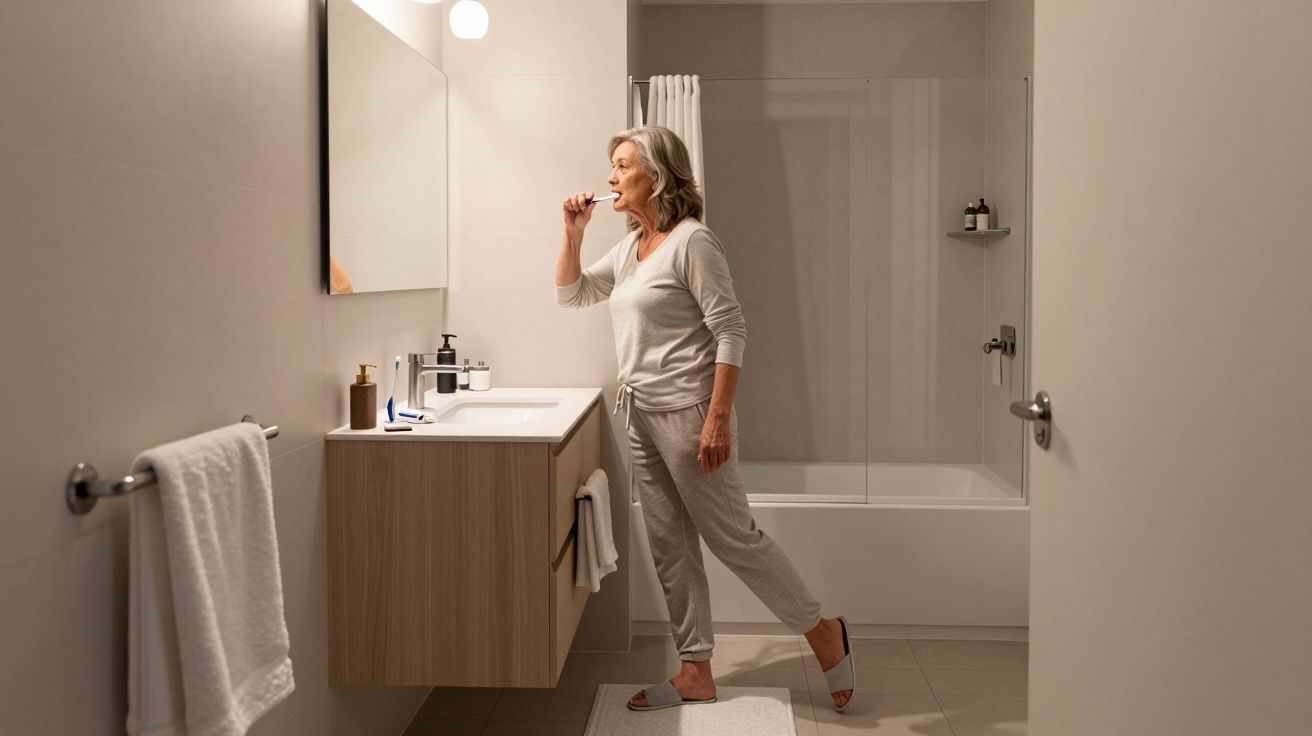
Why standing on one leg to brush your teeth could keep you steadier on your feet in old age
For most of us, brushing our teeth is the definition of autopilot. Same tap, same mirror, same two minutes twice a day. You are there in body, but your mind is scrolling through emails, tomorrow’s meeting, what’s for breakfast. What you almost certainly are not thinking is: this could be my daily balance workout.
Yet quietly, physiotherapists and geriatric specialists have been slipping a simple suggestion into their advice: stand on one leg while you brush. No fancy kit, no gym membership, no Lycra. Just you, a toothbrush and the slightly unnerving discovery that you are wobblier than you thought.
Hidden in that wobble is a crucial skill that could make the difference, decades from now, between walking confidently or fearing every uneven pavement.
The day you discover your balance isn’t what you thought
We grow up assuming that balance is something you either have or you don’t. The kid who can spin on a beam, the mate who never seems to trip, the grandparent who “still has good balance for their age”. It feels like a personality trait, not a system that needs regular maintenance.
Try this: tonight, when you brush your teeth, lift one foot just a few centimetres. Keep your eyes open. Notice what happens in your ankle, your hips, your stomach muscles. Many people are surprised to find they start to sway almost immediately. Some have to grab the sink.
Nothing dramatic has changed since yesterday. But your inner balance system - eyes, inner ear, joints, muscles and brain - has had very little training for single‑leg work in years. You walk, you sit, you stand on two feet. You very rarely ask your body to do something as basic as calmly holding one leg off the ground for 30 seconds.
That’s the awkward truth behind falls in later life. It isn’t that people suddenly become clumsy at 75. It’s that the stitched‑together system that keeps you upright has been quietly losing practice for decades.
Why balance fades long before we notice
On paper, it sounds simple: stand up straight, don’t fall over. Underneath, there is a constant stream of data: your eyes judging the horizon, your inner ear sensing movement, tiny receptors in your feet reporting pressure, your brain issuing microscopic corrections.
From around your forties, several of these systems start to decline. Muscles shrink gradually, especially around hips and thighs. Nerves conduct signals a little more slowly. The inner ear becomes less sensitive. None of this is dramatic enough to show up in a single year, but over twenty or thirty it adds up.
The problem is that daily life rarely challenges balance enough to expose the slide. Smooth pavements and lifts are not a training ground. You can go years without crouching on one leg, walking on a narrow beam or turning your head sharply while stepping over something. The first real test often comes too late - a missed kerb, a wet bathroom floor, a ladder that wobbles once.
In that moment, you do not have time to construct new reflexes. You rely on what you have already built.
The quiet crisis: why falls matter so much in old age
It is easy to joke about being a bit wobbly. The statistics are less funny. In older adults, falls are one of the leading causes of broken hips, head injuries and loss of independence. A single slip can mean weeks in hospital, months of rehab and, for some, a permanent move out of their own home.
What makes it more unsettling is that many of the risk factors sound like ordinary ageing: weaker leg muscles, slower reaction times, reduced sensation in the feet. Add in poor lighting, loose rugs, medication that makes you drowsy, and you have a quiet trap set in an otherwise familiar hallway.
Yet unlike genetics or the date on your birth certificate, balance is trainable. That is the hopeful part. Your nervous system remains plastic well into old age. Give it regular, small challenges, and it will respond with sharper reflexes and stronger muscles. Ignore it, and it will give you exactly what you have asked for: the minimum needed to shuffle through the day.
The strange power of a toothbrush workout
At first glance, “stand on one leg while you brush your teeth” sounds like lifestyle‑blog fluff. In practice, it bundles together exactly the ingredients balance training needs: frequency, low effort, and built‑in habit.
Brushing is already anchored in your day, morning and evening. You do it (hopefully) without fail. Adding a balance task to that slot turns it into a tiny, automatic training session. You do not need willpower to “remember your exercises” - you just attach them to something you would never skip.
Two minutes is longer than it feels. If you alternate legs every 30 seconds, you can get two solid rounds per side without stretching the clock. Do that twice a day and, without leaving your bathroom, you are banking more than four minutes of targeted balance practice.
How to start without scaring yourself (or your dentist)
Begin with success, not drama. The aim is not to prove how bad your balance is; it is to give your brain consistent, slightly challenging practice.
- Start with both hands near the sink. Lift one foot only a few centimetres behind you. If you need to tap down, do it and try again.
- Keep your gaze steady. Pick a point on the wall or mirror. Constant eye movement makes the task harder than it needs to be at first.
- Use time, not heroics. Ten seconds of calm balance beats forty seconds of wild flailing.
- Swap legs halfway. If you brush for two minutes, try 30 seconds per leg, rest on two feet, then repeat.
As this gets easier, you can lift the bar in tiny notches. Close one hand but keep the other hovering near the sink. Turn your head slightly from side to side while staying on one leg. Very gradually, you are teaching your body to manage more difficult situations - the real‑world versions being looking for the bus while stepping off a kerb, or turning to answer someone while you walk.
What’s actually getting stronger when you wobble
It is tempting to think of this as a calf or ankle exercise. In reality, the biggest changes are happening higher up, in your nervous system.
Every time you nearly overbalance and pull yourself back, your brain refines its internal map of where your body is in space. The tiny receptors in your joints, muscles and skin become more sensitive. The pathways between your feet and your spinal cord speed up their response. You are, quite literally, practising the act of not falling.
Muscles do play a role, especially around hips and thighs. Standing on one leg recruits the gluteus medius - a sideways stabiliser at the top of your leg that is crucial for steady walking and stair‑climbing. Many people’s glutes are surprisingly weak after decades of chair‑based living. Single‑leg work wakes them up.
There is also a quiet confidence shift. The first time you catch yourself from falling without grabbing something, your brain files that as proof: we can handle this. Over months, that can erode the fear that makes some older adults walk stiffly and cautiously, ironically increasing their risk of tripping.
Turning a tiny habit into long‑term protection
No single trick in the bathroom will guarantee you never fall. But stacked over months and years, these micro‑sessions create a foundation that more formal exercise can build on.
If you like structure, you can treat your balance practice a bit like a garden plan: small, regular interventions, rotated over time.
| Habit | When | Why it helps |
|---|---|---|
| One‑leg stance while brushing | Twice daily | Frequent, low‑stress balance work |
| Heel‑to‑toe walk along a hallway | After lunch | Trains narrow‑base walking for kerbs and edges |
| Sit‑to‑stand from a chair without hands | TV advert breaks | Builds leg strength for stairs and getting up after a fall |
You do not have to start them all at once. Pick one extra habit and attach it to something you already do. The magic is not in intensity; it is in consistency. Just as your teeth stay healthier through daily brushing rather than a once‑a‑year deep clean, your balance thrives on regular, modest challenges.
Safety first: how to push without tipping over
The aim is to flirt with instability, not to end up on the bathroom floor.
- Have a support within arm’s reach. A sink, a sturdy worktop, a heavy chair. Light fingertips are fine; a full grab is your emergency brake.
- Choose sensible footwear. Bare feet or flat shoes with a good grip beat socks on a slick floor.
- Know your starting line. If you already use a walking aid, begin with very small weight shifts rather than lifting a leg, ideally after speaking to a physiotherapist.
- Avoid multitasking to the point of risk. Once you start turning your head or closing your eyes, the difficulty ramps up quickly. Only add those variations when the basic version feels easy.
Think of it as learning to drive on an empty car park before heading into city traffic. You want plenty of margin for error while your body is still figuring things out.
What this could change in your seventies and eighties
It is hard to care about your “future falls risk” when you are rushing for the bus or scrolling in bed. The payoff feels too distant, too abstract. But zoom out slightly, and the stakes sharpen.
If, ten or twenty years from now, you can still:
- Step off a crowded train without hesitating.
- Carry a shopping bag up the stairs without needing both hands on the rail.
Turn quickly when someone calls your name without feeling your feet slide under you.
then the few minutes you spent over decades, wobbling in front of your bathroom mirror, will have returned extraordinary value.
You may never know which stumble you avoided because your brain reacted a fraction faster, or which near‑miss on a rainy pavement ended in a laugh instead of an ambulance. That is the quiet, unglamorous nature of prevention. Its successes are almost always invisible.
A tiny shift, a steadier future
The next time you stand at the sink, toothpaste on your brush and phone buzzing in the other room, you have a small choice. You can let those two minutes pass as blank time, or you can treat them as a daily investment in the way you will move through the world in later life.
No alarms will sound. No app will applaud you. Just your body, gently re‑learning how to keep you upright on one leg, so that on two legs, in the messy, uneven real world, you feel quietly more secure.
FAQ:
- Am I too old to start balance exercises like this? In most cases, no. Balance can improve at almost any age, but if you already have significant mobility problems or a history of serious falls, speak to your GP or a physiotherapist before changing your routine.
- How long before I notice a difference? Many people feel a little steadier within a few weeks of daily practice, but bigger, more reliable changes usually build over several months. The key is consistency rather than intensity.
- Is standing on one leg enough on its own? It is a strong start, especially if you are currently doing very little. For best protection, combine it with regular walking, some leg‑strength work (like sit‑to‑stands) and, if possible, activities that challenge balance more broadly, such as Tai Chi.
- What if I have osteoporosis? Gentle balance work can still be beneficial, as preventing falls is especially important when bones are fragile. However, it is vital to exercise safely and ideally under professional guidance, particularly when adding more advanced variations.


Comments (0)
No comments yet. Be the first to comment!
Leave a Comment