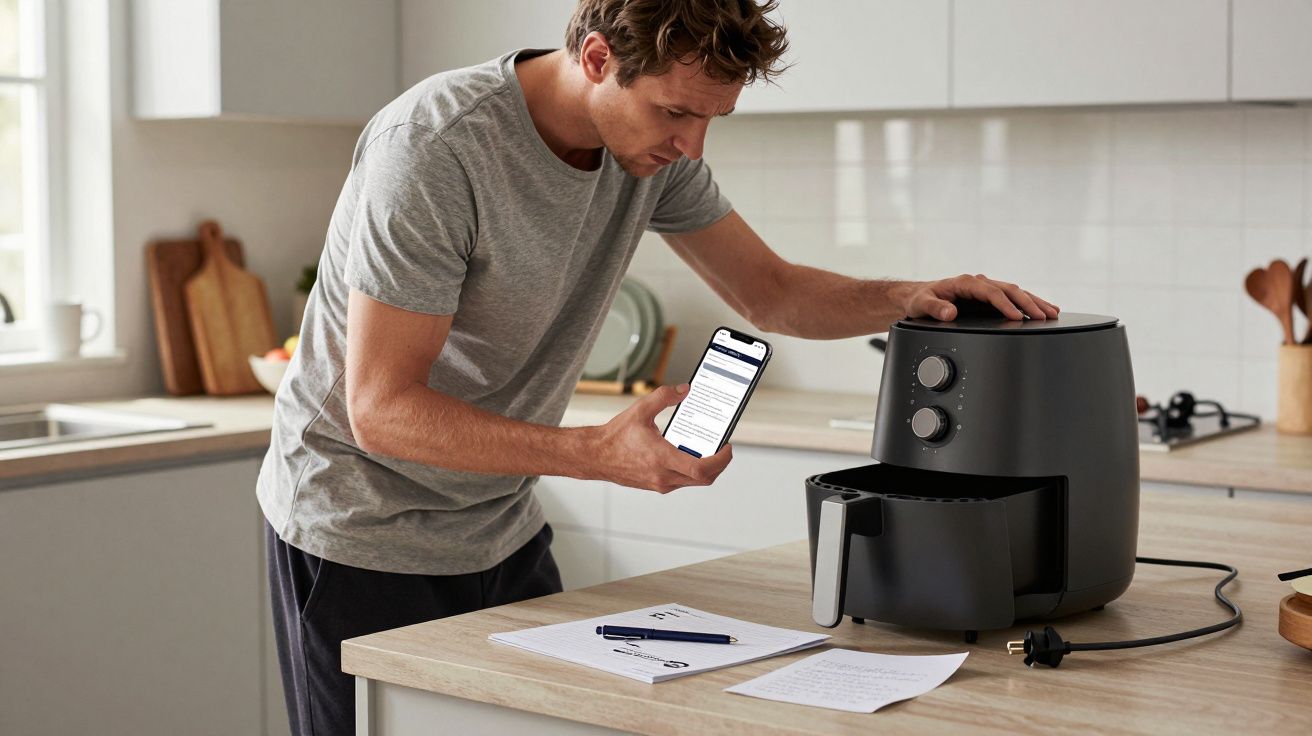
Why you should never bin a faulty air fryer before checking this one manufacturer list
The plug trips, the display dies, or the basket warps with a worrying crunch. An air fryer that once crisped everything from chips to chickpeas suddenly feels like a small bomb in waiting. The instinct is simple: unplug, swear softly, and plan a trip to the tip. Yet that reflex could be costing you money, peace of mind, and sometimes a safer replacement than anything you could buy.
Behind the headlines about exploding appliances and kitchen fires, there is a quieter system at work. Manufacturers and retailers maintain recall lists and safety notices that most people never read. Tucked into those lists are faulty batches, free repairs, and full refunds that only help if you know they exist.
The hidden life of a “dead” air fryer
When a fault is more than bad luck
A blown fuse or a loose handle can feel like random wear and tear. Often it is. Sometimes, though, it’s the visible edge of a known problem: a wiring issue that overheats, a batch of plastic that can’t handle repeated high temperatures, a control board prone to shorting.
Manufacturers track these patterns through returns, warranty claims, and reports from trading standards. When they see the same fault across a batch, they issue a safety notice or product recall. That status quietly turns your flaky appliance into something else: an item the company is obliged to fix, replace or refund.
A “write-off” air fryer on your worktop might appear on a recall list that entitles you to a brand new unit, a repair, or your money back.
Ignoring that possibility means you carry the risk and eat the cost. Checking takes minutes. Not checking can mean paying twice for the same mistake.
How recall lists actually work
Recall lists look dry: model codes, date ranges, batch numbers. They are rarely pushed under your nose unless the fault is serious enough to make the news. More often they sit on a manufacturer’s website, on the retailer’s safety page, or on official portals like the UK government’s product recall listings.
Your air fryer does not have to be brand new or still under its standard guarantee to qualify. Safety recalls sit outside normal warranty rules. A three-year-old model with a known fire risk is still the manufacturer’s problem to solve, not yours. The hurdle is simple but crucial: you need to match their list to your appliance before you give up on it.
The one list to find before you touch the bin
Where to look in the UK
If your air fryer starts playing up, the next step is not the bin, but a short search. Start with three sources:
- The manufacturer’s website – look for a “Product recall”, “Safety notice” or “Support” section.
- The retailer’s website – many big chains host their own product safety pages.
- The official UK database – the government’s “Product Recalls and Alerts” page lists current and historic issues.
Most people never visit these pages until a headline scares them into it. Treat them as part of routine ownership instead. A quick check when you buy, then again if anything feels off, builds a quiet safety net around your kitchen.
The information you need is usually already on the fryer itself: brand, model number, sometimes a batch or production code. With that in hand, the search stops being a vague “is my air fryer dangerous?” and turns into a specific match-or-no-match question.
How to read the codes without losing your temper
The most confusing part is often not the recall itself, but the jumble of letters and numbers on the appliance. You do not have to decipher everything. You just need to match the right bits.
Look for:
- A model number: often near the plug cord, printed on a silver or white label under the base or on the back.
- A batch code or date code: a short string that may include a week and year (for example, 2022-48).
- A brand and product name: the obvious text on the front and in the manual.
On the recall page, you will usually see a table or bullet list with something like “Models affected: AF300UK, AF400UK, batch codes between 2101–2130”. If your label and their list line up, you have a match. If they do not, keep the evidence anyway: photos of the label, proof of purchase, and a short description of the fault ready for support.
Take a clear photo of the rating plate and serial label before you email or call. It turns a vague complaint into a precise case they can’t easily dismiss.
Why throwing it away can make things worse
Safety, cost and the waste problem
Binning a damaged air fryer feels like the safest option once trust is gone. In reality, fast disposal can:
- Waste a chance at a free repair or replacement.
- Mask a pattern of faults that only becomes visible when people report them.
- Add to electrical waste that could have been recovered or recycled under take-back schemes.
From a safety point of view, the worst outcome is not keeping a faulty unit on the worktop; it’s continuing to use it while ignoring worrying signs. The second-worst is quietly dumping it without telling anyone what went wrong. When you report faults, even if they seem minor, you add one more dot to a picture that regulators and manufacturers are trying to see clearly.
From a budget point of view, replacing an air fryer is rarely a small spend. If a recall or extended repair programme covers your model, you may be entitled to a like‑for‑like upgrade at no extra cost. It is one of the few times in life when paperwork actually favours you.
How manufacturers respond when you have a match
Once you find your air fryer on a recall or safety notice list, the process tends to follow a simple script:
- You fill in an online form or call a hotline with model details and your contact info.
- They confirm whether your specific unit is affected.
- They offer one of three routes:
- Collection and repair (for certain fixable faults).
- Replacement with a safe model.
- Refund or voucher, sometimes adjusted for age or original price.
The language may be wrapped in polite disclaimers, but underneath it is a legal obligation. They are not doing you a favour; they are dealing with a safety liability. Staying calm, factual and persistent helps the process move quickly.
If they insist your unit is not on the affected list but you are seeing similar symptoms, ask them to log your case formally. If a wider issue emerges later, your report helps tip the balance towards a new or expanded recall.
A simple checklist before you give up
Five steps to take when your air fryer misbehaves
Before your fryer heads for the bin or the back of a cupboard, pause for ten minutes and work through this:
- Unplug it immediately if you notice burning smells, smoke, scorch marks, flickering displays, or repeated tripping of the electrics.
- Note the symptoms: when they happen, what you were cooking, any error codes or sounds.
- Find the label: take a clear photo of the model number, batch/serial code, voltage and brand logo.
- Check recall pages: manufacturer, retailer, and the UK Product Recalls and Alerts site.
- Contact support: share your photos and a short description; ask directly if your unit is part of any recall or extended repair scheme.
Keep emails and reference numbers. They form a quiet paper trail that can be useful if the issue escalates.
What it might cost – and what you might save
There is no universal figure for what you could save by checking, but the pattern is familiar:
- A mid‑range air fryer: £70–£150 to replace.
- Time spent checking lists and writing a brief email: around 15 minutes.
- Potential outcome if recalled: £0 for a replacement, sometimes with a newer model.
The “cost” sits mostly in mild admin and waiting a week without your favourite crispy potatoes. The gain can be a safer kitchen and money that stays in your account for something you actually want.
| Step | What you do | Why it matters |
|---|---|---|
| 1 | Unplug and document the fault | Keeps you safe and gives evidence |
| 2 | Capture model and batch info | Turns “faulty fryer” into a traceable unit |
| 3 | Search recall lists | Unlocks potential free remedy |
| 4 | Contact support with proof | Triggers their formal process |
| 5 | Decide repair, replace, or recycle | You choose from informed options |
Turning frustration into leverage
When the answer is “no recall, no repair”
Sometimes you will do everything right and still hear: “We’re sorry, but your product is out of warranty and not on a recall list.” This is where most people shrug, sigh, and pay again. You do not have to stop there.
In the UK, your rights sit not only with the manufacturer but with the retailer under the Consumer Rights Act 2015. If an appliance develops a serious fault earlier than reasonably expected for its price and type, you may still have a case for a repair, partial refund or replacement, even outside the basic guarantee.
To use that leverage effectively:
- Be specific: outline the fault, the age of the product, and how often it is used.
- Use calm but clear language: “Not of satisfactory quality” and “not durable as expected” are the phrases the law recognises.
- Ask what they can offer rather than demanding one fixed outcome.
You are not begging for goodwill; you are asking a business to meet its basic obligations for safety and durability.
If the retailer still refuses, you can escalate to their complaints team, use an ombudsman where available, or, in serious safety cases, report to Trading Standards. You may still decide a fresh purchase is simpler, but you will be making a choice, not falling into it.
Making recall checks part of normal life
Like checking smoke alarms or resetting passwords, recall checks work best when they are small, regular, and un-dramatic. You do not need to live in a state of suspicion about every gadget you own. You just need a repeating habit:
- When you buy a new electrical item, register it on the manufacturer’s site.
- Once or twice a year, skim the official recall list for your main brands.
- Any time an appliance behaves oddly, check the lists before using it again.
The point is not to live in fear of your air fryer. It is to make sure you are first in line for help if something goes wrong.
FAQ:
- Is it really worth checking recall lists for a cheap air fryer? Yes. Even budget models can be recalled for safety faults, and you may be entitled to a safer replacement at no extra cost. The price you paid does not cancel the manufacturer’s safety obligations.
- What if I’ve lost the receipt? You can often prove purchase with bank statements, online order histories, or loyalty card records. For safety recalls, some manufacturers will help even without proof of purchase if the model and batch clearly fall within the affected range.
- My air fryer isn’t on any recall, but it smells of burning. Can I keep using it? No. Unplug it, stop using it, and contact support. Recalls lag behind reality; a dangerous fault can exist before it appears on any list. Your report may help trigger wider action.
- Is throwing it in the normal bin okay once it’s dead? No. In the UK, small appliances count as WEEE (Waste Electrical and Electronic Equipment) and should go to proper recycling points or retailer take‑back schemes. Many shops will collect old units when you buy a new one.
- Do I have to register products when I buy them? You do not have to, but it helps. Registration means the manufacturer can contact you directly about recalls or safety upgrades instead of hoping you stumble across a notice online.





Comments (0)
No comments yet. Be the first to comment!
Leave a Comment