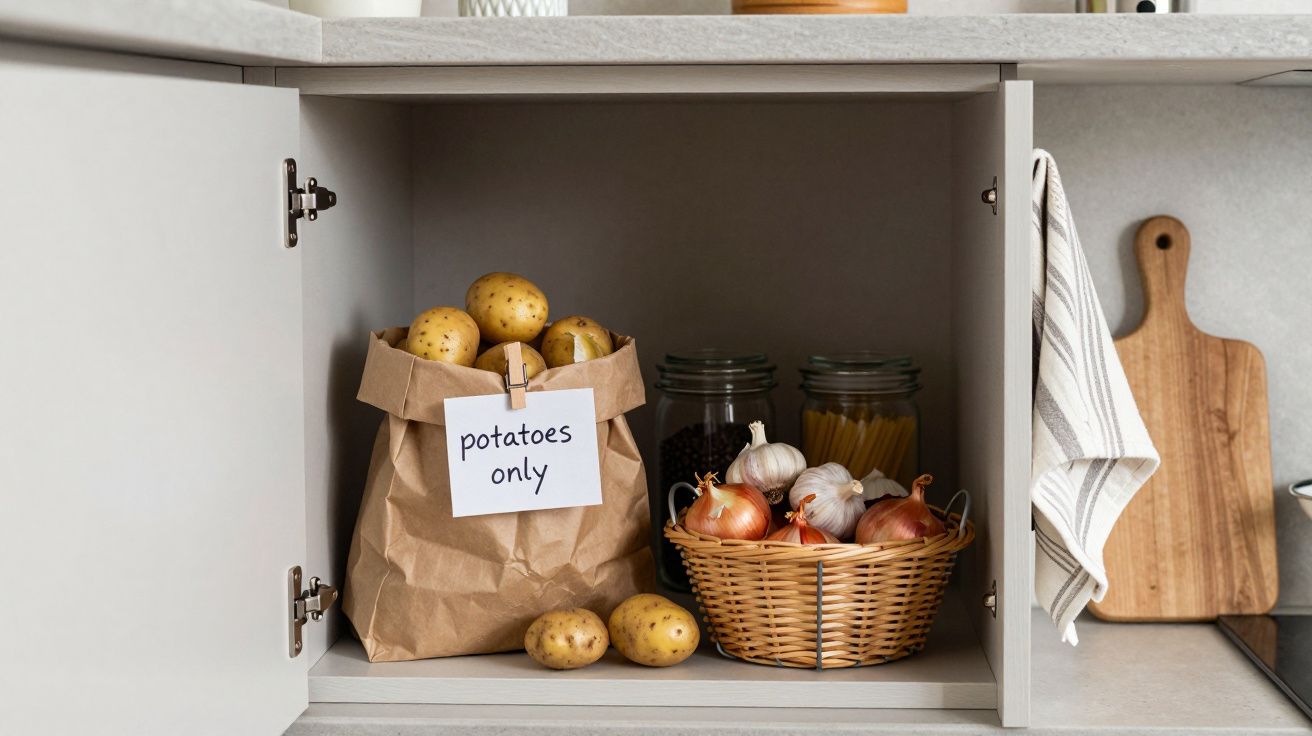
Why you should never store potatoes next to onions – and the one place greengrocers secretly prefer
Open most home cupboards and you’ll find it: a plastic bag of potatoes slumped against a net of onions, all exiled to the darkest corner. It looks efficient, like a tidy still life of dinners-to-come. Then a week slips by, you reach in for a potato and your fingers land on something that feels more like a water balloon than a spud. The onion skin is papery, the potato has sprouted an alien crown, and there’s a faint, sweet‑musty smell that says, “You waited too long.”
The thing is, this isn’t just absent‑mindedness or a bad batch. It’s storage sabotage. Potatoes and onions behave like quiet chemists when you push them together, swapping gases and moisture in ways that turbo‑charge spoilage. Greengrocers know this, which is why they rarely let them cosy up in the same crate, however photogenic it might look for a display. If you’ve ever wondered why your veg never lasts as long at home as it does in the shop, that shelf duet is one of the culprits.
What actually happens when potatoes and onions share a corner
Imagine a tiny weather system inside your cupboard. Onions sit there breathing out ethylene gas, the plant hormone that whispers “ripen, age, move things along”. Potatoes, meanwhile, are storing energy, constantly deciding whether to stay dormant or wake up and sprout. Put them side by side and the onion’s ethylene is like an alarm clock going off next to a sleeping spud.
You see the result as those eager, pale shoots and soft patches. The potato starts to break down its own starch to feed the sprouts, its texture turns floury at first, then waxy and hollow. At the same time, the onion isn’t exactly thriving. Potatoes hold and release moisture; that extra humidity around the bulbs nudges them towards mould and those tell‑tale black spots under the skin. The cupboard smells more intense, but the flavours on the plate go flat.
It’s not just about taste; it’s about safety. As potatoes age and sprout hard, they can start to produce more solanine, the natural compound that gives very green or bitter potatoes their off taste and, in high amounts, can irritate your stomach. Most of us catch it with our noses and eyes long before it’s dangerous, but when onions accelerate the whole decay cycle, your window between “perfect mash” and “into the bin” shrinks without you noticing.
How greengrocers quietly keep them apart
Walk through the back room of a decent greengrocer and you’ll see a pattern. Potatoes tend to live low to the ground in breathable sacks, somewhere cool, dry and gently dim. Onions get their own stack or crate, often higher up where air can move more freely and humidity is a touch lower. They might share a wall, but not the same breath.
One produce buyer described it to me as “roommates, not bunkmates”. Keep them in the same general climate, but give each its own bed. Shops also pay attention to airflow and light: potatoes hate strong light, which pushes them towards greening, while onions can tolerate it better as long as they’re not in direct sun. So you’ll see potatoes tucked away from bright windows, onions closer to the front where people can actually see the colour of the skins.
There’s something else you don’t see: plastic suffocation. Greengrocers avoid sealing either vegetable in tight plastic for storage, because trapped moisture quickly becomes condensation and then rot. They favour mesh, paper and open crates that let the air do half the work for them. When everything is breathing properly, gases and humidity don’t build up in one dense pocket, and the veg behaves more like it did in the soil.
The one place professionals secretly prefer at home
At home, we don’t have walk‑in storerooms, but we do have an underused asset: that cool, dark, boring space you almost never show guests. For many kitchens, the closest thing to a greengrocer’s back room is a shaded lower cupboard away from the oven or a pantry under the stairs. That’s the sweet spot for potatoes in particular: dark, dry, slightly cool, and out of the fridge.
Greengrocers will tell you they wince when customers mention storing potatoes in the fridge or on a sunny windowsill. Cold can push certain varieties towards developing more sugars, which may affect both taste and the way they brown when you roast them. Too much light, and they green faster. A breathable paper bag or open basket in that cooler cupboard is the quiet upgrade most homes skip.
Onions, by contrast, are happier with a bit more air and don’t mind being slightly closer to the action. A ventilated rack or basket on a shelf, still away from direct sunlight and not right above the hob, suits them fine – as long as it’s not the same bag or basket as the potatoes. Think of it as zoning your dry storage: one “root lane” for spuds, one “bulb lane” for onions, a little distance between them like polite neighbours over the fence.
Simple storage rules that make both last longer
You don’t need a cellar or fancy containers to make this work. A few small changes do most of the heavy lifting.
- Separate them by habit, not by mood. Decide once: potatoes live in X cupboard, onions in Y basket. The less you improvise, the less they drift back together by accident.
- Let them breathe. Use paper bags, mesh, or open baskets. Avoid sealing either in plastic unless you’re talking peeled, prepped onions in the fridge for immediate use.
- Guard against light and heat. Keep potatoes low and dark; keep onions shaded but airy. Avoid storing either right next to the dishwasher, oven or radiator.
- Check, don’t forget. Every week, do a quick rummage. Pull out anything sprouting, soft or mouldy so it doesn’t turn the whole stash.
Here’s a compact guide you can screenshot and stick on the inside of a cupboard door.
| What to store | Where it prefers | How to keep it happy |
|---|---|---|
| Potatoes | Cool, dark lower cupboard, away from onions | Paper bag or open basket, no fridge, no light |
| Onions (dry) | Ventilated rack or basket, separate from potatoes | Room temperature, low humidity, not in plastic |
| Shallots & garlic | Similar to onions, slightly drier is better | Small mesh bag or bowl, good airflow |
When the rules bend – and when they really don’t
There are a few caveats that confuse people. Spring onions and bunches of leafy green tops, for example, behave more like herbs than storage onions; they’re best in the fridge, loosely wrapped, far from your potatoes entirely. New potatoes and salad varieties are more delicate and don’t last as long no matter how perfectly you store them, so treat those as “eat soon” guests, not pantry staples.
Once potatoes are cooked, the story flips. Leftover roasties or mash can go in the fridge, and at that point it doesn’t matter what’s sitting next to them. Same for sliced or chopped onions: once cut, they belong in a sealed container in the fridge, where the main battle is odour, not ethylene. The don’t‑mix rule is really about whole, raw, storage‑type veg breathing in the same small, stagnant pocket of air.
Let’s be honest: nobody rearranges their entire kitchen for the sake of a bag of Maris Pipers. The trick is to make the better choice the path of least resistance – a basket here, a paper bag there, one marked “potatoes only” so you don’t have to think about it at 6 p.m. on a Tuesday. The payoff shows up not as a halo of virtue, but as fewer slimy surprises and a cupboard that smells like, well, almost nothing.
FAQ:
- Can I ever store potatoes and onions together? Ideally no, not for longer than a couple of days. If they have to share a cupboard, keep them in separate open bags or baskets with a bit of space between so gases and moisture don’t build up.
- Why do my potatoes go green, and is that from onions too? Greening is mainly from light, not onions. It often comes with increased solanine, which can taste bitter; cut off green patches generously or discard very green potatoes.
- Is the fridge always bad for potatoes? For long‑term storage of most varieties, yes, a cool dark cupboard is better. A short spell in the fridge won’t ruin them, but aim to bring them back to room temperature before cooking.
- What about storing onions in the fridge? Whole, dry onions prefer room temperature. The fridge can make them soft and mouldy more quickly. Once peeled or cut, they should go into a sealed container in the fridge.
- How often should I check my stored veg? A quick weekly check is enough. Remove anything soft, sprouting heavily or mouldy so it doesn’t speed up spoilage in the rest of the batch.
Comments (0)
No comments yet. Be the first to comment!
Leave a Comment