Why your dog barks at the upstairs neighbour but not the postman, according to animal behaviourists
The racket begins the same way every evening: a footstep above, a chair scrape, the faint thud of someone crossing the bedroom, and your dog goes from dozing angel to full‑throated alarm. Yet when the postman rattles the letterbox or even leans into the porch for a parcel, there’s barely a flicker. It feels personal, almost moral, as if your dog has decided who is suspicious and who is welcome.
Behaviourists will tell you it’s far less about judgement and far more about information. To your dog, the neighbour upstairs is a collection of half‑heard thumps and distant scents with no clear pattern. The postman is a predictable, ground‑level rhythm that makes sense. One is a puzzle. The other is a timetable.
The world your dog actually hears
Dogs don’t hear “someone upstairs”. They hear specific sound signatures: heel on floorboard, washing machine on spin, pipes ticking as they cool. Each has its own pitch, duration and vibration. Sounds from above are muffled, intermittent and harder to locate, which tips many dogs into red alert.
By contrast, the postman announces himself with the same cues every day: steps on the path, hinge squeak, flap clatter, retreat. Within a week or two, most dogs file that under “loud but safe”. Their brains stop flagging it as urgent because nothing worrying ever follows.
What looks like your dog “having it in” for the neighbour is often just uncertainty. They can’t see the source, they can’t sniff it properly, and the noise arrives at odd angles through ceilings and walls. In canine terms, that’s all the ingredients of a possible threat.
Why upstairs noise feels more threatening than the postman
Animal behaviourists see three big differences between an upstairs neighbour and the postie: predictability, control and proximity.
- Predictability: The postman is a once‑a‑day event, usually at roughly the same time, with the same sequence of sounds. Upstairs footsteps happen at 6am one day, 11pm the next, in bursts that mean nothing to a dog.
- Control: You can walk to the door, speak to the postman, take the mail. Your dog watches that interaction and logs it as “my human has this covered”. You rarely march upstairs every time a chair scrapes.
- Proximity: Footsteps above carry low‑frequency vibrations that some dogs feel through the floor. That can register as “someone is almost on top of us”, especially in older buildings.
Add in personality and history and the picture sharpens. A noise‑sensitive dog, or one rehomed from a kennel environment, may already be on edge indoors. For them, any ambiguous clatter is a rehearsal of previous stress, not a fresh start.
The hidden rules dogs use to decide when to bark
From a dog’s point of view, barking is problem‑solving. It’s how they say “I’ve noticed something; should we do something about it?” Over time, they build rules: if X noise happens and nothing bad follows, I can ignore it. If Y noise happens and my person tenses, shouts or joins in, I should keep going.
Behaviourists see the same decision tree again and again:
- Detection: The dog hears or feels something unusual.
- Assessment: They sniff the air, look to you, listen again. If they can’t place it, arousal climbs.
- Trial bark: A few sharp barks to test the environment.
- Feedback check: If the noise stops or you rush about, the brain logs “bark made change”.
- Rule formed: Next time, they skip straight to step four.
That’s why neighbours who pause in the hall when a dog barks can accidentally reinforce the behaviour. From the dog’s perspective, “I sounded the alarm, the footsteps vanished. Job done.” The postman, on the other hand, simply carries on and leaves regardless of how much noise the dog makes. Over time, the bark achieves nothing, so it fades.
When it’s not “nuisance” but normal anxiety
Anxious dogs are like nervous security guards: quick to react, slow to stand down. Rescue dogs, adolescent males and certain breeds (herding, guarding and some small companion types) often sit closer to the alarm end of the spectrum.
Common signs you’re looking at anxiety rather than cheekiness include:
- Pacing or panting before or after the noise.
- Startling at other sounds – keys, cutlery, the fridge hum.
- Following you from room to room, especially in the evening.
- Difficulty settling even when the house is quiet.
For these dogs, the upstairs neighbour is just one trigger in a wider pattern. The barking isn’t about being “naughty”; it’s a nervous system trying – clumsily – to keep everyone safe.
What behaviourists actually do: make the upstairs neighbour boring
The quiet trick is to turn the mysterious upstairs soundtrack into background wallpaper. Behaviourists usually combine three ideas: changing the association, changing the environment and changing the dog’s job.
1. Change the emotional meaning
You can’t ask a dog to “ignore it” if their body says “danger”. You have to teach their brain that upstairs sounds predict something good.
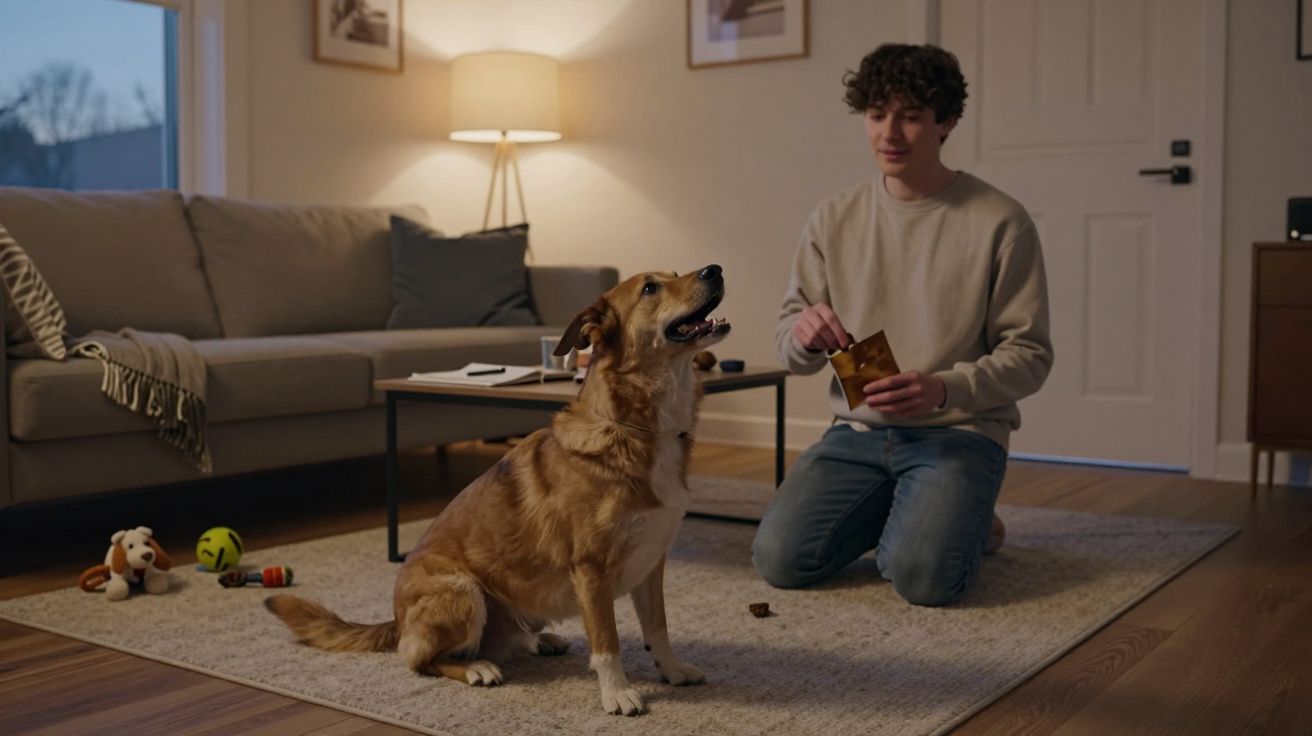
- Pair the sound with rewards: Each time you hear a familiar upstairs noise, calmly say a cue word (“Neighbour”) and drop a small treat on the floor away from doors and windows.
- Stay neutral: No scolding, no fussing; the sound must quietly equal food, not a row.
- Repeat at low intensity: Start when the neighbour is pottering, not when they’re moving furniture at midnight.
Bit by bit, the brain rewires: thud above → snack appears → body relaxes. Once that link is solid, many dogs simply glance up and wait, rather than charging into full bark.
2. Tweak the environment in your favour
You can’t control your neighbour’s timetable, but you can soften its impact.
- Use rugs or runners in the noisiest rooms to dampen vibration.
- Move beds away from corners where sound echoes or radiators tick.
- Play low‑level soundscapes (rain, gentle music) at times you know the neighbour is active, to blur sudden noises.
- Offer safe chews or food puzzles in those windows so the dog’s jaws – and brain – are busy.
Think of it as acoustic gardening. You’re not silencing the world; you’re trimming the sharp edges.
3. Give your dog a clearer job
Barking often escalates when a dog thinks they’re in sole charge of security. A small shift in routine can convince them the role is shared.
Try a simple “thank‑you, off duty” pattern:
- Dog barks once or twice.
- You walk to them, step between them and the noise, say a consistent phrase (“Got it, thank you”), and guide them to a mat or bed.
- On the mat, they get a scatter of kibble or a chew.
Done calmly and consistently, this tells the dog: “Your notice was useful, but I’m handling it now.” Over time, some dogs reduce their bark to a single “woof” and then trot to their spot, confident you’ve heard them.
Why the postman gets a free pass
So where does the postman fit in? Behaviourists point to a few quiet advantages.
- Early exposure: Many puppies experience the letterbox from their first weeks in the home. Owners often laugh, film, or ignore, teaching the pup “this is just life”.
- Visible, scent‑rich human: Dogs can usually see or at least smell the postie directly. They log that person as “real, familiar human”, not a faceless ghost in the ceiling.
- Outcome never changes: Letters arrive whether the dog howls or not. There’s no sense of the bark making the world bend.
Some owners even open the door for parcels with the dog on a lead, allowing a brief, calm sniff and greeting. That simple ritual downgrades the postman from “intruder at the door” to “friend who brings boxes that make my human happy”.
Simple steps you can try this week
You don’t need a full behaviour consult to start changing the pattern. A few small, steady habits help most households.
- Track the triggers: For three days, jot down when the barking happens and what you were doing. Patterns usually appear – early‑morning showers, late‑night homework upstairs, TV bass through the ceiling.
- Introduce a “neighbour = treat” game: Keep a pot of high‑value treats handy. Every minor noise from above earns one, tossed calmly on the floor.
- Practice one calm door routine: Decide how you’ll handle the postman or other visitors – where your dog stands, what cue you’ll use, what reward follows. Rehearse it when the house is quiet.
Think of yourself as your dog’s translator. You’re showing them that the bumps and scrapes of human life don’t all need a siren.
Key points at a glance
| Key idea | What it means | Why it matters |
|---|---|---|
| Uncertainty drives barking | Invisible, irregular upstairs noises are harder to interpret than the predictable postman | Explains why one feels more threatening |
| You shape the “rules” | Your reactions teach your dog which sounds deserve a response | Small changes in your behaviour can shift theirs |
| Make mystery sounds boring | Pair neighbour noise with calm, good things until it loses its edge | Reduces stress for both dog and household |
FAQ:
- Is my dog being aggressive when they bark at the neighbour? Usually not. Most dogs are sounding an alarm, not plotting an attack. They’re unsure what’s happening and trying to get your attention or push the threat away.
- Will punishing the barking make it stop? It may suppress noise in the moment, but it rarely solves the underlying anxiety and can make some dogs more tense. Teaching alternative responses and changing the association with the sound is safer and more effective.
- Could pain or illness make my dog more reactive to upstairs noise? Yes. Dogs in discomfort often have a lower tolerance for disturbance. If the barking is new or suddenly worse, a vet check is wise before assuming it’s “just behaviour”.
- Do some breeds bark more at this kind of noise? Herding, guarding and some toy breeds tend to be more vocal about territory and movement. They’re not doomed to be noisy, but they may need more careful training and management.
- When should I call a professional behaviourist? If the barking is intense, daily, or paired with other signs of anxiety (destruction, toileting indoors, self‑licking), or if you feel frustrated or stuck, a qualified behaviourist can design a plan tailored to your dog and building.




Comments (0)
No comments yet. Be the first to comment!
Leave a Comment