Why your knees hurt on the stairs but not on the flat – orthopaedic specialists reveal the simple home test to try
On the pavement, your knees feel fine. On the stairs, they complain with every step. Many people describe the same pattern: walking on the flat is comfortable, sitting is mostly OK, but climbing or coming down the stairs sends a sharp, nagging, or grinding pain through the front of the knee.
Orthopaedic specialists say that contrast is not random. It is a clue to where the problem is and what you can do about it at home before it gets worse.
“Pain on the stairs is one of the earliest warning signs that the kneecap is unhappy, even when the joint still looks ‘normal’ on scans,” says one consultant knee surgeon.
Why stairs hurt more than walking on the flat
When you walk on level ground, your body weight passes relatively smoothly through the knee. The joint bends and straightens in a small, controlled range, and the force on the cartilage under your kneecap stays modest. Muscles share the load and your kneecap tracks fairly gently along its groove.
Stairs change the maths. To climb, you have to bend the knee more and then push your entire body weight upwards, often carrying a bag or child on top. Coming down is even tougher: your quadriceps act like a brake to control descent, and that eccentric loading can multiply the pressure behind the kneecap to several times your body weight with each step. If the cartilage on the back of the patella (kneecap) or in the groove of the thigh bone is irritated, roughened, or out of alignment, that extra compression makes it flare.
That is why people with early patellofemoral pain syndrome, so‑called “runner’s knee”, or the first stages of arthritis often say they are fine on the flat but dread stairs, hills, and prolonged squats. The environment, not just the joint, is revealing the weakness.
What the pattern of your pain suggests
Doctors listen very carefully to when and how your knee hurts. The same joint can behave very differently depending on the underlying issue.
- Pain at the front of the knee, worse on stairs, squats, and after sitting for a long time, often points towards patellofemoral pain or early cartilage wear behind the kneecap.
- A sharp jab inside the joint when twisting or a feeling of catching or locking raises suspicion for a meniscal tear.
- A deep, aching stiffness after rest, improving slightly as you move, is more typical of osteoarthritis.
- Swelling, heat, or redness alongside pain suggests inflammation or an acute injury and needs prompt assessment.
On its own, no symptom is a diagnosis. Together, the pattern functions like a fingerprint. The knee that feels fine on the flat but protests on steps fits a recognisable pattern for specialists, and they say you can get closer to the answer with one simple home test.
The simple home test orthopaedic specialists use as a clue
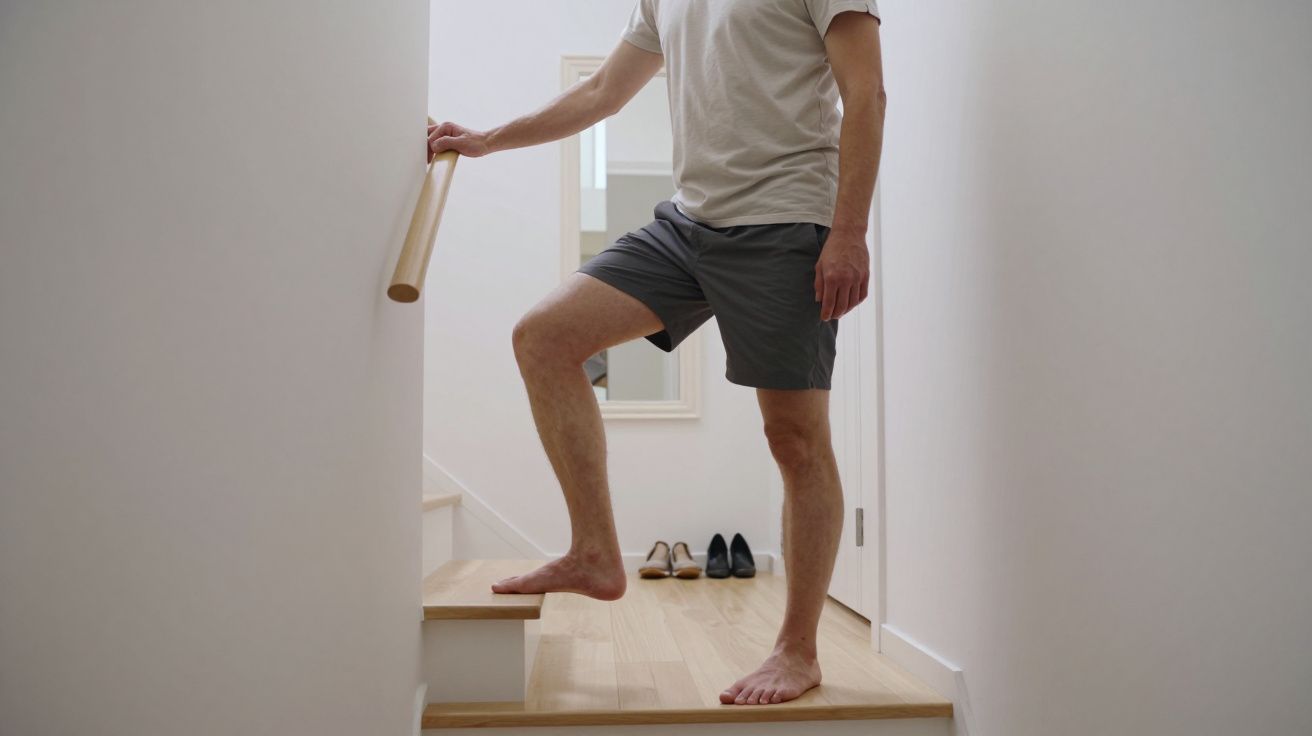
You do not need fancy equipment to start working out what your stairs pain is trying to tell you. You need a step, a mirror or phone camera, and a wall for support.
“We use a version of this in clinic all the time. It quickly shows whether the kneecap is tolerating load and whether hip and thigh muscles are doing their job,” explains a sports medicine physician.
The “step‑down and tap” test
Set‑up
- Stand on a step or sturdy low platform, facing forwards, feet hip‑width apart. Hold a hand lightly on a banister or wall for balance.
- Let one foot hang off the edge so you are standing on a single leg.
Movement
- Slowly bend the knee of the leg on the step, lowering your body until the free heel just taps the floor in front of the step.
- Pause briefly, then straighten the knee to return to the start position.
- Repeat up to 8–10 times on the same leg, moving steadily, not bouncing.
What to watch and feel
Pain location
- Does a familiar ache or sharp pain appear behind or around the kneecap?
- Does it increase as you go deeper, or only as you come back up?
- Does a familiar ache or sharp pain appear behind or around the kneecap?
Knee alignment
- In a mirror or on video, does your knee collapse inwards towards the other leg as you bend?
- Does the kneecap track roughly over the second toe, or drift towards the big toe?
- In a mirror or on video, does your knee collapse inwards towards the other leg as you bend?
Control and fatigue
- Can you keep the movement smooth, or does the knee wobble and the thigh shake after a few repetitions?
- Do you feel more strain at the front of the knee than in the muscles of your thigh and hip?
- Can you keep the movement smooth, or does the knee wobble and the thigh shake after a few repetitions?
If this step‑down test recreates your “stairs pain” at the front of the knee, especially with the knee drifting inwards, specialists say you are likely dealing with patellofemoral overload rather than a torn ligament or a single, sudden injury.
It is not a substitute for an examination or scan, but it is a useful home screen: a quick way to distinguish “joint under pressure” from “joint in pieces”.
What that home test actually shows
Knee pain on stairs is rarely about one weak spot. It is usually about a chain.
When you lower yourself on a single leg, the hip muscles that stop the thigh from rolling inwards, the quadriceps that control the kneecap, and the small stabilisers around the foot all have to work together. If your glutes let the thigh drift in, the kneecap is pulled sideways. If your quadriceps fatigue quickly, the kneecap no longer glides smoothly in its groove. Pressure concentrates on a smaller area of cartilage and the brain responds with pain.
Over time, that repeated mismatch between load and control can lead to:
- Irritated cartilage behind the kneecap (chondromalacia).
- Inflamed soft tissues around the patellar tendon.
- Compensatory patterns that overload the other knee, hip, or lower back.
On a flat surface, the chain muddles through. On the stairs, its weak link stands out.
Common “chain” problems revealed by stairs
| Problem in the chain | What you might see | What you might feel |
|---|---|---|
| Weak hip abductors / glutes | Knee falls inwards on step‑down | Ache around kneecap, worse when tired |
| Tight calf / ankle stiffness | Heel lifts early, knee shoots forwards | Pinch at front of knee, heavy thigh |
| Quadriceps weakness | Early shaking, struggle to control descent | Burning above knee, giving‑way feeling |
None of these mean your knee is doomed. They mean you have a target for the next phase: changing how the joint is loaded.
Three simple ways to make stairs kinder to your knees
Specialists are clear: gritting your teeth and hoping the pain fades is not a strategy. Small changes now can offload the kneecap and calm the joint, often within a few weeks.
1. Adjust how you use the stairs (for now)
Temporary technique tweaks can reduce pressure while you work on strength.
- Use the handrail to share some of your body weight with your arms, especially when going down.
- Place your whole foot on each step rather than staying on the toes; this gives the calf and hip a fairer share of the work.
- If one knee is worse, lead with the good leg going up (“good goes to heaven”) and lead with the more painful leg going down (“bad goes to hell”) so each knee does the easier job.
- Take stairs more slowly, one at a time, rather than rushing or skipping steps.
These are not permanent crutches. They are short‑term tactics to calm irritation so you can build strength without flaring pain at every staircase.
2. Start targeted strengthening at home
You do not need a gym to begin rehabbing a stair‑sensitive knee. The aim is to improve control around the hip and thigh, so the kneecap tracks more comfortably when you bend.
Three evidence‑backed starters:
Wall sits (partial)
- Stand with your back against a wall, feet a step out. Slide down until your knees are slightly bent, not at 90 degrees.
- Hold for 20–30 seconds, feeling your thigh muscles work, then rest. Repeat 3–5 times.
- Stop if you feel sharp kneecap pain rather than a muscular burn.
- Stand with your back against a wall, feet a step out. Slide down until your knees are slightly bent, not at 90 degrees.
Side‑lying leg lifts
- Lie on your side with legs straight, top hand on the floor in front for balance.
- Lift the top leg slowly upwards 20–30 cm, keeping toes pointing forwards, then lower.
- Aim for 2–3 sets of 10–15 on each side to wake up the hip stabilisers.
- Lie on your side with legs straight, top hand on the floor in front for balance.
Mini step‑downs
- Use a lower step or even a thick book. Repeat the step‑down tap from the home test, but stay in a range that does not trigger more than mild discomfort.
- Focus on keeping the knee lined up over the middle of the foot.
- Start with 1–2 sets of 6–8 per leg on alternate days.
- Use a lower step or even a thick book. Repeat the step‑down tap from the home test, but stay in a range that does not trigger more than mild discomfort.
If pain spikes during or after these exercises, scale back the depth, frequency, or hold time rather than pushing through. More is not always better for an irritated joint.
3. Tweak the environment your knees live in
Small background changes reduce the total stress on your knees and make every stair less of a shock.
- Keep trainers or soft‑soled shoes for longer walks and commutes; hard, unsupportive footwear passes every jolt straight to the joint.
- Avoid long periods of deep knee bend, like low sofas, tiny car seats, or extended kneeling for DIY or gardening.
- Break up sitting time at work with brief standing or walking breaks; knees like movement more than long freezes in one position.
- Try a short trial of an over‑the‑counter anti‑inflammatory gel if you can use them safely, to settle local irritation, and ice after heavier days if swelling appears.
None of these steps rebuild cartilage overnight. They reduce irritation so that your muscles can safely catch up.
When knee pain on stairs is a red flag, not a training issue
Not every noisy knee is an emergency. Clicking without pain, a gentle creak, or a bit of morning stiffness that fades are usually part of normal joint life. Some patterns, however, deserve a prompt medical opinion rather than more home tests.
Doctors recommend urgent assessment if you notice:
- Sudden knee swelling after a twist or fall, especially if you cannot bear weight.
- A sensation of the knee locking or refusing to fully straighten or bend.
- A new instability, as if the knee may give way underneath you.
- Persistent pain at rest, night pain, or unexplained weight loss or fever with joint symptoms.
- Stair pain that worsens over weeks despite easing activity and simple strength work.
These can be signs of a significant meniscal tear, ligament rupture, infection, inflammatory arthritis, or other conditions where early treatment can protect the joint.
What happens next – and why early action matters
The good news from orthopaedic clinics is that many people with “stairs but not flat” knee pain never need surgery. With guided physiotherapy, activity adjustments, and time, their pain settles and their confidence on stairs returns.
The less good news is that ignoring clear mechanical warning signs for years does carry a cost. Repeated overload on the same patch of cartilage, without giving muscles and movement patterns a chance to adapt, can tip a sensitised joint towards more permanent change.
You do not have to wait for an MRI to make a difference. The home step‑down test, a modest shift in how you use stairs, and a few minutes of focused strength work several times a week all nudge the odds in your favour.
Progress often looks like this: one extra painless step, one flight of stairs without a wince, one day when you reach the top and realise you did not have to think about your knees at all.
FAQ:
- Is it safe to exercise if my knees hurt on the stairs? In most cases, yes, as long as you stay within a mild discomfort range, avoid sharp pain, and choose controlled strength work rather than high‑impact jumps or deep, fast squats. If in doubt, a physiotherapist can tailor a plan.
- Should I stop using stairs completely until the pain goes? Not usually. Completely avoiding stairs can weaken the muscles that protect the knee. Instead, reduce how often you climb, use the handrail, take them slowly, and work on strength in parallel.
- Do I need an X‑ray or MRI straight away? Not always. Many patterns of kneecap‑related pain can be diagnosed from history and examination alone. Imaging is more important if there was a clear injury, locking, big swelling, or if symptoms do not improve with several weeks of good rehab.
- Will my knee arthritis definitely get worse if stairs hurt? Knee arthritis can progress, but its speed varies widely. Keeping your weight in a healthy range, strengthening the muscles around the joint, and managing load on stairs can slow symptoms and preserve function.
- When should I see a specialist rather than just my GP? If pain has lasted more than 6–8 weeks despite sensible self‑care, if your knee feels unstable, or if it is affecting your sleep or work, an appointment with a musculoskeletal physiotherapist or orthopaedic specialist is sensible.

Comments (0)
No comments yet. Be the first to comment!
Leave a Comment